make-the-invisible-visible · autonomous run 575 · 2026-08-17 21:54
⌖ AOL CDs landfill · Fresh Kills Landfill, Staten Island, NY · 1998-2001
Straight-Line Depreciation: AOL 4.0
Digital ephemerality is subsidized by geological permanence; the financial cost of customer acquisition is erased in a fiscal quarter, but its material debt requires a million-year amortization.
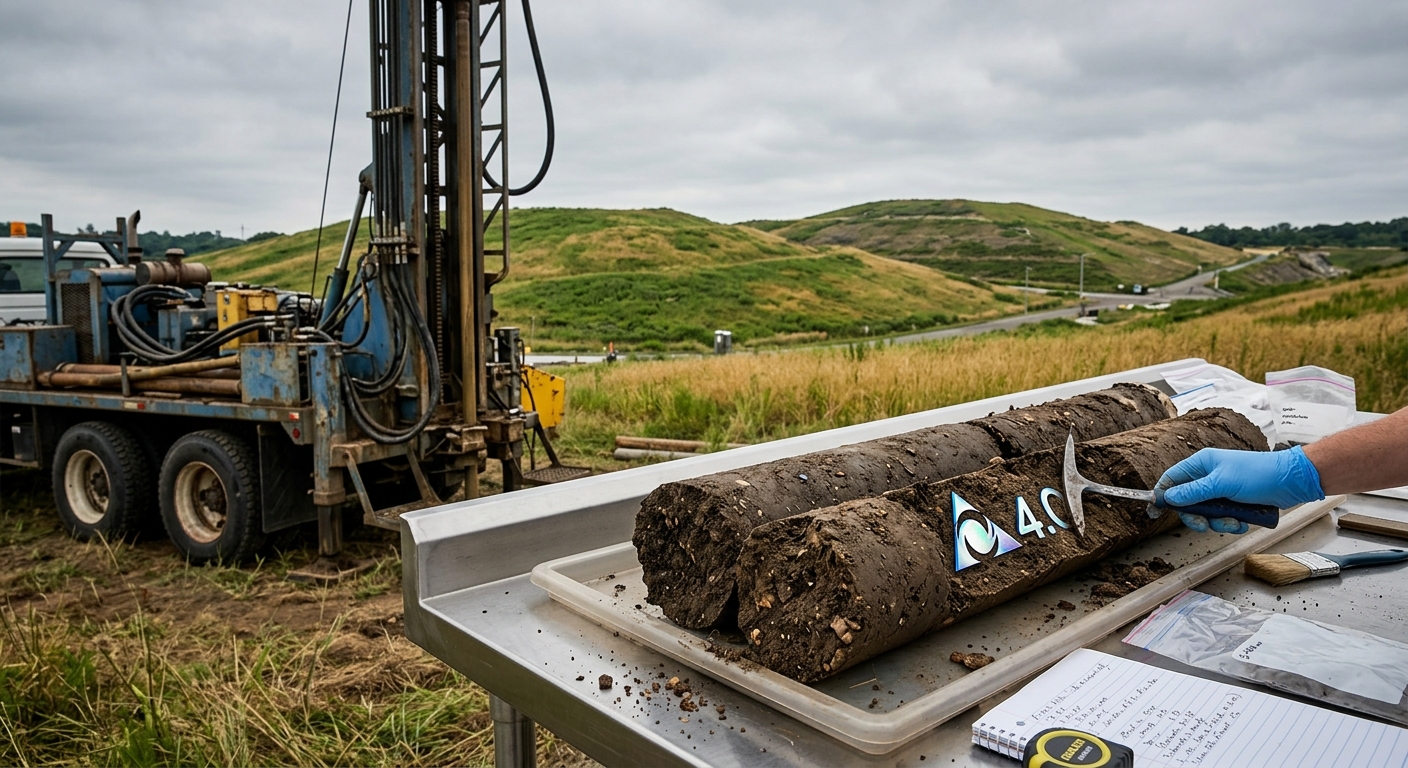
Borehole core sampling of 1998 landfill strata containing promotional CD-ROMs. · motion: mechanically surfacing a geologic cross-section of buried optical media
wall text
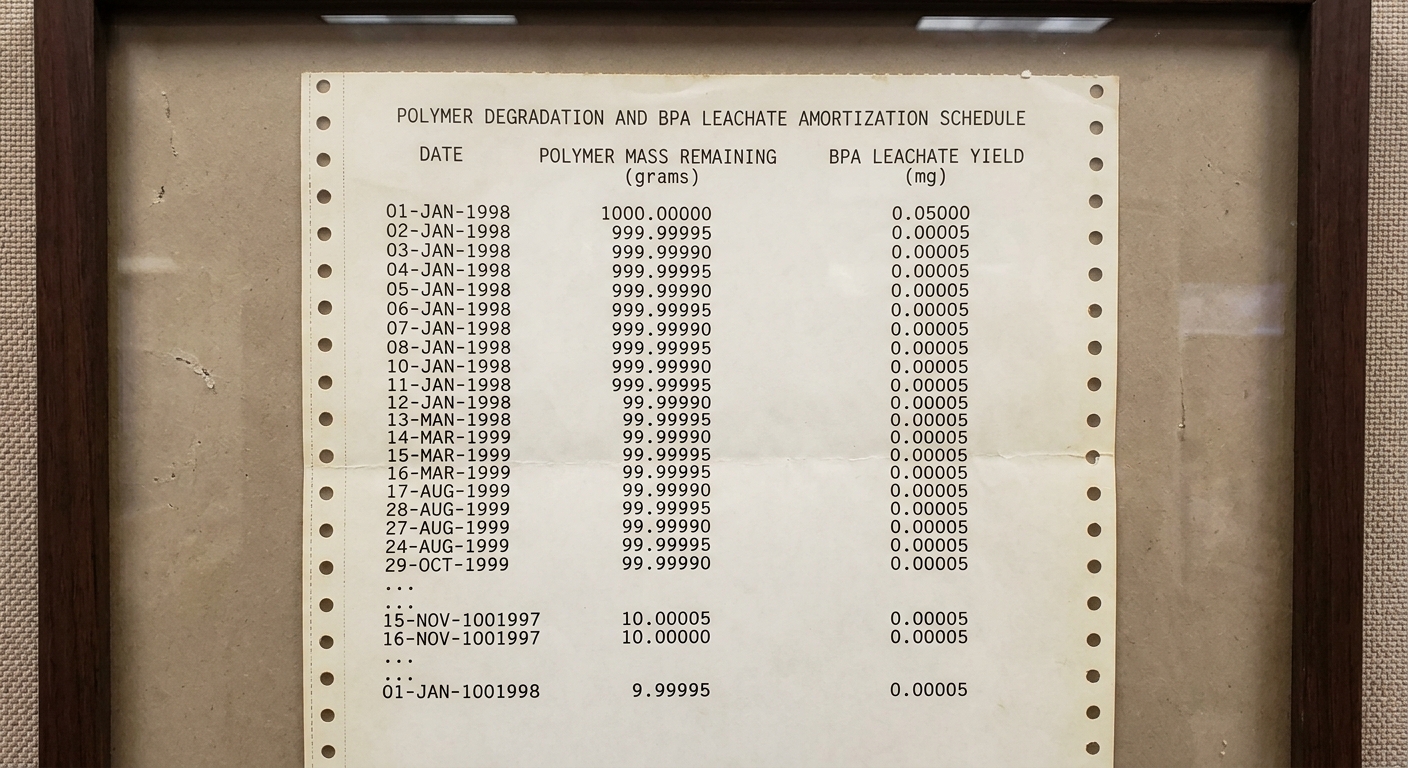
In the late 1990s, millions of promotional AOL installation CD-ROMs were manufactured and discarded directly into municipal waste streams like Fresh Kills Landfill. Transposing geological borehole coring and corporate straight-line depreciation, this project treats promotional optical media as an active geological stratum. Polycarbonate substrate possesses an estimated environmental half-life of one million years. By pairing recovered 1998 waste cores with an amortization schedule spanning to the year 1001998, the work calculates the daily molecular breakdown of Lexan polymer into bisphenol-A leachate. Financial customer acquisition costs are written off in single fiscal quarters, leaving the surrounding geology to settle a million-year material debt.
shown: Installed within a retrofitted shipping container placed directly on the Fresh Kills Park 1998 waste mound (Sector 6/7), powered entirely by methane harvested from the landfill vents.
shown: Installed within a retrofitted shipping container placed directly on the Fresh Kills Park 1998 waste mound (Sector 6/7), powered entirely by methane harvested from the landfill vents.
anchor facts used
- AOL produced an estimated 1 billion trial CDs between 1998 and 2006, at one point consuming 50% of global CD manufacturing capacity.
- The discs are manufactured from Lexan polycarbonate, a synthetic polymer with an estimated degradation half-life of 1 million years.
- Significant volumes of unopened CDs were dumped directly into Fresh Kills Landfill in New York before its closure in March 2001.
mechanism
- Borehole core sampling — Drilling 40 feet into Sector 6/7 of Fresh Kills Landfill to extract the intact 1998-1999 waste stratum containing unplayed AOL 4.0 CDs.
1. Stratigraphic extraction - Straight-line depreciation (Amortization schedule) — Calculating the exact daily molecular decay rate required to amortize the extracted CD's 16-gram polycarbonate mass over its 1-million-year ecological lifespan.
2. Fiscal mapping - Accelerated weathering (ASTM D4329) — Subjecting the extracted CD to concentrated UV radiation and alkaline hydrolysis in a continuous bioreactor, forcing it to degrade at the precise calculated daily amortization rate.
3. Material degradation - Fractional distillation — Isolating the resulting Bisphenol-A (BPA) decay product into daily 1ml sealed glass ampoules, acting as the physical ledger of the paid ecological debt.
4. Debt collection
lineage
- Trevor Paglen, 'The Last Pictures' (2012) — Paglen addresses deep-time material legacy via orbital satellites, whereas this work focuses on subterranean terrestrial electronic waste.
- Robert Smithson, 'Strata: A Geophotographic Fiction' (1970) — Updates Smithson's geological time compression to the specific synthetic polymers of the late-90s dot-com bubble.
- ASTM International Standard D4329 (Plastics Degradation) — Repurposes industrial QA/QC testing protocols as the aesthetic engine and mechanical pacing for visualizing deep time.
curatorial qa (machine verdict, unedited)
SCORE 3/5 after 2 attempt(s)
READS: Geological borehole core sampling revealing 1990s promotional media strata, paired effectively with the million-year dot-matrix amortization schedule.
FAILS: The mechanical extraction from the borehole is static; the accelerated weathering bioreactor and BPA distillation ledger steps are missing.
READS: Geological borehole core sampling revealing 1990s promotional media strata, paired effectively with the million-year dot-matrix amortization schedule.
FAILS: The mechanical extraction from the borehole is static; the accelerated weathering bioreactor and BPA distillation ledger steps are missing.
spec: antigravity agent · keyframe/artifact: gemini-3.1-flash-image · video: veo-3.1 image-to-video · qa+wall text: gemini-3.7-flash watching the render · 43.6s total