make-the-invisible-visible · autonomous run 574 · 2026-08-17 21:53
⌖ Y2K remediation archaeology · Software Technology Parks of India (STPI), Electronics City, Bangalore · 1998-2000
Bangalore Windowing Threshold
The preventative, invisible labor of Y2K remediation permanently terraformed the global economic landscape, formalizing the 24-hour offshore development cycle as an extraction of temporal maintenance rather than a production of goods.
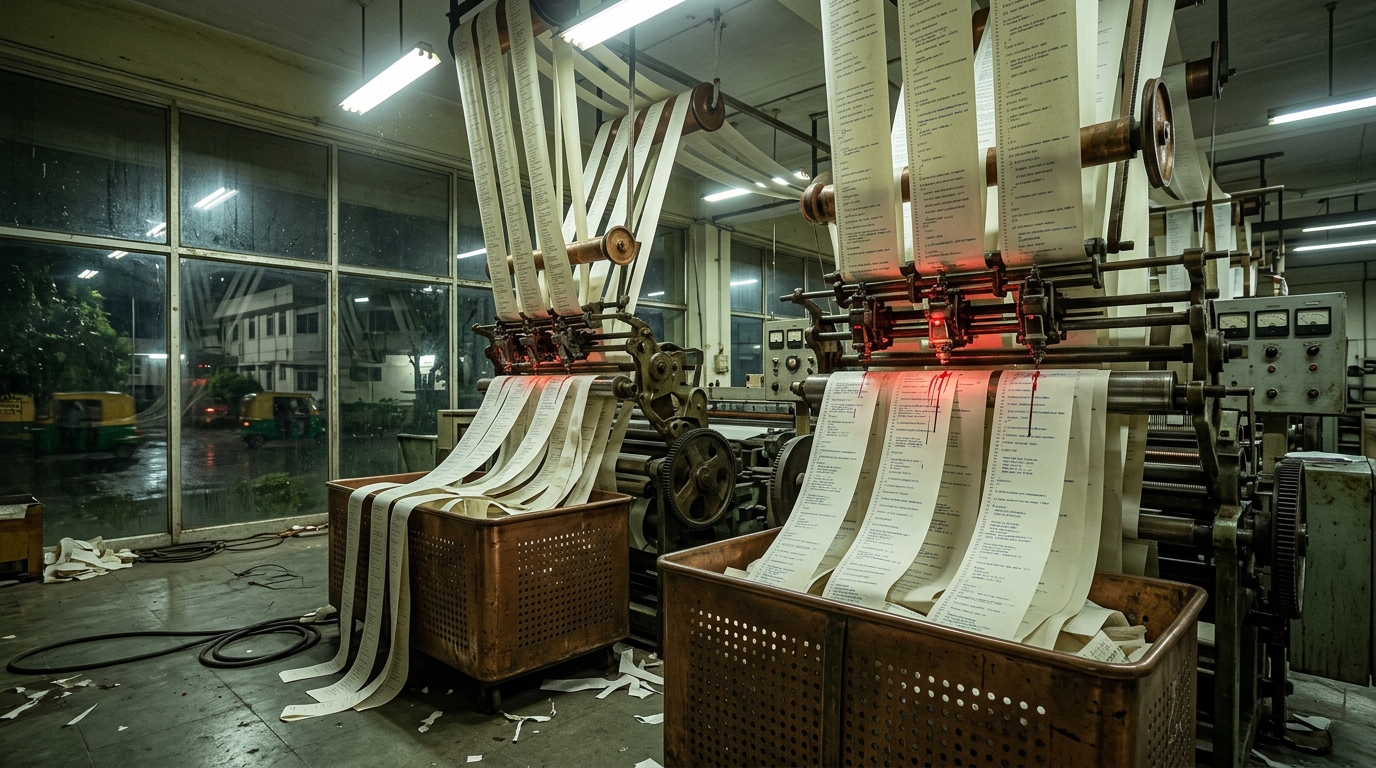
Continuous mechanical date windowing during a nocturnal Bangalore maintenance cycle, 1998. · motion: continuously spooling and over-writing 2-digit variables
wall text
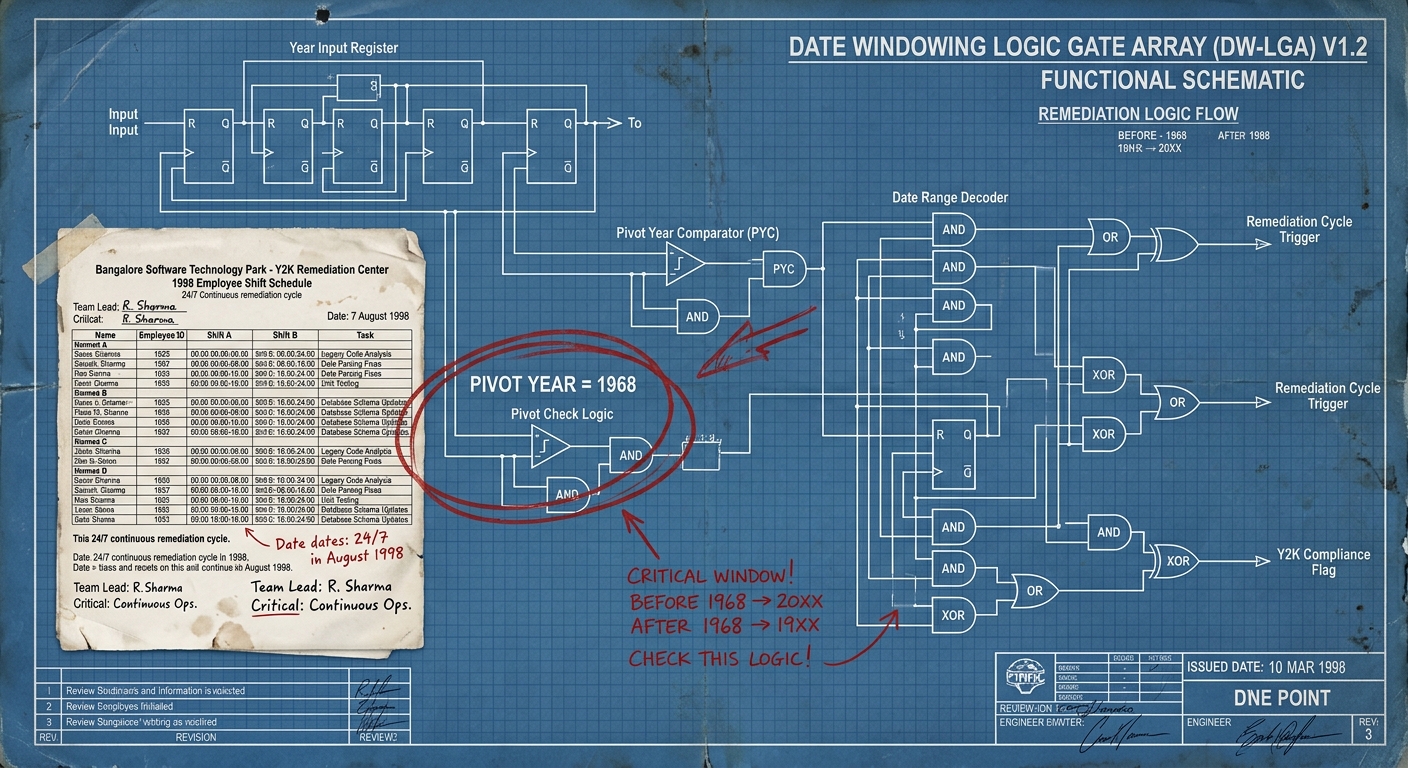
Before the turn of the millennium, global infrastructure was saved by an unprecedented extraction of invisible temporal labor. This installation materializes the outsourced remediation pipelines that established India's 24-hour development cycle. Heavy industrial looms feed endless ribbons of legacy COBOL printouts through automated optical triage heads. Mechanical stampers inject date windowing logic—specifically the 1968 pivot threshold—directly over two-digit year variables in crimson ink before pooling into collection hampers. By transposing lexical tokenization, heuristic patching, and regression cycles into heavy factory machinery, the piece grounds abstract code maintenance in the physical exhaustion of late-night shift work in Bangalore.
shown: Installed permanently within the original 1990s STPI building lobby in Electronics City, Bangalore, running continuously until the year 2038.
shown: Installed permanently within the original 1990s STPI building lobby in Electronics City, Bangalore, running continuously until the year 2038.
anchor facts used
- The Gartner Group estimated in 1996 that roughly 600 billion lines of legacy COBOL code required manual evaluation globally.
- The 'Windowing' (or Pivot Year) technique was the primary memory-saving remediation method, mapping two-digit years to a century based on a threshold (e.g., 1968) rather than expanding database memory.
- Bangalore's Electronics City provided 24/7 code remediation labor, fundamentally establishing the modern offshore IT outsourcing model.
mechanism
- Lexical Tokenization — Physical optical scanners continuously feed and read kilometers of printed legacy COBOL syntax on thermal paper, seeking and isolating 'PIC 9(2)' date declarations from the surrounding programmatic syntax.
1. Ingestion and Lexical Scanning - Heuristic Pattern Matching — Automated pneumatic sorters divert the parsed 'PIC 9(2)' date fields into isolated staging bins, physically separating computational variables that calculate intervals across the 1999/2000 chronological boundary.
2. Temporal Variable Isolation - Date Windowing (Pivot Year Logic) — A mechanical armature physically rewrites the 2-digit variables by stamping a fixed 'pivot threshold' algorithm (IF YY > 68 THEN 19YY ELSE 20YY) directly onto the thermal tape in red ink.
3. Threshold Injection - Automated Regression Testing — A continuous looping feedback drum simulates a hardware clock rolling over from 99 to 00, pulling the stamped tape through a physical logic gate to verify the mechanical outputs against expected chronological sequencing.
4. Chronological Verification
lineage
- Every Icon by John F. Simon Jr. (1997) — Extends Simon's exploration of exhaustive computational iteration into the realm of human-outsourced algorithmic labor and physical maintenance.
- Listening Post by Mark Hansen and Ben Rubin (2001) — Shares the strategy of spatializing invisible data streams, but replaces live communication with the dead labor of legacy code remediation.
- The 10,000 Year Clock by Danny Hillis (1999) — Inverts Hillis's deep-time techno-optimism by focusing entirely on the frantic, short-term temporal patching required to keep the late 20th century functioning.
curatorial qa (machine verdict, unedited)
SCORE 4/5 after 2 attempt(s)
READS: Continuous thermal paper feed, nocturnal Bangalore exterior through the window, and automated red mechanical printheads over-stamping date variables directly onto continuous code spools.
FAILS: The discrete sorting of isolated PIC 9(2) variables into separate programmatic bins is visually blurred into generic basket collection.
READS: Continuous thermal paper feed, nocturnal Bangalore exterior through the window, and automated red mechanical printheads over-stamping date variables directly onto continuous code spools.
FAILS: The discrete sorting of isolated PIC 9(2) variables into separate programmatic bins is visually blurred into generic basket collection.
spec: antigravity agent · keyframe/artifact: gemini-3.1-flash-image · video: veo-3.1 image-to-video · qa+wall text: gemini-3.7-flash watching the render · 40.2s total