make-the-invisible-visible · autonomous run 573 · 2026-08-17 21:53
⌖ Bitcoin mining in Abkhazia · Sukhumi and the Inguri Dam region, Abkhazia · 2010s-present
Underfrequency Sovereignty
Unrecognized statehood is materialized not by geopolitical borders, but by the thermal exhaustion of shared infrastructure, where cryptographic consensus directly cannibalizes civic illumination.
Underfrequency load shedding converts municipal illumination directly into computational heat exhaust. · motion: flickering into darkness as computational heat rises
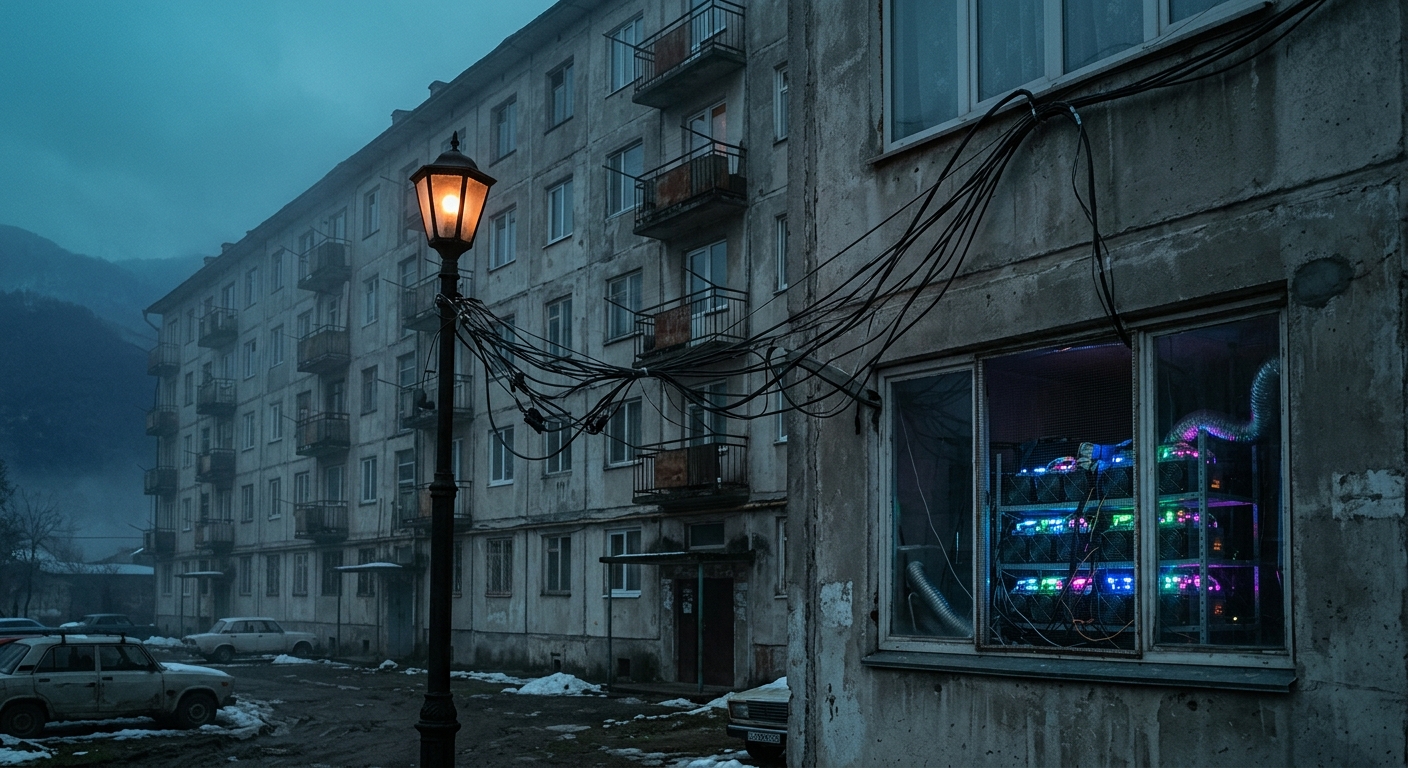
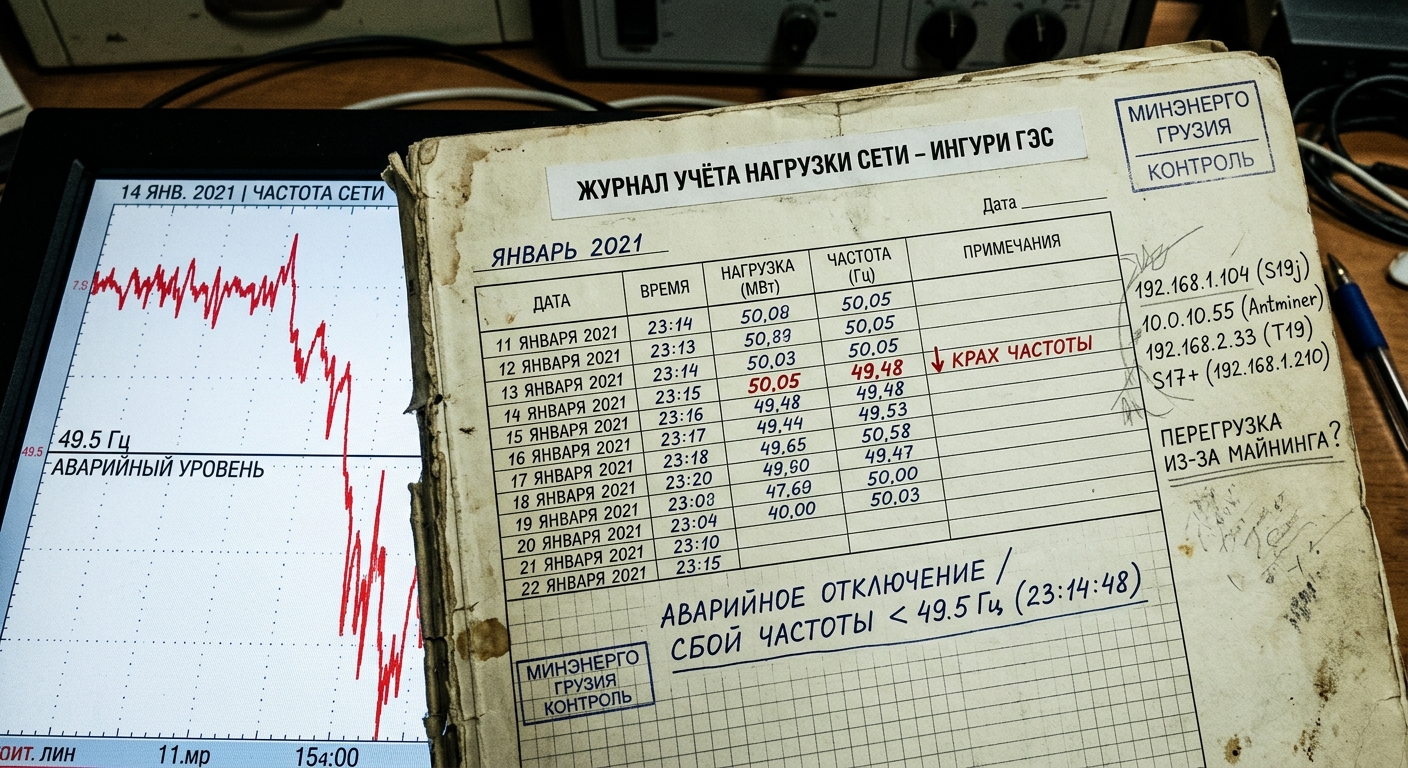
wall text
In post-Soviet contested borderlands powered by the shared Inguri hydroelectric station, cryptocurrency mining operates as physical thermodynamic cannibalism. The installation transposes real-time underfrequency load shedding (UFLS) protocols deployed during regional winter grid failures. A phase-locked loop continuously tracks mains AC frequency; as computational demand drops the line below the critical 49.5 Hz threshold, relays sever local lighting circuits to simulate municipal blackouts. The spared power feeds directly into high-density ASIC rigs, displacing civic illumination with computational convective heat exhaust. Political sovereignty is thus measured not by borders, but by the thermal exhaustion of public infrastructure converted into distributed hash rate.
shown: Installed inside an abandoned Soviet-era sanatorium in Sukhumi, powered directly by the precarious, siphoned Inguri Dam grid.
shown: Installed inside an abandoned Soviet-era sanatorium in Sukhumi, powered directly by the precarious, siphoned Inguri Dam grid.
anchor facts used
- The Inguri hydroelectric dam supplies over 90% of Abkhazia's power, with the dam in Georgia and the powerhouse in Abkhazia.
- Electricity tariffs in Abkhazia were subsidized to roughly $0.005 per kWh, creating a massive arbitrage incentive for ASIC mining.
- In the winter of 2020, unregulated cryptocurrency mining caused power consumption to surge by 20%, triggering widespread rolling blackouts and grid frequency instability.
mechanism
- Phase-locked loop (PLL) frequency estimation — A customized phase-locked loop circuit is wired directly into the gallery's mains power, continuously tracking the AC frequency of the local grid in real-time.
1. Grid Synchronization and Measurement - Underfrequency Load Shedding (UFLS) — As the measured grid frequency drops below 49.5Hz due to external ASIC mining strain, the UFLS relays automatically disconnect the gallery's overhead lighting circuits to prevent total system collapse.
2. Civic Load Disconnection - Convective heat transfer — The electrical load is permanently diverted to a central, suspended Antminer S9; as civic lights die, the miner's exhaust fans push 85-degree Celsius air into the darkened room.
3. Cryptographic Heat Exhaust - Algorithmic liquidation — The Bitcoin fractions generated by the active ASIC miner are instantly liquidated into fiat via a script to pay the Georgian state power company's operating costs.
4. Geopolitical Debt Amortization
lineage
- Julian Oliver, 'Harvest' (2017) — Expands on Oliver's use of renewable energy for cryptocurrency mining by tethering it to explicit geopolitical grid collapse rather than climate funding.
- Peter Fend, 'Ocean Earth' (1980s) — Updates Fend's surveillance of ecological and infrastructural borders to include cryptographic energy arbitrage as a terraforming force.
- Pauline Oliveros, 'Tape Delay' (1960s) — Replaces the acoustic feedback loop with an infrastructural one, where the artifact produced (Bitcoin) accelerates the degradation of the medium producing it (the grid).
curatorial qa (machine verdict, unedited)
SCORE 4/5 after 2 attempt(s)
READS: Improvised electrical taps draining municipal streetlights directly into window-mounted ASIC mining rigs; thick convective exhaust vapor venting into cold air; clear documentary evidence linking Inguri Dam underfrequency load shedding (<49.5Hz) to localized mining strain.
FAILS: The civic lighting does not noticeably dim or cut out in direct synchrony with the surge of exhaust in the video loop; the streetlamp remains lit rather than undergoing load shedding.
READS: Improvised electrical taps draining municipal streetlights directly into window-mounted ASIC mining rigs; thick convective exhaust vapor venting into cold air; clear documentary evidence linking Inguri Dam underfrequency load shedding (<49.5Hz) to localized mining strain.
FAILS: The civic lighting does not noticeably dim or cut out in direct synchrony with the surge of exhaust in the video loop; the streetlamp remains lit rather than undergoing load shedding.
spec: antigravity agent · keyframe/artifact: gemini-3.1-flash-image · video: veo-3.1 image-to-video · qa+wall text: gemini-3.7-flash watching the render · 37.6s total