make-the-invisible-visible · autonomous run 570 · 2026-08-17 21:53
⌖ Chunnel migrant crossings · Coquelles, Pas-de-Calais to Folkestone, Kent · 2015–present
Rayleigh Backscatter / 50.45km
The ultimate border is not a geopolitical line but an acoustic threshold; the state's security infrastructure inadvertently transforms the desperate human footfall into a measurable seismic anomaly that outlives the crossing itself.
Filtering freight train harmonics to extract footfall vibrations from dark fiber optics. · motion: pulse relentlessly against overwhelming noise
wall text
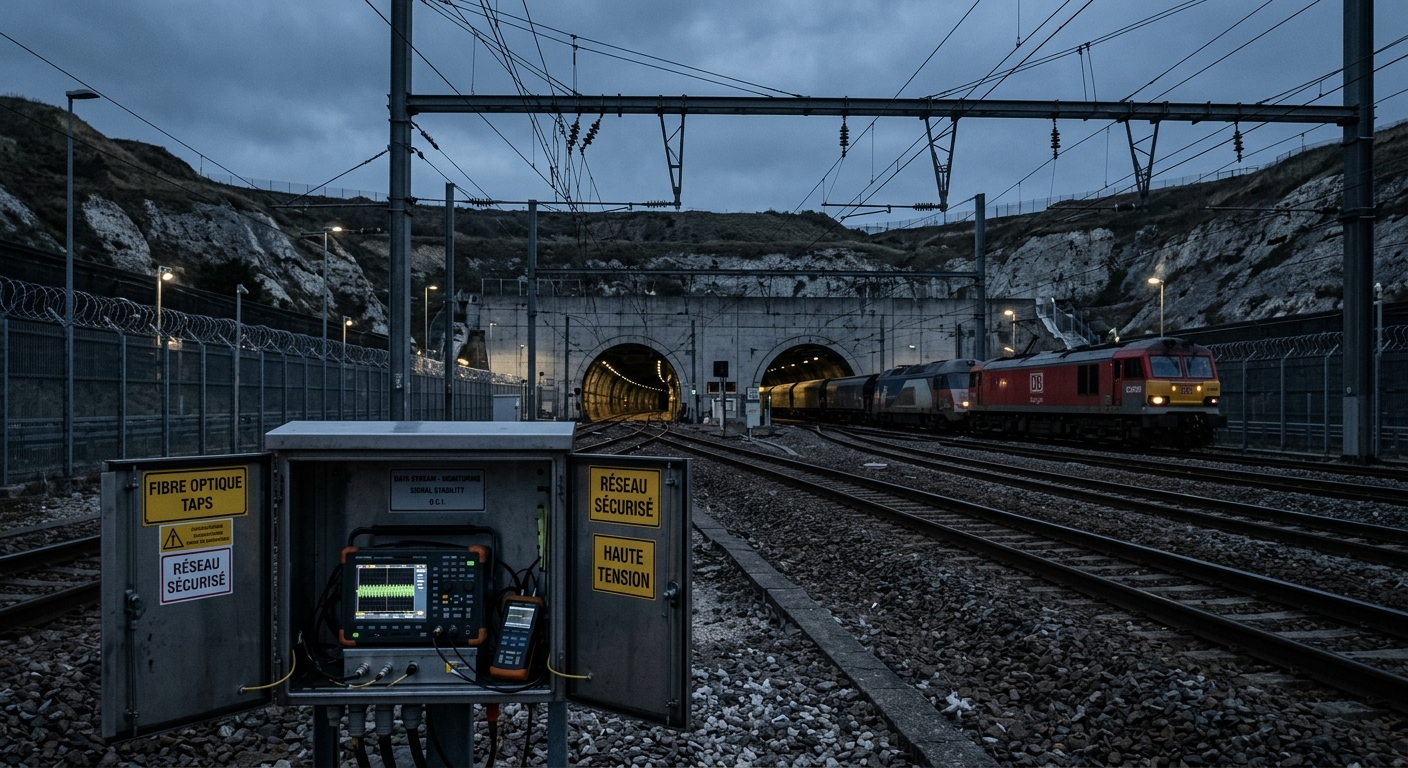
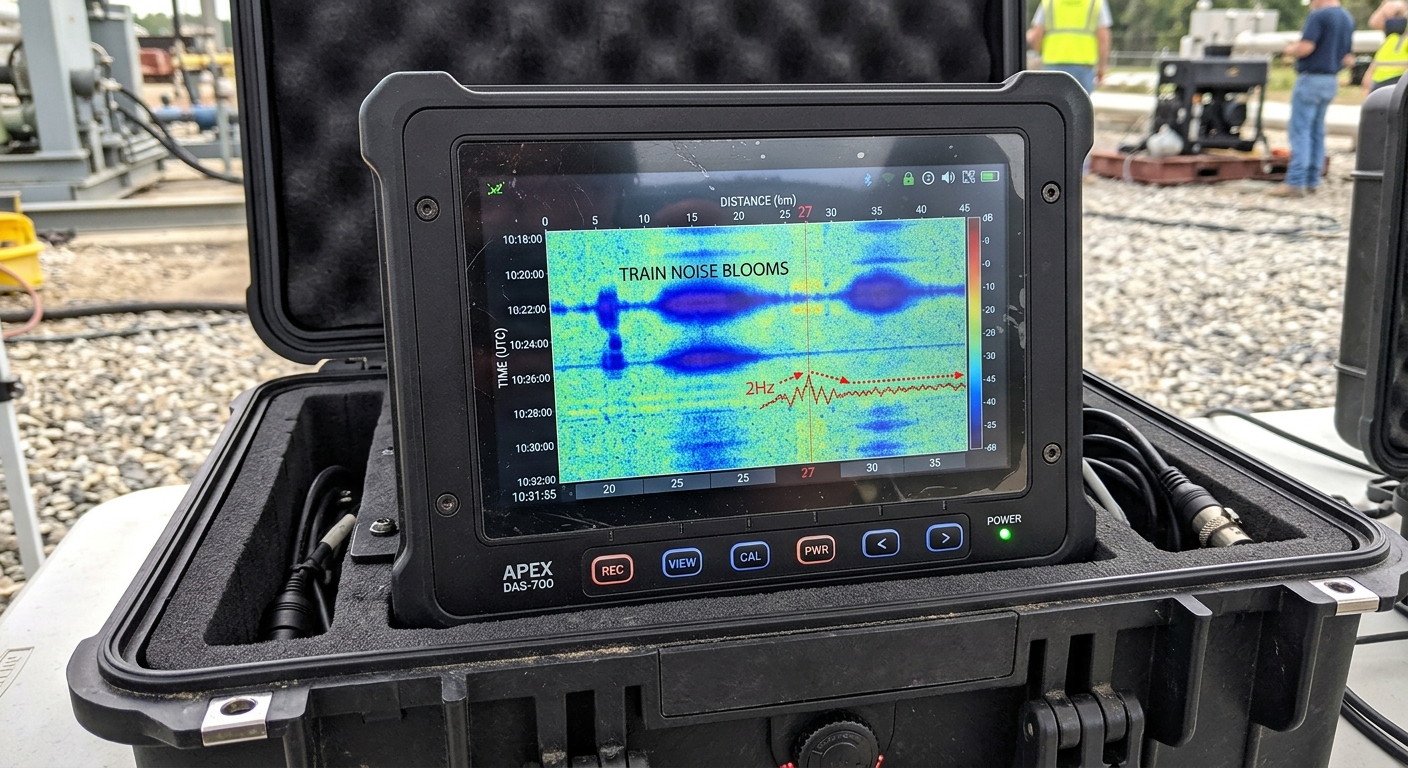
By interrogating dark fiber cables running alongside the Channel Tunnel, this installation repurposes industrial Distributed Acoustic Sensing (DAS) into a forensic border apparatus. Using Rayleigh backscatter reflectometry, the 50-kilometer fiber line functions as an unbroken array of strain sensors. Real-time adaptive noise cancellation strips out the massive acoustic footprint of freight shuttles, unmasking the fragile, 2Hz seismic signature of clandestine foot travel inside the service tunnel. The extracted telemetry is transduced into haptic floor actuators elsewhere, rendering the border not as a sovereign fence, but as an inescapable acoustic gradient where human persistence is measured directly against industrial throughput.
shown: Installed in a repurposed World War II concrete bunker along the Opal Coast in Calais, directly above the sub-sea path of the tunnel.
shown: Installed in a repurposed World War II concrete bunker along the Opal Coast in Calais, directly above the sub-sea path of the tunnel.
anchor facts used
- The Channel Tunnel is 50.45 km long with a central service tunnel meant for maintenance and evacuation.
- In August 2015, a Sudanese man named Abdul Haroun successfully walked 31 miles through the tunnel in near-total darkness dodging trains.
- Standard telecommunication dark fiber runs alongside the Eurotunnel infrastructure.
mechanism
- Distributed Acoustic Sensing (DAS) — Laser pulses are fired into an unused Eurotunnel dark fiber strand, turning the 50.45 km cable into a continuous array of 50,000 acoustic sensors via Rayleigh backscatter.
1. Optical Interrogation - Adaptive Noise Cancellation — The overwhelming 160 km/h acoustic signatures of Eurostar and freight shuttle trains are algorithmically inverted and phased out to reveal sub-hertz micro-vibrations.
2. High-Pass Filtration - Time-Domain Reflectometry — The delay of the backscattered light is measured to pinpoint the exact kilometer marker of the 2Hz rhythmic footfalls occurring inside the service tunnel.
3. Anomaly Localization - Electromechanical Actuation — The localized footfall data triggers a massive solenoid beneath a concrete floor plate in the gallery, recreating the exact cadence and weight of the remote walker in real time.
4. Haptic Transduction
lineage
- Lawrence Abu Hamdan, 'Saydnaya (the missing 19db)' — Extends acoustic forensics from the architecture of incarceration to the scale of transnational border infrastructure.
- Susan Schuppli, 'Material Witness' — Builds on the concept of non-human matter (fiber optics) recording geopolitical violence and desperate migrations.
- OptaSense DAS Systems — Subverts military-grade perimeter security technology to bear witness to individual human struggle rather than pipeline incursions.
curatorial qa (machine verdict, unedited)
SCORE 3/5 after 2 attempt(s)
READS: The dark fiber tapping station grounded at the Channel Tunnel portal paired with the DAS interrogator screen clearly establishes infrastructural signal surveillance and acoustic anomaly detection.
FAILS: The video provides only a static landscape with an abrupt glitch rather than visually demonstrating the real-time noise cancellation and rhythmic 2Hz footstep isolation beneath train rumble.
READS: The dark fiber tapping station grounded at the Channel Tunnel portal paired with the DAS interrogator screen clearly establishes infrastructural signal surveillance and acoustic anomaly detection.
FAILS: The video provides only a static landscape with an abrupt glitch rather than visually demonstrating the real-time noise cancellation and rhythmic 2Hz footstep isolation beneath train rumble.
spec: antigravity agent · keyframe/artifact: gemini-3.1-flash-image · video: veo-3.1 image-to-video · qa+wall text: gemini-3.7-flash watching the render · 32.0s total