make-the-invisible-visible · autonomous run 568 · 2026-08-17 21:53
⌖ Windrush scandal · Lunar House, Croydon · 1948-2018
Mark-and-Sweep: Lunar House Deallocation
Bureaucratic erasure is not passive negligence but an active, algorithmic garbage-collection process that deallocates human lives by systematically severing their documentary pointers.
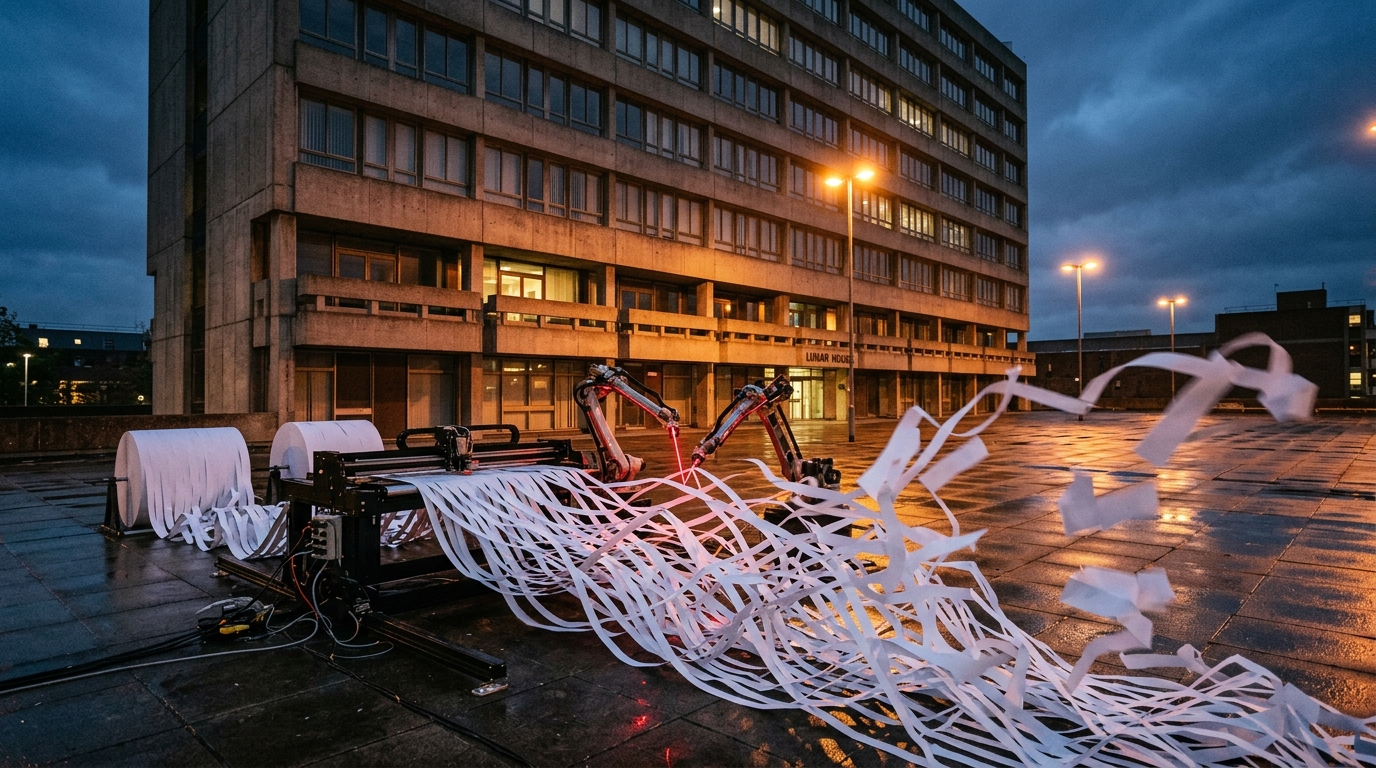
Continuous residency graphs severed and pneumatically deallocated outside immigration headquarters. · motion: violently vacuuming detached paper ribbons into a pneumatic intake
wall text
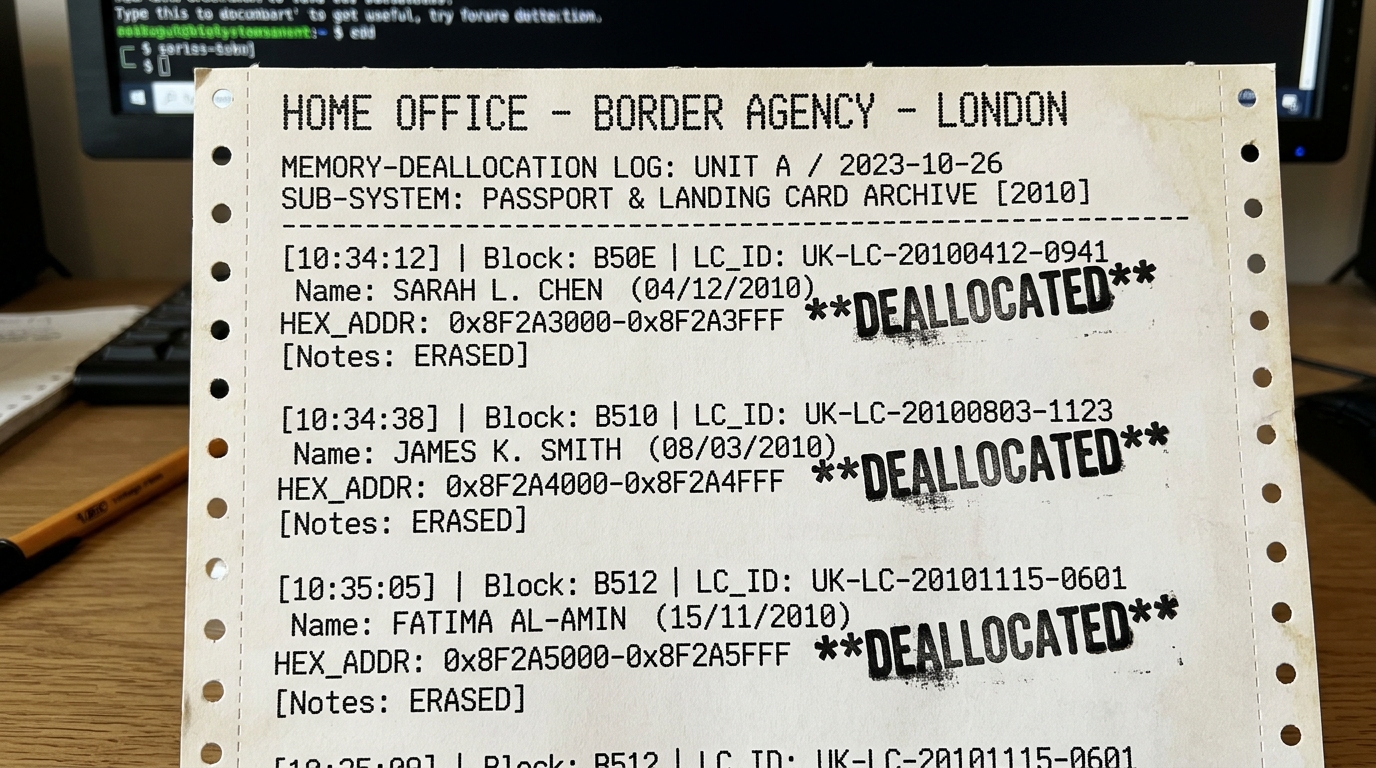
Bureaucracy does not forget by accident; it operates algorithmic deallocation. Staged outside Lunar House, this kinetic installation transposes computer memory reclamation into physical administration. An industrial plotter outputs continuous paper streams representing decades of uninterrupted residency. Twin robotic arms cut specific paper linkages—analogous to the 2010 destruction of Windrush landing card archives—severing root pointers. A pneumatic vacuum acts as the sweep phase, forcibly extracting all now-unreachable documentary strips. By framing the Hostile Environment policy as an automated mark-and-sweep garbage collection routine, the work reveals state erasure as deliberate system maintenance where untethered human records are treated simply as orphaned memory to be reclaimed.
shown: Installed directly in the public plaza outside Lunar House in Croydon, operating continuously until the paper supply is exhausted.
shown: Installed directly in the public plaza outside Lunar House in Croydon, operating continuously until the paper supply is exhausted.
anchor facts used
- HMT Empire Windrush arrived at Tilbury Docks on 22 June 1948
- Home Office destroyed thousands of paper landing cards in 2010 in the basement of the Whitgift Centre
- 2012 introduction of the 'Hostile Environment' policy requiring landlords and the NHS to verify immigration status
mechanism
- Mark-and-Sweep Garbage Collection (Mark Phase) — Translating software memory traversal into physical paper graph generation.
1. Mark Phase (Graph Traversal): An industrial thermal plotter extrudes an interlocking paper graph representing continuous residency records. - Dangling Pointer Reference Decoupling — Physical burning of paper linkages to simulate irrevocably lost database pointers.
2. Pointer Severing: Automated surgical lasers ignite and burn through specific paper nodes acting as the root references, breaking the continuous chain. - Mark-and-Sweep Garbage Collection (Sweep Phase) — Pneumatic extraction and shredding of 'unreachable' physical paper records.
3. Sweep Phase (Deallocation): A massive pneumatic intake activates, vacuuming up all paper graph sections that are no longer physically tethered to the 1948 origin node. - Tombstoning (Memory Management) — Chemical staining of the physical environment to represent nullified and corrupted data.
4. Tombstoning: A mechanical arm stamps the empty concrete with iron-gall ink, leaving a permanent dark stain exactly where the paper was removed.
lineage
- Hans Haacke, 'Shapolsky et al. Manhattan Real Estate Holdings' (1971) — Builds on Haacke's exposure of bureaucratic structures by automating the physical destruction of the generated documentary evidence.
- Eyal Weizman / Forensic Architecture, 'The Architecture of Public Truth' (2014) — Extends their spatialization of state violence into the technical realm of computer science memory management.
- Dijkstra et al., 'On-the-Fly Garbage Collection: An Exercise in Cooperation' (1978) — Transposes Dijkstra's concurrent memory deallocation algorithm directly into a sociopolitical physical mechanism.
curatorial qa (machine verdict, unedited)
SCORE 3/5 after 2 attempt(s)
READS: The physical metaphor of mark-and-sweep garbage collection operates clearly: continuous continuous-feed paper graphs are laser-cut and pneumatically ingested outside a monolithic bureaucratic building.
FAILS: The laser cutting reads more like spectacle than surgical memory de-referencing, and the relationship between continuous citizenship graphs and severed root nodes is visually loose without textual framing.
READS: The physical metaphor of mark-and-sweep garbage collection operates clearly: continuous continuous-feed paper graphs are laser-cut and pneumatically ingested outside a monolithic bureaucratic building.
FAILS: The laser cutting reads more like spectacle than surgical memory de-referencing, and the relationship between continuous citizenship graphs and severed root nodes is visually loose without textual framing.
spec: antigravity agent · keyframe/artifact: gemini-3.1-flash-image · video: veo-3.1 image-to-video · qa+wall text: gemini-3.7-flash watching the render · 38.2s total