make-the-invisible-visible · autonomous run 561 · 2026-08-17 21:53
⌖ Banana monoculture Gros Michel collapse · Valle de Sula, Honduras · 1890s-1960s
Race 1: Soil Memory Amplification
Monoculture capitalism leaves a permanent, quantifiable biochemical debt in the soil that outlives the economic entity that extracted its value.
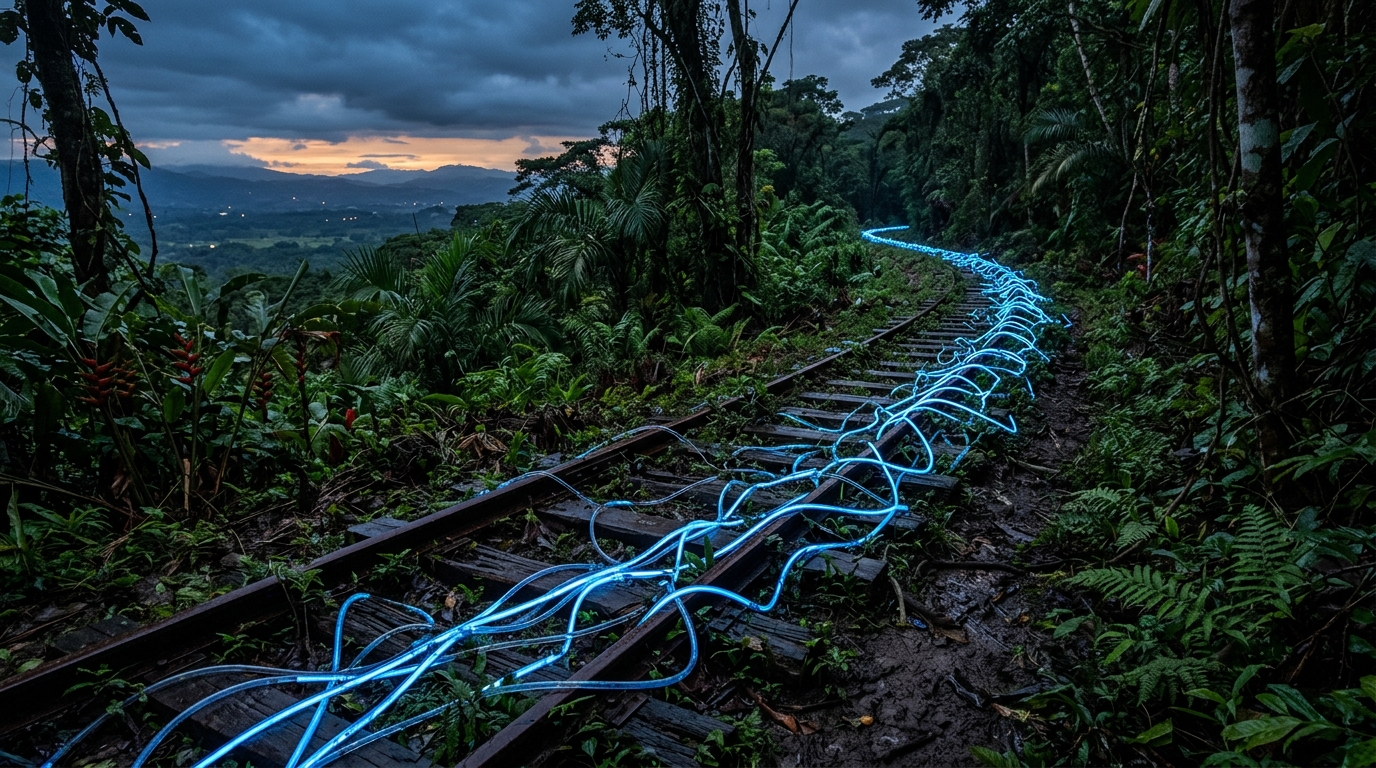
Capillary tubes tracing fungal DNA concentration along abandoned plantation rail lines. · motion: pulsing luminescently outward along abandoned infrastructure
wall text
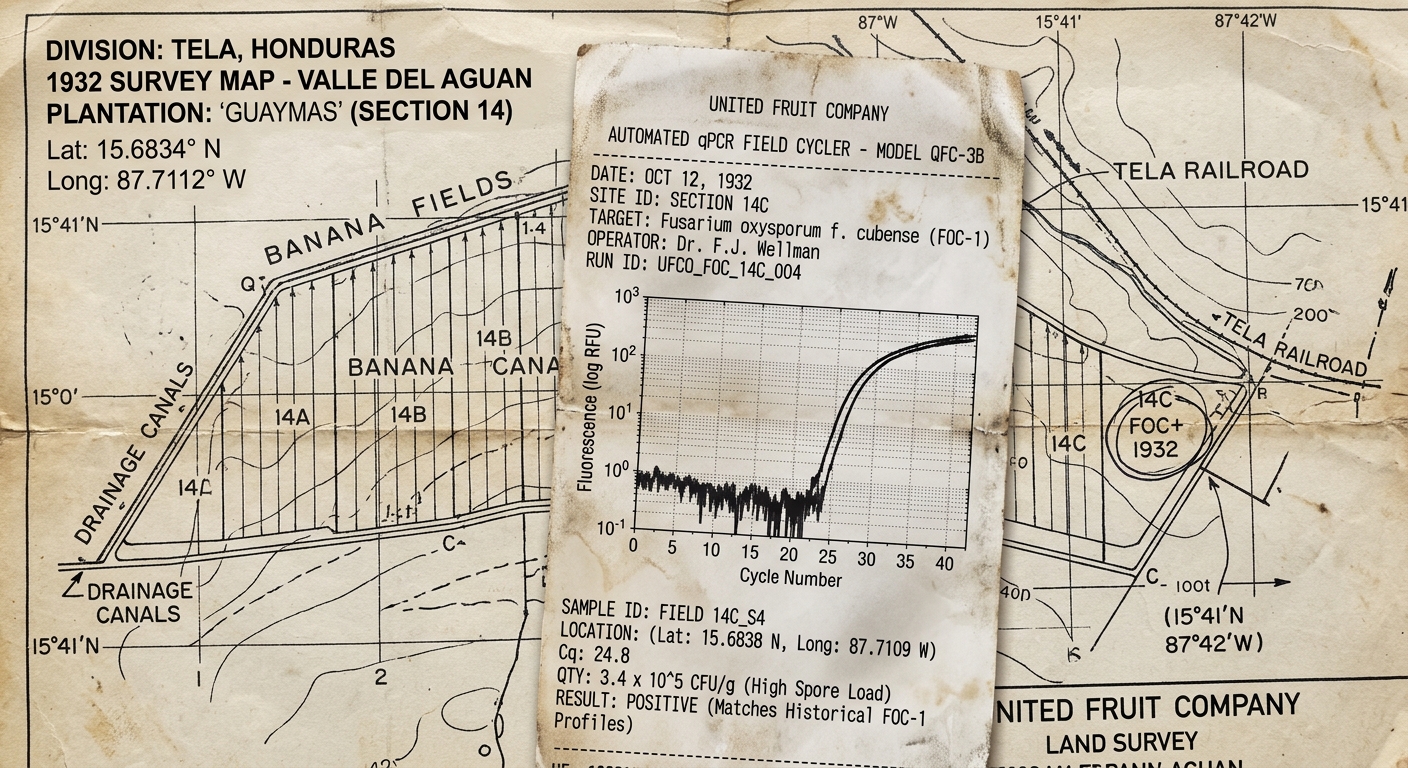
In the 1930s, the United Fruit Company abandoned extensive monoculture banana plantations in Honduras after Fusarium oxysporum f. sp. cubense wiped out the Gros Michel variety. This piece transposes environmental DNA extraction and quantitative polymerase chain reaction (qPCR) into a landscape-scale diagnostic circuit. Sampling units extract residual soil eDNA from Valle de Sula coordinates, running continuous thermal cycles to amplify the fungal pathogen's genetic footprint. As amplification crosses detection thresholds, fluidic pumps push fluorescent marker dye through glass capillary networks laid across the decaying Tela Railroad ties, visualizing how industrial monoculture leaves an indelible biological ledger long after capital has divested.
shown: Installed in-situ as an illuminated nocturnal intervention along a 2-kilometer stretch of an abandoned United Fruit Company railway line outside Tela, Honduras.
shown: Installed in-situ as an illuminated nocturnal intervention along a 2-kilometer stretch of an abandoned United Fruit Company railway line outside Tela, Honduras.
anchor facts used
- The United Fruit Company incorporated in 1899 and established massive monoculture plantations in the Valle de Sula linked by narrow-gauge railways.
- Fusarium oxysporum f. sp. cubense (Race 1) caused Panama disease, forcing the complete abandonment of Gros Michel by 1965.
- Chlamydospores of the Fusarium fungus can remain viable and dormant in the soil for over 30 years without a host plant.
mechanism
- Environmental DNA (eDNA) extraction — The extraction is scaled into an automated pneumatic tube system drawing continuous soil samples across an abandoned plantation field into a central bioreactor.
1. Extraction of deep soil cores from coordinates 15.3917 N, 87.9739 W, filtering out organic detritus to isolate microbial environmental DNA. - Polymerase Chain Reaction (PCR) denaturation and annealing — The 94 C heating and 55 C cooling cycles are mapped to large-scale industrial heating plates laid directly over the soil, monitored by thermal imaging cameras.
2. Target isolation of the specific DNA sequence of Fusarium oxysporum f. sp. cubense Race 1 from the raw eDNA soup. - PCR amplification extension — The logarithmic replication rate regulates a synchronized fluid pump, flooding clear glass capillary tubes that physically trace the old rail networks.
3. Exponential replication of the pathogen's genetic material via continuous thermal cycling. - Real-time fluorometric quantification (qPCR) — The glowing capillary network illuminates the landscape at night, creating a real-time topographical light map of the blight's density in the soil.
4. Binding of the amplified DNA to a fluorescent probe, yielding visible light intensity directly proportional to historical spore density.
lineage
- Oron Catts and Ionat Zurr, Tissue Culture & Art Project — Extends their use of living biological protocols from the gallery into landscape-scale historical archaeology.
- Heather Dewey-Hagborg, Stranger Visions — Inverts her individual forensic DNA phenotyping to trace macro-scale corporate environmental impact.
- Paul Vanouse, Latent Figure Protocol — Adapts his real-time DNA gel electrophoresis imaging into an in-situ territorial illumination mechanism.
curatorial qa (machine verdict, unedited)
SCORE 3/5 after 2 attempt(s)
READS: The installation clearly overlays fluidic bioluminescent capillary networks onto overgrown railway infrastructure, anchored by the archival qPCR readout documenting residual pathogen load.
FAILS: The glowing tubes appear like static electroluminescent wire rather than a dynamic, metered PCR amplification process pulsing in response to real soil data.
READS: The installation clearly overlays fluidic bioluminescent capillary networks onto overgrown railway infrastructure, anchored by the archival qPCR readout documenting residual pathogen load.
FAILS: The glowing tubes appear like static electroluminescent wire rather than a dynamic, metered PCR amplification process pulsing in response to real soil data.
spec: antigravity agent · keyframe/artifact: gemini-3.1-flash-image · video: veo-3.1 image-to-video · qa+wall text: gemini-3.7-flash watching the render · 31.0s total