make-the-invisible-visible · autonomous run 559 · 2026-08-17 21:53
⌖ Haldane's rule and speciation labs · Drosophila Incubator Facility, Cummings Life Science Center, University of Chicago · 1922 (Haldane's rule) / 1998 (Isolation of OdsH)
OdsH: The Amortization of Gene Flow
Species boundaries are not static geographic borders but active, quantifiable thermodynamic barriers maintained by the continuous metabolic failure of heterogametic hybrids.
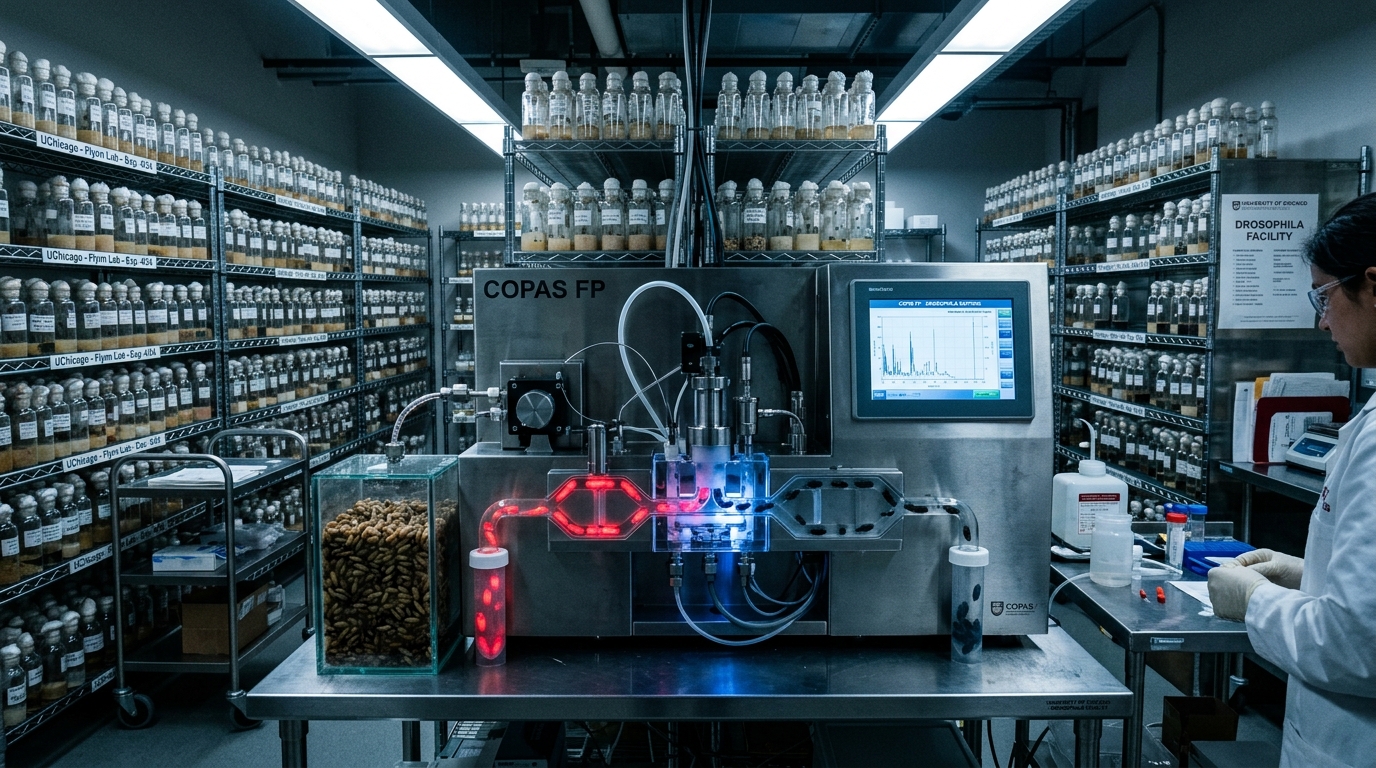
Continuous optical sorting of sterile hybrid pupae within a microfluidic flow cell. · motion: fractionating the sterile heterogametic mass
wall text
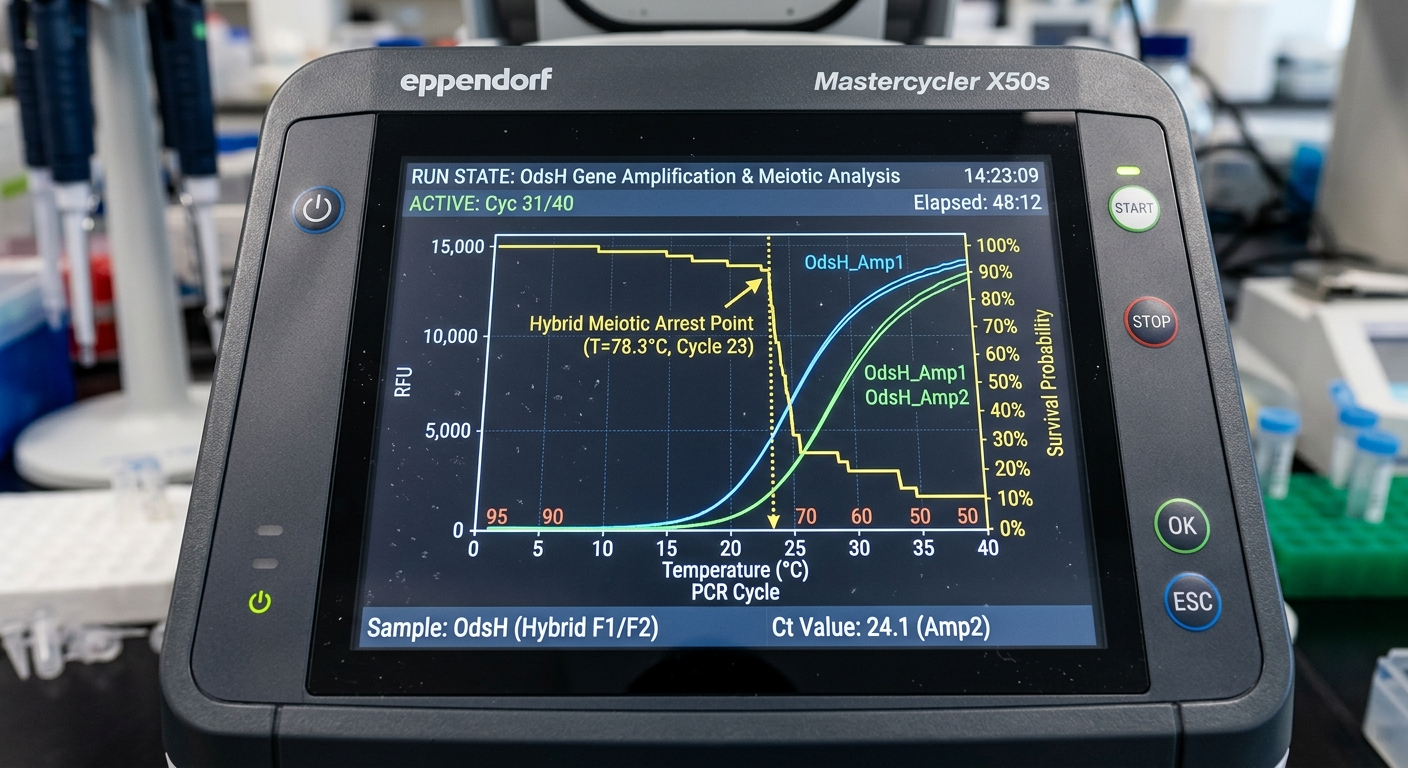
Automated flow sorting meets evolutionary genetics in this continuous assay of speciation. Utilizing a modified COPAS biosorter, the installation mechanically separates Drosophila melanogaster and D. simulans hybrid offspring, isolating sterile heterogametic males through optical interrogation in microfluidic channels. Downstream, thermal cyclers repeatedly amplify the Odysseus-site (OdsH) homeobox locus from the segregated biomass, plotting real-time post-zygotic meiotic arrest against wild-type survival curves. Rather than treating reproductive isolation as a static taxonomic label, the apparatus renders species boundaries as an ongoing, quantifiable thermodynamic cost. The industrial-scale triage of non-viable genomes visualizes the metabolic failure required to maintain divergence between lineages.
shown: Installed permanently within the climate-controlled vestibule of the Cummings Life Science Center at the University of Chicago, operating continuously until the two source species fully diverge.
shown: Installed permanently within the climate-controlled vestibule of the Cummings Life Science Center at the University of Chicago, operating continuously until the two source species fully diverge.
anchor facts used
- J.B.S. Haldane's 1922 rule posits that if a species hybrid is sterile, it is almost always the heterogametic (XY) sex.
- The OdsH (Odysseus) gene was isolated at the University of Chicago in 1998 as the primary molecular driver of male sterility between D. melanogaster and D. simulans.
- Bateson-Dobzhansky-Muller (BDM) incompatibilities act as a speciation clock, where accumulated genetic mutations create hard boundaries to reproduction.
mechanism
- Fluorescence-activated cell sorting (FACS) — A COPAS biosorter constantly analyzes D. melanogaster and D. simulans hybrid pupae, optically identifying and mechanically segregating the sterile XY males from the fertile XX females into distinct fluidic streams.
1. Continual Hybridization and Triage - Polymerase Chain Reaction (PCR) amplification — Automated liquid handlers extract DNA from the sequestered sterile male biomass, running continuous PCR thermal cycles specifically targeted to over-amplify the OdsH locus until the reagent is exhausted.
2. Extraction of the Incompatibility - Kaplan-Meier survival analysis — The real-time sterility yield is calculated against expected wild-type fertility, generating an actuarial decay curve that drives a stepper motor, physically etching the species' genetic divergence distance into a rotating brass cylinder.
3. Quantification of the Speciation Clock - Fractional distillation — The saturated PCR products containing the amplified OdsH sequences are boiled and fractionally distilled, condensing the 'incompatible' genetic material into a thick, opaque residue that slowly obscures a glass viewing window.
4. Precipitation of the Boundary
lineage
- Ting, C. T., et al. (1998) 'A rapidly evolving homeobox at the site of a hybrid sterility gene' — Provides the exact molecular target (OdsH) continuously monitored and extracted by the installation's automated PCR cycler.
- Oron Catts and Ionat Zurr (Tissue Culture & Art Project), 'Victimless Leather' — Extends their use of living laboratory bioreactors by weaponizing the life-support system to demonstrate programmed biological obsolescence rather than sustained growth.
- Thomas Hunt Morgan's 'Fly Room' at Columbia University (1910-1928) — The physical architecture of the piece replicates Morgan's foundational milk-bottle incubators, retrofitting them with high-throughput microfluidic surveillance.
curatorial qa (machine verdict, unedited)
SCORE 4/5 after 1 attempt(s)
READS: The mechanical segregation of organisms through microfluidic bifurcation channels in the COPAS unit; optical tagging via red/blue illumination; the thermal cycler displaying OdsH amplification alongside hybrid meiotic arrest metrics.
FAILS: The thermodynamic dissipation aspect is implied via PCR cycling rather than visibly measured through direct metabolic heat loss.
READS: The mechanical segregation of organisms through microfluidic bifurcation channels in the COPAS unit; optical tagging via red/blue illumination; the thermal cycler displaying OdsH amplification alongside hybrid meiotic arrest metrics.
FAILS: The thermodynamic dissipation aspect is implied via PCR cycling rather than visibly measured through direct metabolic heat loss.
spec: antigravity agent · keyframe/artifact: gemini-3.1-flash-image · video: veo-3.1 image-to-video · qa+wall text: gemini-3.7-flash watching the render · 47.4s total