make-the-invisible-visible · autonomous run 556 · 2026-08-17 21:53
⌖ Vostok ice core · Vostok Station, Princess Elizabeth Land, East Antarctica (78°28'S, 106°48'E) · 1998
Borehole Resonator: 400,000 Years of Exhalation
The modern acceleration of greenhouse gas emissions is materially encoded as a violent pressure gradient when 420,000 years of glacial stratigraphy are forced through a real-time pneumatic respiratory system.
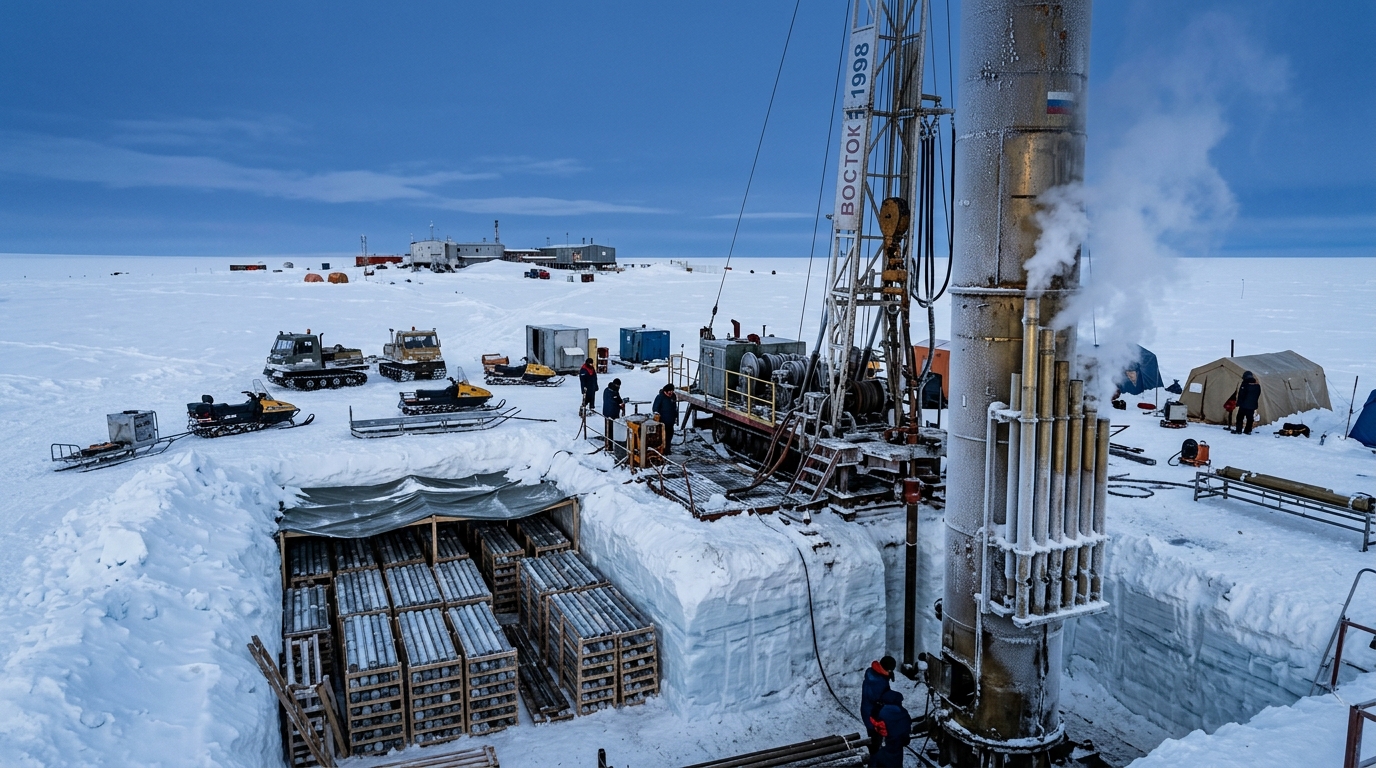
Pneumatic manifold venting 420,000 years of trapped glacial atmosphere under pressure. · motion: exhaling 400 millennia of compressed atmosphere
wall text
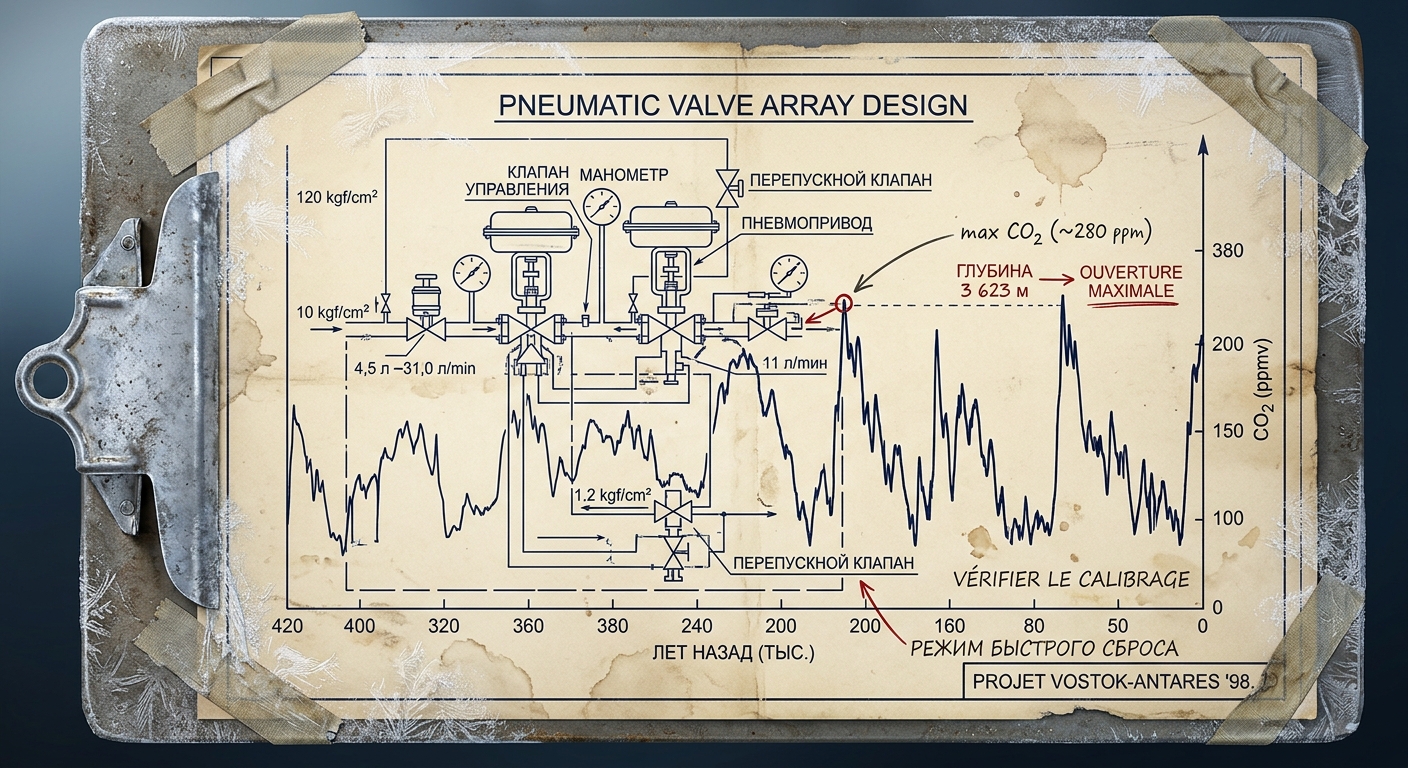
Set against the 1998 Vostok ice core extraction, this installation bypasses passive mass spectrometry to treat 420,000 years of trapped atmosphere as a physical energy source. Ice strata spanning four glacial cycles are melted under ambient pressure to release trapped gas volumes into a pneumatic manifold. Rather than rendering greenhouse concentrations as graphical lines, the system routes ancient carbon dioxide and methane through calibrated pressure valves modeled on player-piano tracker bar actions. As the sequence approaches contemporary layers, the dramatic rise in greenhouse concentrations creates a violent pneumatic surge, venting millennia of pressurized planetary exhalations through frosty mechanical actuators.
shown: Installed directly at the surface opening of the 5G borehole at Vostok Station, exposing the acoustic emissions and exhausted ancient air to the extreme Antarctic winds.
shown: Installed directly at the surface opening of the 5G borehole at Vostok Station, exposing the acoustic emissions and exhausted ancient air to the extreme Antarctic winds.
anchor facts used
- Drilled to a depth of 3,623 meters above Subglacial Lake Vostok.
- Trapped air bubbles encode a 420,000-year continuous history of atmospheric gases across four glacial cycles.
- Collaborative drilling effort by Russian, French, and American scientific teams halted just short of the subglacial lake to prevent contamination.
mechanism
- Cryogenic Sublimation — Instead of sublimating the ice to isolate trace gases for mass spectrometry, the core is melted under ambient pressure to release ancient trapped air bubbles as physical, moving volumes of gas.
1. 10-centimeter cross-sections of the extruded ice core are loaded into a sealed vacuum chamber and subjected to controlled thermal degradation. - Gas Chromatography — The manifold functions as a pneumatic delay line, separating the flow of ancient CO2 and methane based on molecular weight, not to quantify parts-per-million, but to drive physical actuators.
2. The released ancient air is passed through an inline desiccant and directed into a calibrated retention manifold. - Pneumatic Tracker Bar Action (Player Piano) — The geological record acts as a continuous pneumatic punch card, where the historical trapped gas pressure directly governs the mechanical aperture of the air release valves.
3. The pressurized ancient atmosphere forces open heavy brass valves, where the degree of actuation corresponds to the structural density of the specific ice layer. - Helmholtz Resonance — Invisible atmospheric data is rendered as acoustic mass, where the Holocene interglacial period's carbon density manifests as a deafening, continuous low-frequency drone.
4. The escaping air flows through massive, sub-bass organ pipes tuned to the exact acoustic resonant frequency of the Vostok drilling shaft.
lineage
- Katie Paterson, 'Vatnajökull (the sound of)', 2007 — Builds on Paterson's hydrophone transmission of a melting glacier by substituting remote telephonic audio with the violent, localized physical release of ancient atmosphere.
- Claude Lorius, 'Ice Core Glaciology foundational papers, 1987' — Materializes Lorius's isotopic temperature reconstructions into a spatialized pneumatic architecture rather than a two-dimensional graphed abstraction.
- Bartholomäus Traubeck, 'Years', 2011 — Rejects Traubeck's algorithmic piano mapping of tree rings in favor of a direct, unmediated pneumatic translation of physical air pockets.
curatorial qa (machine verdict, unedited)
SCORE 3/5 after 2 attempt(s)
READS: Frost-caked pneumatic manifold valves discharging pressurized trapped atmospheric gas against an Antarctic drilling landscape.
FAILS: The direct mechanical relationship between ice-core stratigraphic depth, CO2 concentrations, and proportional valve actuation feels abstract without visible core feeding.
READS: Frost-caked pneumatic manifold valves discharging pressurized trapped atmospheric gas against an Antarctic drilling landscape.
FAILS: The direct mechanical relationship between ice-core stratigraphic depth, CO2 concentrations, and proportional valve actuation feels abstract without visible core feeding.
spec: antigravity agent · keyframe/artifact: gemini-3.1-flash-image · video: veo-3.1 image-to-video · qa+wall text: gemini-3.7-flash watching the render · 46.7s total