make-the-invisible-visible · autonomous run 553 · 2026-08-17 21:52
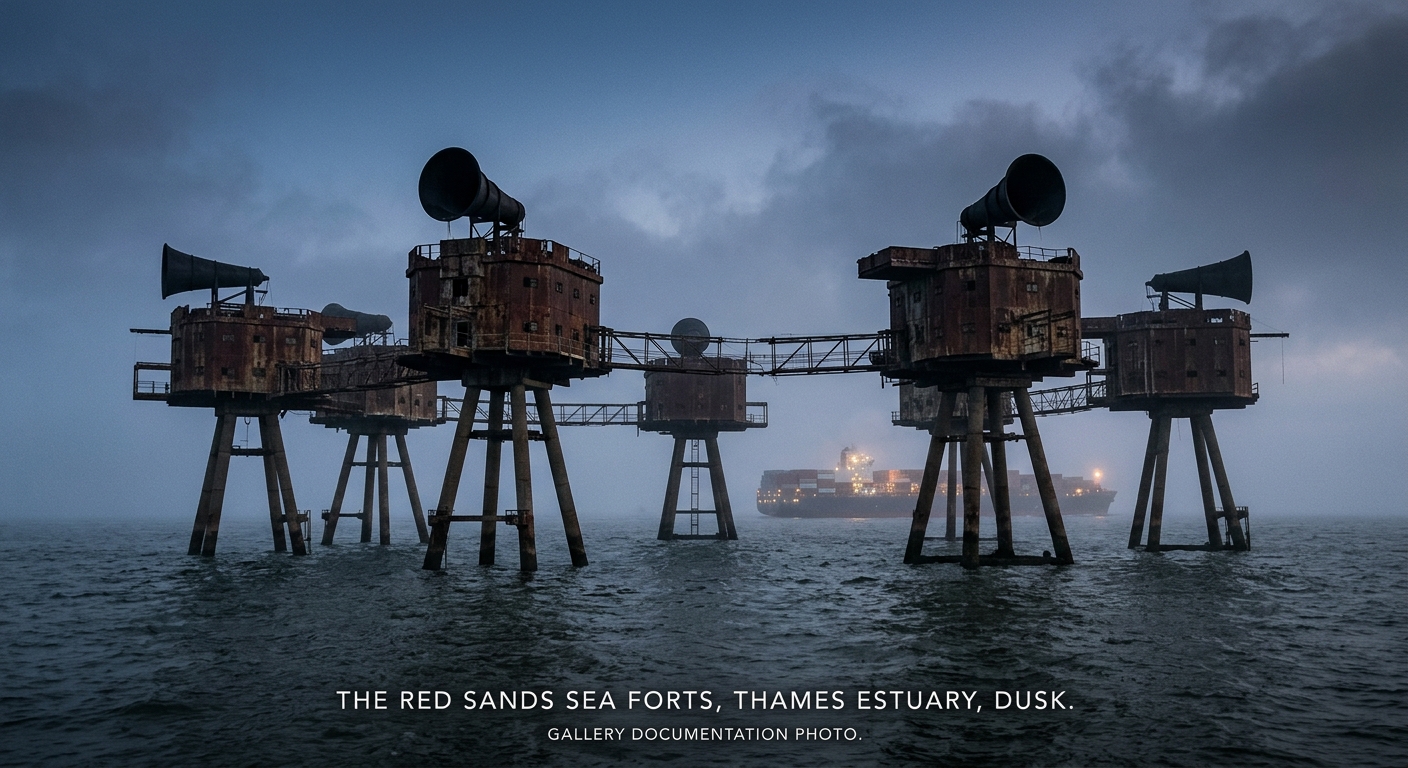
⌖ Maunsell sea forts (Red Sands) · Thames Estuary, United Kingdom · 1943-present
Beneficial Ownership Beamformer (Red Sands)
The modern equivalent of hostile intrusion is not military aviation but the obfuscated flow of untaxed global capital; piercing this requires weaponizing historical defense infrastructure to acoustically target the logistical vessels that sustain it.
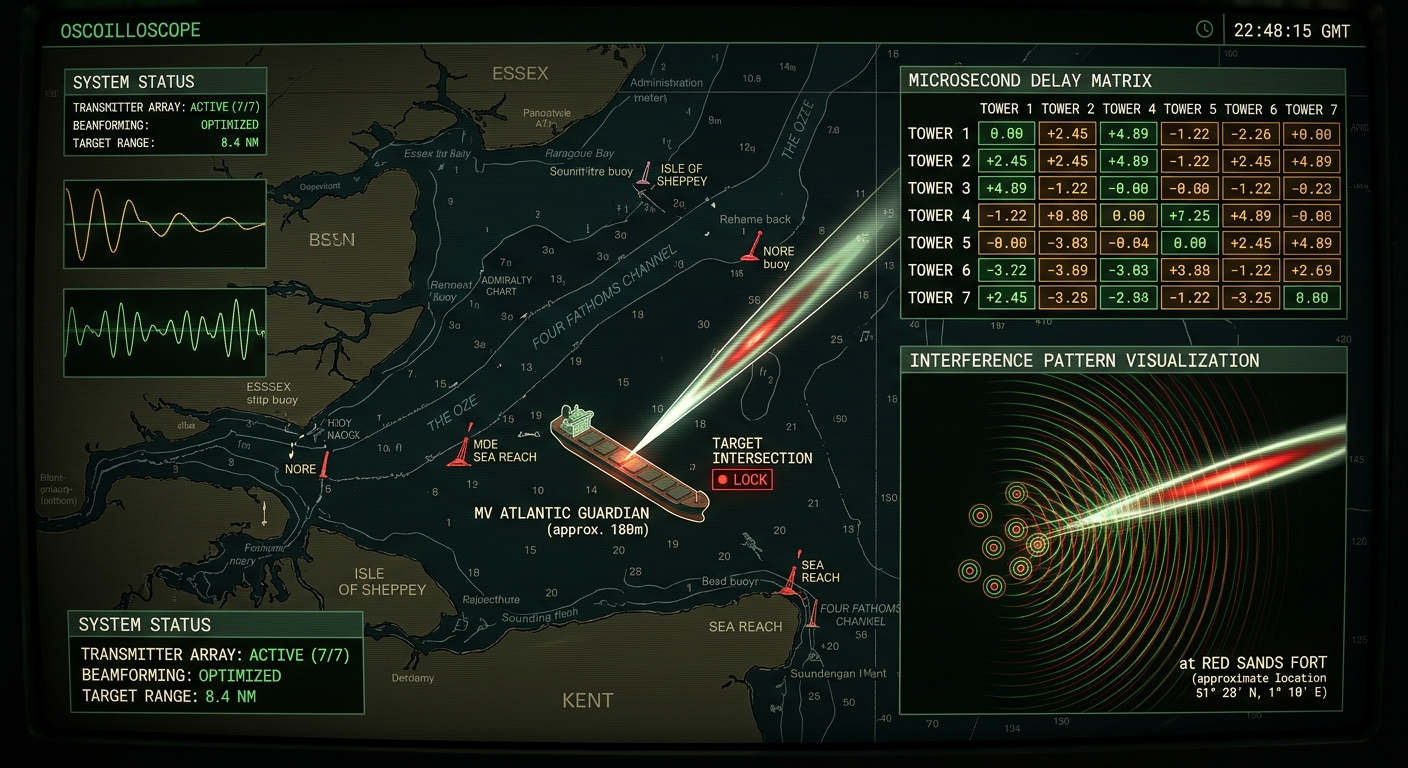
Phased acoustic array at Red Sands targeting Thames maritime freight. · motion: panning slowly to track a passing target while invisibly concentrating acoustic pressure
wall text
Installed across the seven decommissioned towers of the Red Sands Maunsell Forts, this intervention transposes WWII anti-aircraft early warning systems into an offensive acoustic installation. The system taps Automatic Identification System (AIS) maritime telemetry to identify approaching cargo vessels navigating the Thames shipping lanes, resolving their registration numbers against leaked offshore corporate registries. Seven pneumatic acoustic emitters calculate microsecond phase delays across the fort array, focusing constructive low-frequency sonic interference directly at the target ship's bridge. By turning abstract corporate evasion databases into physical acoustic pressure, the installation reclaims maritime defense architecture to confront global logistical flows.
shown: Installed permanently as an autonomous, self-powered system on the Red Sands fort itself, sensible only to targeted maritime traffic and specialized chartered vessels operating within the beam.
shown: Installed permanently as an autonomous, self-powered system on the Red Sands fort itself, sensible only to targeted maritime traffic and specialized chartered vessels operating within the beam.
anchor facts used
- The Red Sands fort consists of seven distinct steel-and-concrete towers linked by walkways, originally equipped with 3.7-inch anti-aircraft guns to track incoming bombers.
- Occupied in 1964 by pirate radio station Radio Invicta, circumventing BBC monopoly by broadcasting from just outside national territorial waters.
- Located directly adjacent to the principal deep-water shipping channel serving the modern Port of London Gateway.
mechanism
- Automatic Identification System (AIS) maritime telemetry logging — Repurposed from collision avoidance into an early-warning radar for approaching offshore tax entities.
1. An Automatic Identification System (AIS) receiver on the central control tower intercepts the MMSI number of a container ship entering the Thames Estuary deep-water channel. - Graph database traversal and entity resolution — Transposed from financial compliance auditing into the real-time generation of a synthesized broadcast script.
2. A local server queries leaked offshore financial databases (e.g., Panama Papers, Paradise Papers) to resolve the ship's MMSI to its Ultimate Beneficial Owner (UBO) and holding company jurisdiction. - Digital-to-analog audio conversion and high-SPL pneumatic amplification — Transforms abstract, digitized financial data into brute physical pneumatic pressure.
3. The generated script is converted to low-frequency audio and routed to seven pneumatic air-raid sirens, one installed on the roof of each of the seven Red Sands towers. - Phased array beamforming via digital time-delay interference — Transposed from RF radar and sonar steering into highly directional, targeted acoustic harassment.
4. A digital signal processor applies microsecond-precise offsets to each tower's audio feed, utilizing constructive and destructive acoustic interference to steer a narrow, deafening beam of sound directly at the moving ship's bridge.
lineage
- Julian Oliver, 'Transparency Grenade' (2012) — Builds on Oliver's localized network interception by scaling it to maritime logistics and massive physical acoustic projection.
- Lawrence Abu Hamdan, 'Saydnaya (the missing 19db)' (2016) — Reverses Hamdan's acoustic forensics; rather than listening to violence, it weaponizes sound to confront the architects of financial violence.
- HeHe, 'Nuage Vert' (2008) — Shares the strategy of projecting real-time industrial data directly back onto the physical infrastructure responsible for it.
curatorial qa (machine verdict, unedited)
SCORE 4/5 after 2 attempt(s)
READS: The acoustic targeting of commercial cargo ships via repurposed WWII anti-aircraft forts is unmistakable, underscored by the water cavitation and the technical UI detailing phased-array beamforming delays.
FAILS: The direct connection to offshore financial registries and tax evasion is purely conceptual, relying entirely on the explanatory metadata rather than visible telemetry or legibility on the vessel.
READS: The acoustic targeting of commercial cargo ships via repurposed WWII anti-aircraft forts is unmistakable, underscored by the water cavitation and the technical UI detailing phased-array beamforming delays.
FAILS: The direct connection to offshore financial registries and tax evasion is purely conceptual, relying entirely on the explanatory metadata rather than visible telemetry or legibility on the vessel.
spec: antigravity agent · keyframe/artifact: gemini-3.1-flash-image · video: veo-3.1 image-to-video · qa+wall text: gemini-3.7-flash watching the render · 59.0s total