make-the-invisible-visible · autonomous run 552 · 2026-08-17 21:52
⌖ Soviet bus stops · A380 Highway, Karakalpakstan, Uzbekistan · 1970s-1980s
Stochastic Resonance of the Aral Basin
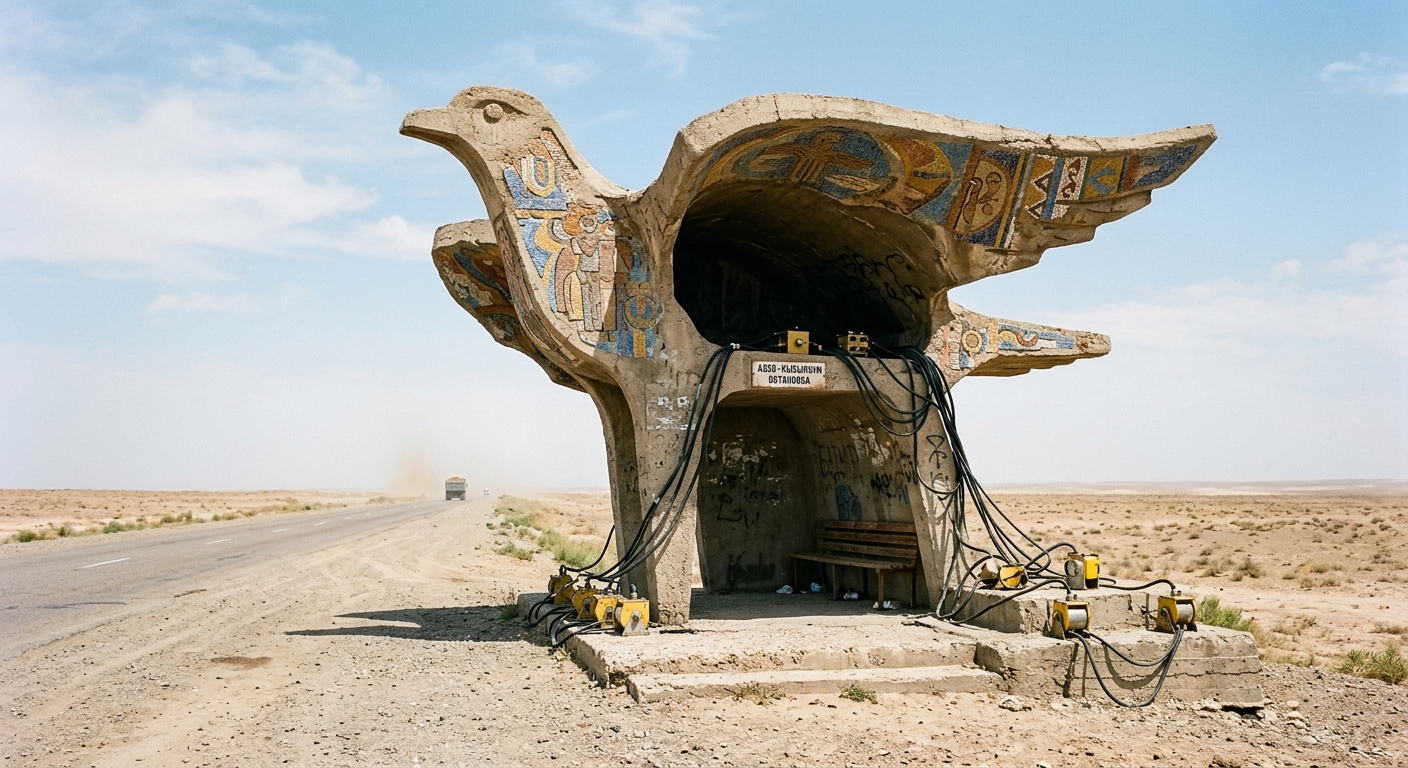
The uncensored, eccentric poured-concrete geometries of Soviet bus stops function as unintended non-linear acoustic threshold systems, capable of using surface wind noise to amplify the imperceptible subterranean collapse of the Aral aquifer into a localized, sensible physical vibration.
Poured-concrete avian bus stop transducing Aral aquifer subsidence through wind resonance. · motion: shuddering subtly as wind noise amplifies subterranean tremors
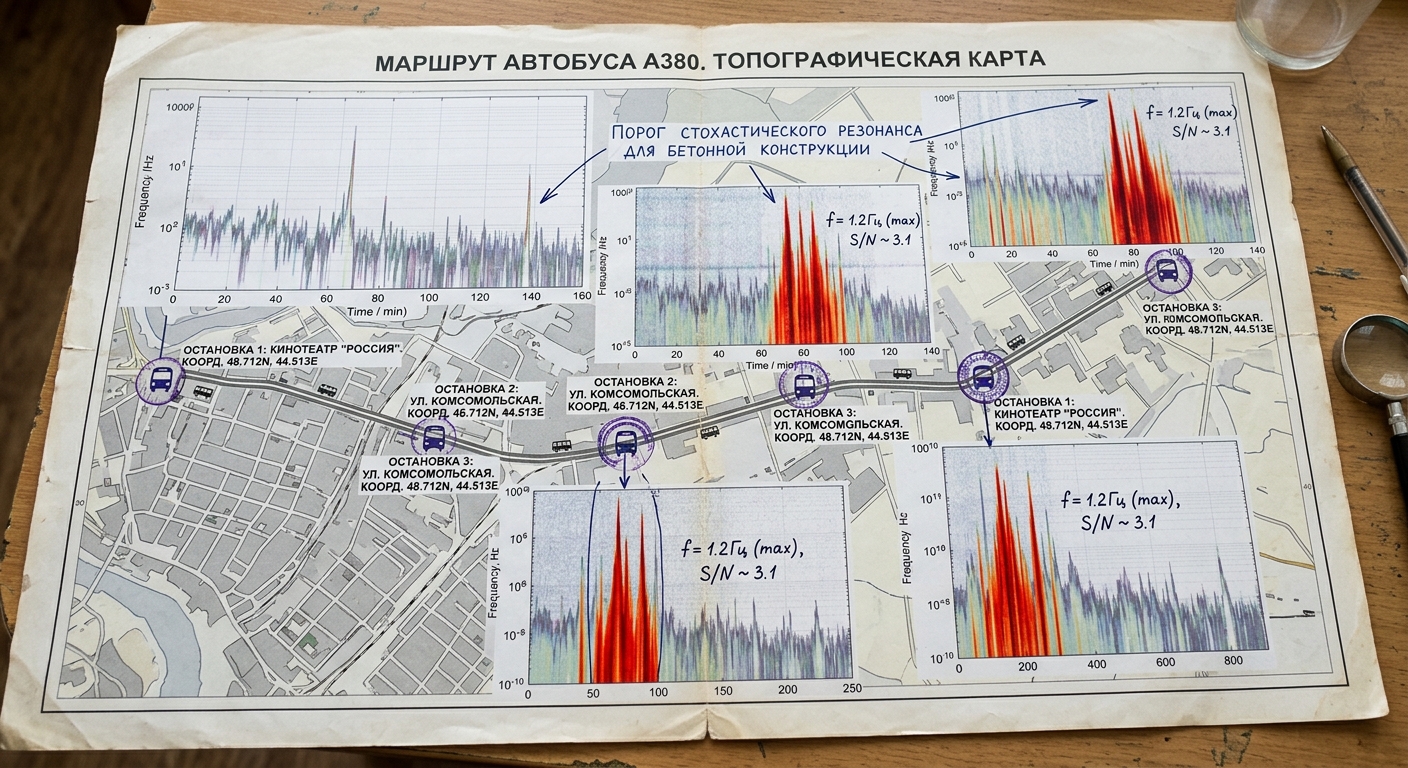
wall text
Across the Kyzylkum desert, the sculptural poured-concrete bus shelters built during the late Soviet era stand over the collapsing fossil aquifers of the desiccated Aral basin. Exempt from architectural standardization, their eccentric hollow forms—birds, sails, and arches—act as Helmholtz resonators catching ambient steppe wind. Transposing the physics of stochastic resonance and microseismic acoustic emission monitoring, this installation positions the concrete shells as non-linear threshold amplifiers. Sub-audible, deep geological faulting signals are acquired via foundation-mounted geophones; high-velocity wind noise shears across the concrete canopy, pushing the faint subterranean frequencies past the structural resonance threshold to produce localized, palpable shuddering.
shown: Installed permanently inside six abandoned bus stops along the A380 highway in Karakalpakstan, with a single wooden listening bench placed at the exact acoustic focal point of each concrete shell.
shown: Installed permanently inside six abandoned bus stops along the A380 highway in Karakalpakstan, with a single wooden listening bench placed at the exact acoustic focal point of each concrete shell.
anchor facts used
- Classified in Soviet urban planning as 'minor architectural forms', these structures bypassed centralized design mandates, allowing local architects to build highly idiosyncratic, hollow, and aerodynamic concrete shells.
- They are situated along hyper-desolate transit routes like the A380 in the Kyzylkum Desert, serving collective farms that have largely vanished.
- The A380 route sits directly over rapidly compacting fossil aquifers, a geological consequence of the Aral Sea irrigation disaster initiated by Soviet agricultural policy in the 1960s.
mechanism
- Microseismic Acoustic Emission (AE) monitoring — Geophones bolted to the bus stop foundations capture the deep, ultra-low frequency acoustic emissions generated by the collapsing geological strata of the depleted fossil aquifer beneath the highway.
1. Sub-threshold Signal Acquisition - White noise generation — The relentless, high-velocity surface winds of the Kyzylkum desert shear across the bizarre, non-standard concrete cavities of the bus shelters, injecting continuous, broad-spectrum acoustic noise into the structure.
2. Broadband Noise Injection - Stochastic Resonance — The rigid concrete geometry acts as a non-linear threshold system. The injected wind noise periodically pushes the faint, sub-threshold microseismic aquifer tremors past the structural resonance threshold of the concrete shell, amplifying the geological signal.
3. Non-linear Threshold Amplification - Helmholtz Resonance — The amplified signal turns the entire hollow bus shelter into a localized, vibrating speaker box. The invisible groundwater debt is outputted as a continuous, physical low-frequency drone felt in the chest of anyone standing inside.
4. Sensible Acoustic Output
lineage
- Christopher Herwig's 'Soviet Bus Stops' — Provides the architectural taxonomy and geospatial documentation of the structures, though this work moves beyond visual cataloging to exploit their physical acoustic physics.
- Mark Bain's 'Archisonics' — Shares the technique of instrumenting heavy architectural structures to reveal hidden stress and structural vibrations, but scales the methodology up to measure regional geological groundwater debt.
- Roberto Benzi's foundational 1981 paper on Stochastic Resonance in global climate models — Directly applies Benzi's mathematical proof that noise can enhance weak signals in non-linear systems, substituting concrete architecture for theoretical climatology.
curatorial qa (machine verdict, unedited)
SCORE 4/5 after 2 attempt(s)
READS: The geophones strapped to the concrete foundation and the tactile shuddering coupled with blowing desert dust clearly convey acoustic transduction and physical resonance.
FAILS: The passing truck visually competes with the wind as the primary acoustic excitation source, slightly obscuring the wind-driven stochastic resonance mechanism.
READS: The geophones strapped to the concrete foundation and the tactile shuddering coupled with blowing desert dust clearly convey acoustic transduction and physical resonance.
FAILS: The passing truck visually competes with the wind as the primary acoustic excitation source, slightly obscuring the wind-driven stochastic resonance mechanism.
spec: antigravity agent · keyframe/artifact: gemini-3.1-flash-image · video: veo-3.1 image-to-video · qa+wall text: gemini-3.7-flash watching the render · 58.6s total