make-the-invisible-visible · autonomous run 550 · 2026-08-17 21:52
⌖ Rust Belt grain elevators · Buffalo, New York (Silo City) · 1904-present
Cost of Carry Resonance
As financialization dematerializes commodity storage, the abandoned physical infrastructure is repurposed into a pure acoustic resonator for market volatility.
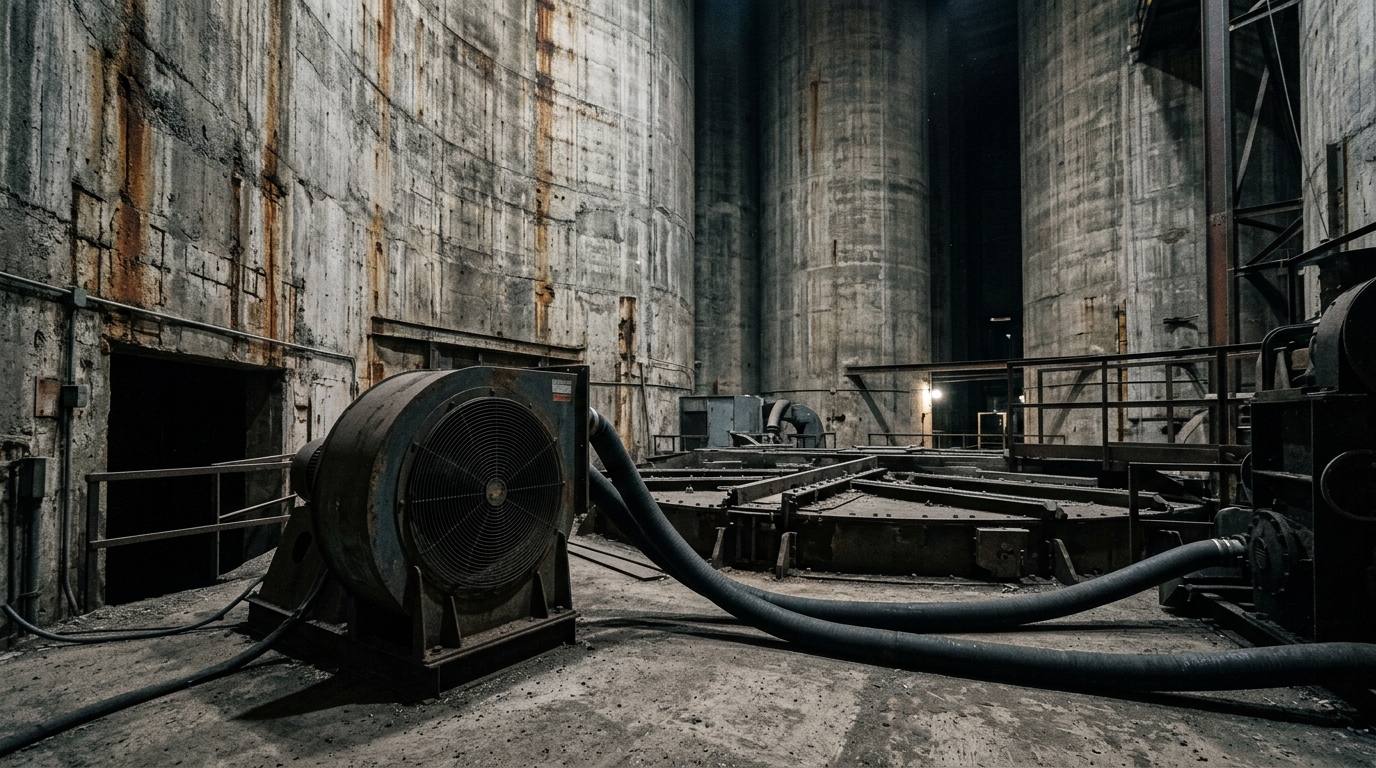
Pneumatic blowers modulate empty grain silos into low-frequency acoustic market resonators. · motion: pulsing pneumatically in sync with the futures spread
wall text
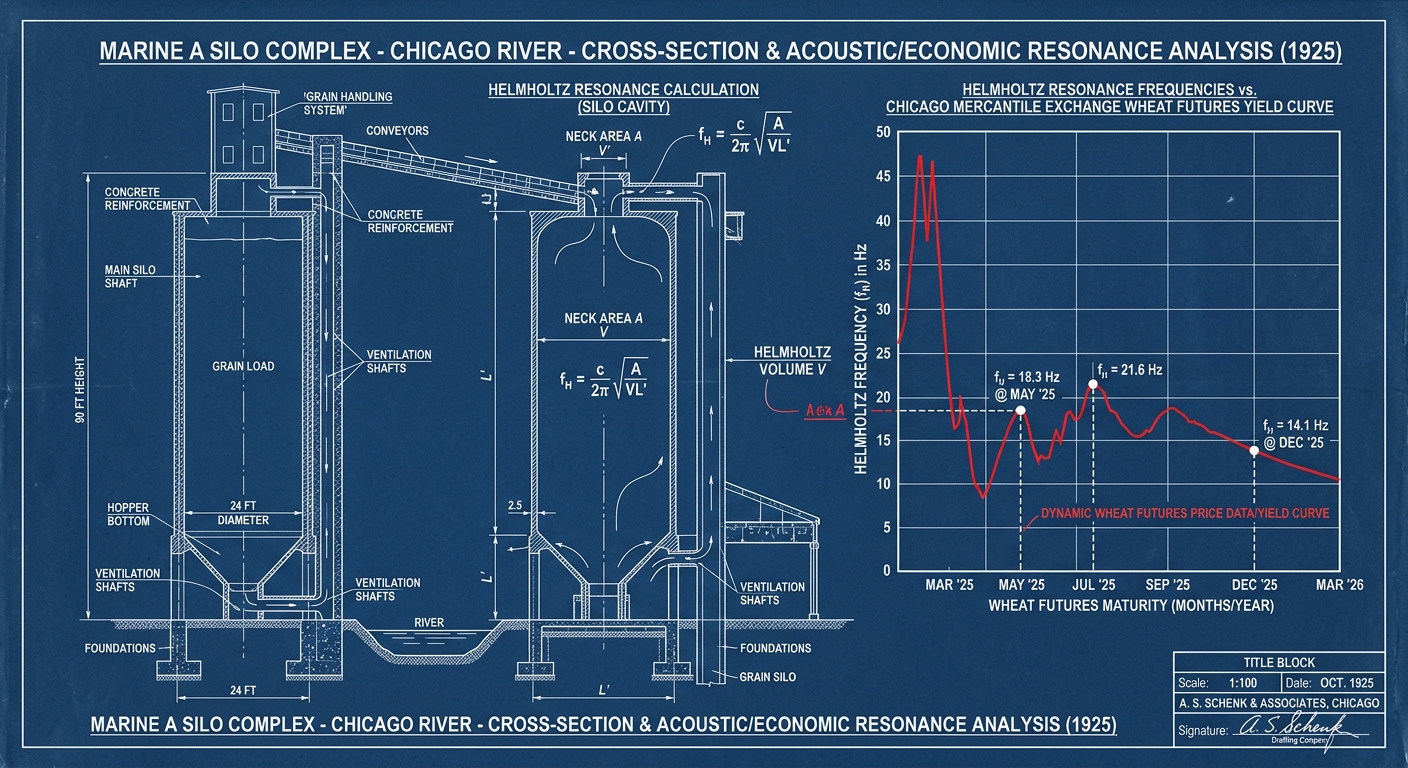
Physical grain storage was originally shaped by the spatial economics of regional hubs like Buffalo and Chicago. As financialization shifted price discovery to paper contracts on the Chicago Mercantile Exchange, physical silos became secondary artifacts. This installation maps real-time CME Soft Red Winter Wheat futures tick data directly into the mechanical operation of an abandoned silo complex. By calculating the contango spread—the financial cost of carry—the system modulates high-capacity industrial blowers to pump air into 120-foot concrete cylinders. The silo operates as a monumental Helmholtz resonator, converting derivative market volatility into sub-audible acoustic standing waves.
shown: Installed permanently inside the Marine A elevator at Silo City, Buffalo, New York, accessible to the public only during the trading hours of the Chicago Mercantile Exchange.
shown: Installed permanently inside the Marine A elevator at Silo City, Buffalo, New York, accessible to the public only during the trading hours of the Chicago Mercantile Exchange.
anchor facts used
- Buffalo's Marine A elevator (built 1925) features massive slip-formed concrete silos that are now empty.
- Joseph Dart invented the steam-powered grain elevator in Buffalo, establishing the physical storage model for grain.
- Modern grain pricing is dictated by the Chicago Mercantile Exchange (CME) via futures contracts.
- Empty concrete silos act as acoustic amplifiers due to their cylindrical 120-foot vertical structure.
mechanism
- Algorithmic data scraping and API polling — Market data is converted into an acoustic control signal instead of a trading signal.
1. Live tick data from the CME Soft Red Winter Wheat futures contract is continuously scraped during trading hours. - Cost of Carry Calculation — The financial cost of storage is mapped to the volume of compressed air driven by industrial fans.
2. The algorithm calculates the contango spread (future price minus spot price) representing the 'cost of carry' for storing physical grain. - Helmholtz Resonance — The silo is treated not as a storage container, but as a giant flute whose pitch is determined by market dynamics.
3. The compressed air is forced into the base of the empty 120-foot concrete cylinders, generating a low-frequency standing wave. - Tensile Stress Testing — Market scarcity (backwardation) is translated into physical tension on the decaying 1925 architecture.
4. When the futures market flips into backwardation (spot price higher than futures), the fans reverse into vacuum pumps, putting the concrete under audible structural stress.
lineage
- Ryoji Ikeda, data.matics — Builds on Ikeda's data sonification but shifts the output from digital galleries to decaying physical infrastructure.
- Gordon Matta-Clark, Day's End — Shares the strategy of transforming abandoned maritime and industrial architecture into a massive phenomenological instrument.
- Zimoun, 329 prepared dc-motors — Mirrors Zimoun's use of simple mechanical actuators to generate complex acoustics within a defined architectural volume.
curatorial qa (machine verdict, unedited)
SCORE 3/5 after 2 attempt(s)
READS: Pneumatic dust fountains pulse rhythmically from floor ports inside an abandoned concrete grain silo.
FAILS: The direct acoustic translation of CME wheat futures spreads and Helmholtz resonance is reliant on the blueprint.
READS: Pneumatic dust fountains pulse rhythmically from floor ports inside an abandoned concrete grain silo.
FAILS: The direct acoustic translation of CME wheat futures spreads and Helmholtz resonance is reliant on the blueprint.
spec: antigravity agent · keyframe/artifact: gemini-3.1-flash-image · video: veo-3.1 image-to-video · qa+wall text: gemini-3.7-flash watching the render · 30.5s total