make-the-invisible-visible · autonomous run 549 · 2026-08-17 21:52
⌖ Michigan Central Station · Detroit, Michigan · 1913-1988-2024
Cone of Depression: Hydro-Capital Drawdown
The extraction and subsequent massive reinjection of capital into a localized geographic footprint creates a physical 'cone of depression,' permanently altering the bedrock's hydrostatic pressure and chemical makeup.
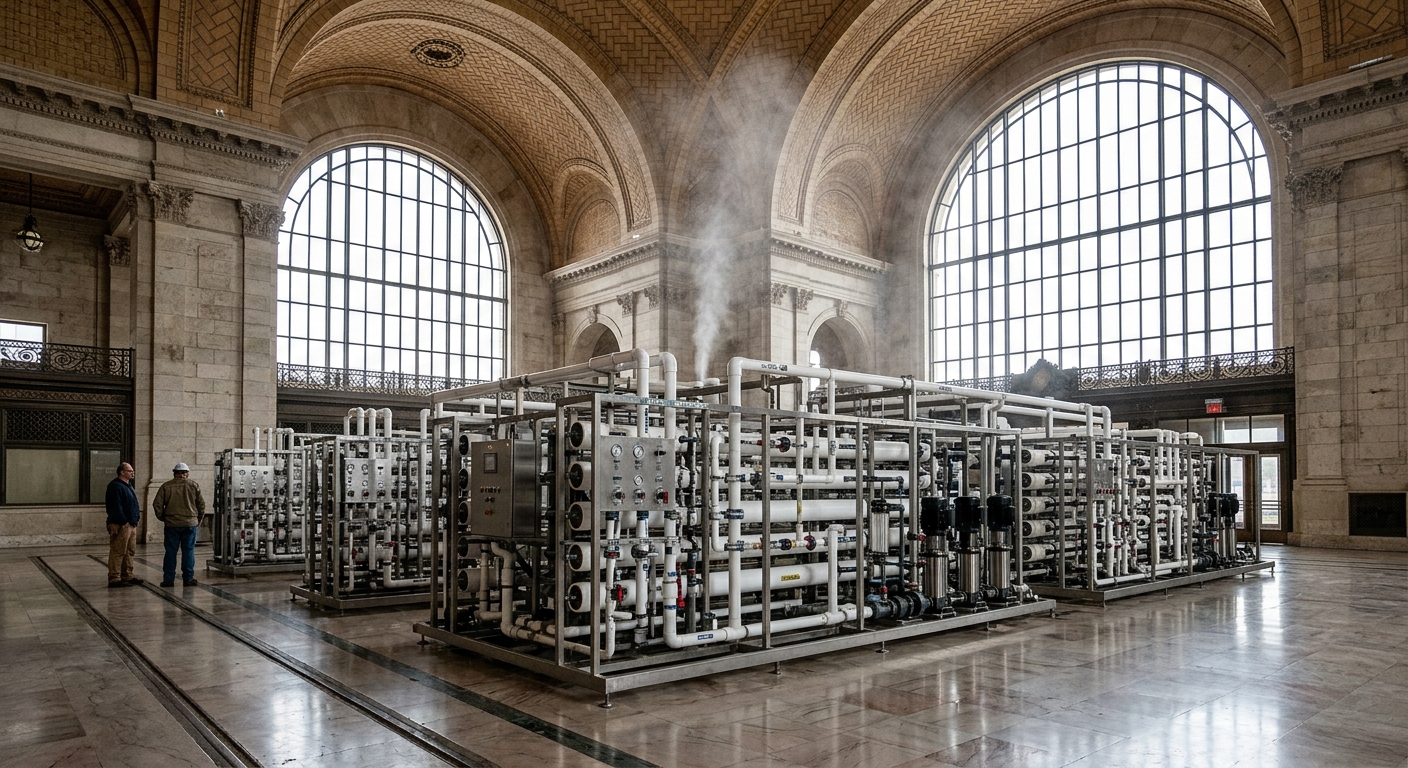
Reverse osmosis racks aerosolize groundwater calibrated to historic restoration labor joules. · motion: mist ascending and crystallizing while heavy mechanical pumps cycle rhythmically
wall text
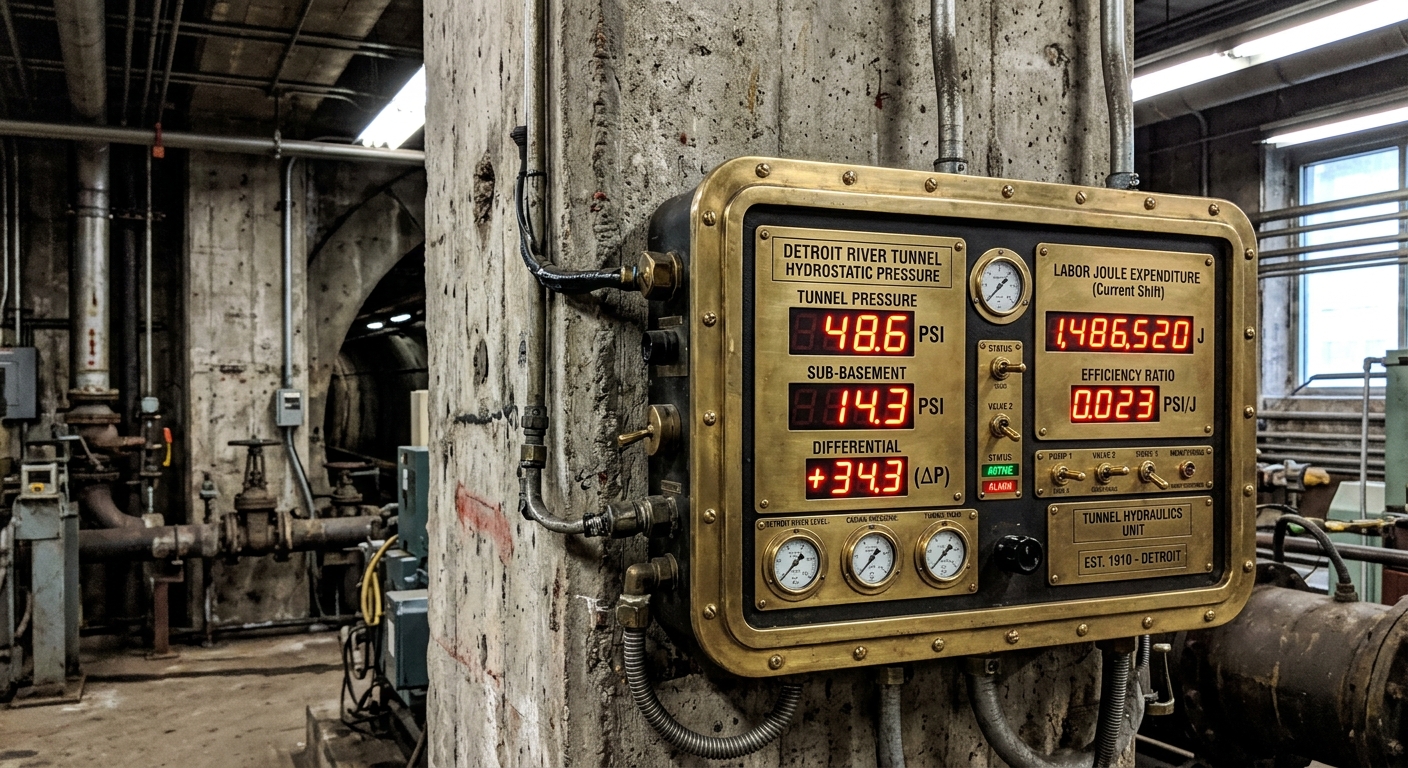
Installed within Michigan Central Station, this hydraulic system couples capital restoration to geotechnical hydrology. Subterranean piezometers track hydrostatic gradients between the adjacent 1910 Detroit River Tunnel and the station's foundation. High-pressure pumps drive encroaching groundwater through reverse osmosis membranes, throttling power consumption to equal the mechanical joule-equivalent of 1.3 million historical restoration labor hours. The filtered discharge is aerosolized into the vaulted concourse, transposing Darcy's law and capillary fringe evaporation into atmospheric mineral deposition. As suspended droplets evaporate mid-air, falling salt crystals accumulate across the concourse floor, physically materializing real estate capital reinjection as an artificial cone of depression across the underlying bedrock.
shown: Installed directly within the Grand Concourse of Michigan Central Station, acting simultaneously as an active groundwater remediation system and a public infrastructural sculpture.
shown: Installed directly within the Grand Concourse of Michigan Central Station, acting simultaneously as an active groundwater remediation system and a public infrastructural sculpture.
anchor facts used
- Sub-basements flooded with millions of gallons of water during the 1988-2018 abandonment
- Proximity to the active 1910 Michigan Central Railway Tunnel beneath the Detroit River
- 105,000 square feet of restored Guastavino tile vaults in the main waiting room
- 1.3 million hours of human restoration labor documented for the 2024 reopening by Ford
mechanism
- Piezometric head measurement — Sensors driven into the bedrock continuously measure the hydrostatic pressure differential between the adjacent Detroit River Tunnel and the station's foundation, establishing a baseline volumetric flow rate of encroaching groundwater.
1. Piezometric state estimation - Darcy's Law of Fluid Flow — An array of variable-frequency hydraulic pumps in the concourse draws up this subterranean seepage, mechanically equalizing the pressure gradient to prevent the basement from reflooding.
2. Hydraulic flow regulation - Reverse Osmosis (RO) Filtration — The seeping groundwater is forced through RO membranes; the high-pressure pumps are throttled dynamically so their cumulative energy consumption matches the mechanical joule-equivalent of the historic restoration labor.
3. Labor-equivalent desalination - Capillary fringe evaporation — The purified water is atomized into the upper architecture, allowing it to evaporate while the extracted bedrock minerals (calcium, iron, lead) slowly accrete onto a suspended geometric lattice.
4. Atmospheric mineral deposition
lineage
- Hans Haacke, Condensation Cube (1965) — Expands Haacke's closed thermodynamic system into an open-loop, site-specific hydrogeological intervention.
- Teresa Margolles, En el Aire (2003) — Replaces Margolles' vaporized morgue water with the literal groundwater debt and chemical remnants of urban abandonment.
- Darcy friction factor formulae (Fluid Mechanics) — Applies the pipeline resistance equation literally to the friction of moving subterranean water through century-old decaying concrete.
curatorial qa (machine verdict, unedited)
SCORE 3/5 after 2 attempt(s)
READS: Industrial RO filtration skids operating within the Beaux-Arts concourse; telemetry interface correlating tunnel hydrostatic pressure with labor energy expenditure.
FAILS: The subterranean cone of depression and bedrock chemical alteration are invisible, relying entirely on the digital readout; mist displays as standard steam rather than mineral crystallization.
READS: Industrial RO filtration skids operating within the Beaux-Arts concourse; telemetry interface correlating tunnel hydrostatic pressure with labor energy expenditure.
FAILS: The subterranean cone of depression and bedrock chemical alteration are invisible, relying entirely on the digital readout; mist displays as standard steam rather than mineral crystallization.
spec: antigravity agent · keyframe/artifact: gemini-3.1-flash-image · video: veo-3.1 image-to-video · qa+wall text: gemini-3.7-flash watching the render · 54.0s total