make-the-invisible-visible · autonomous run 548 · 2026-08-17 21:52
⌖ Sealand · HM Fort Roughs, North Sea · 1967-present
Electrochemical Sovereignty (Sacrificial Anode)
Statehood is not a legal status but a continuous, quantifiable electrochemical defense against thermodynamic decay.
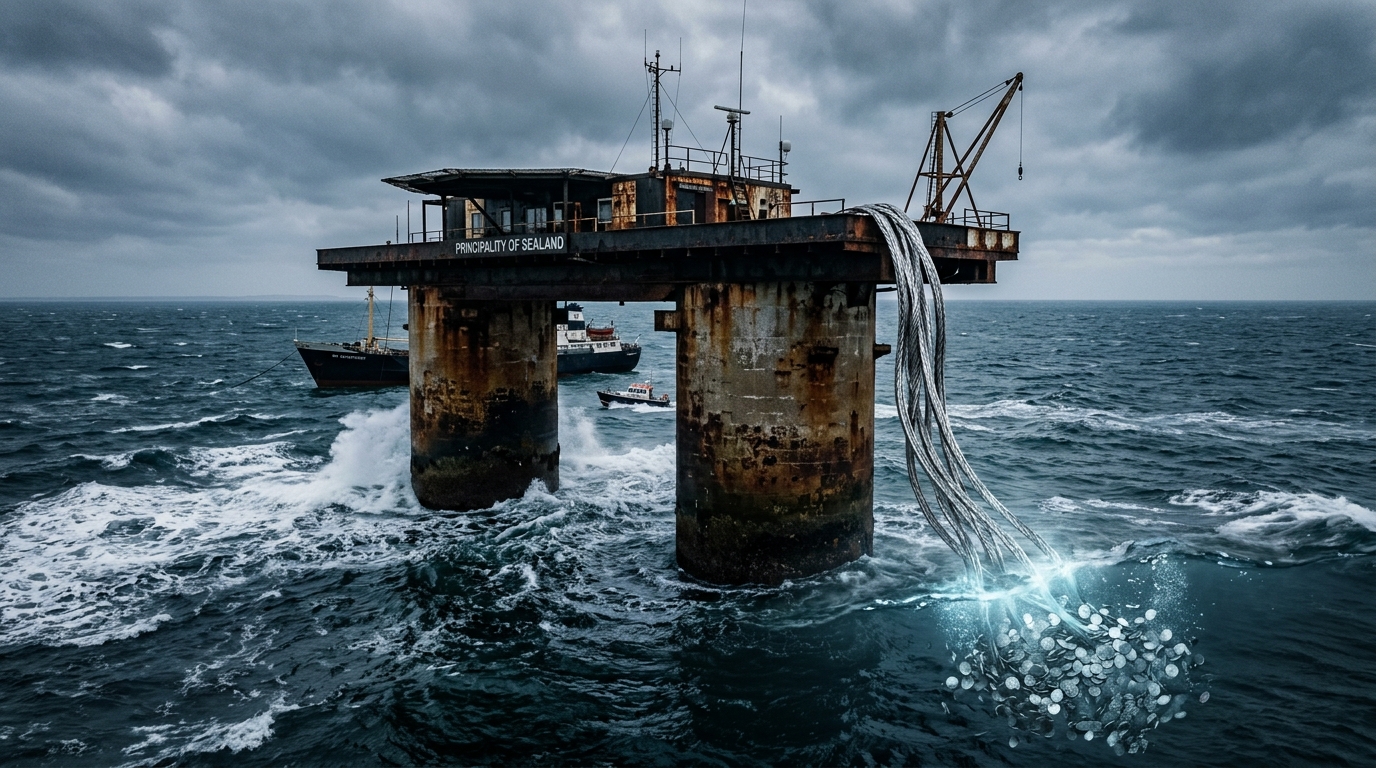
Sacrificing minted Sealand currency to cathodically arrest North Sea oxidation. · motion: Dissolving silver currency into the churning ocean to arrest structural rust
wall text
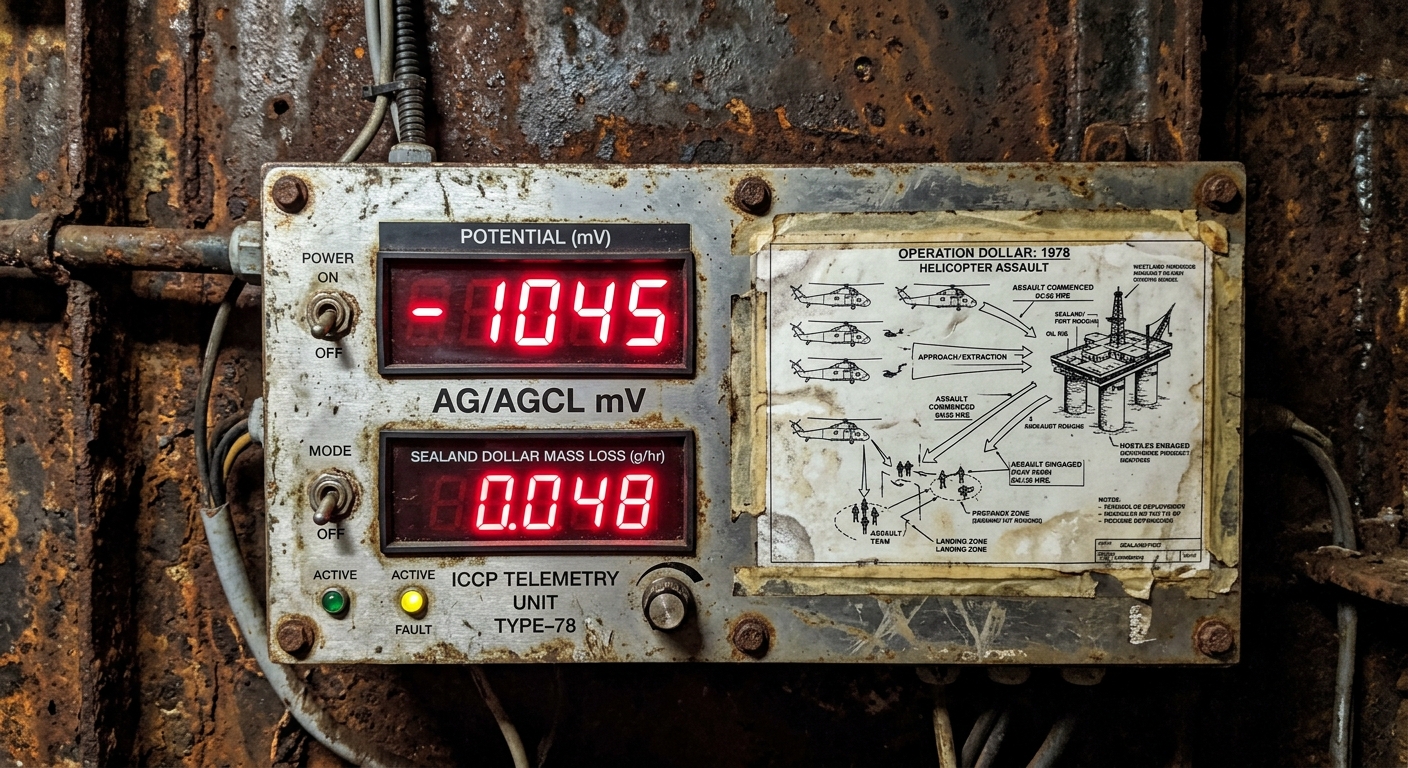
Sovereignty is commonly framed as diplomatic recognition, but for HM Fort Roughs—the WWII platform occupied by the Principality of Sealand—it is an energetic expenditure against marine corrosion. This installation transposes impressed current cathodic protection (ICCP) and sacrificial anode dissolution into sovereign monetary policy. Clusters of minted Sealand Dollars, lowered on titanium conduits into the North Sea, corrode electrochemically to supply protective electrons to the platform's oxidizing legs. Monitored via Silver/Silver-Chloride reference electrodes, Faraday's laws of electrolysis dictate the literal dissolution of the state's fiat reserves to halt thermodynamic decay, rendering territorial survival a quantifiable electrochemical baseline.
shown: Installed permanently on the lower service deck of Sealand itself, with a live telemetry feed displayed on a terminal at a coastal gallery in Felixstowe, Suffolk.
shown: Installed permanently on the lower service deck of Sealand itself, with a live telemetry feed displayed on a terminal at a coastal gallery in Felixstowe, Suffolk.
anchor facts used
- Constructed as a WWII Maunsell Sea Fort using steel and concrete in a highly corrosive marine environment
- Minted the 'Sealand Dollar' in silver and cupronickel starting in 1972
- Defeated a physical helicopter coup led by Alexander Achenbach in 1978
- Hosted HavenCo from 2000 to 2008, functioning as an unregulated offshore data haven
mechanism
- Impressed Current Cathodic Protection (ICCP) — Wind turbines on the fort's deck generate AC power, which is rectified into a continuous DC current fed directly into the steel superstructure.
1. Rectifier Conversion - Galvanic Anode Dissolution — Clusters of 1972 Sealand Dollars (silver and cupronickel) are welded to titanium ribbons and lowered into the sea, dissolving over time to supply electrons to the fort.
2. Galvanic Sacrifice - Reference Electrode Potential Monitoring — Silver/Silver-Chloride (Ag/AgCl) electrodes suspended from the former helicopter pad continuously measure the seawater voltage gradient to ensure the steel is protected.
3. Potential Measurement - Faraday's Law of Electrolysis — The calculated mass loss of the dissolving coins is encoded into a data stream and broadcast continuously via microwave link until the anodes are completely consumed.
4. Mass-Loss Hashing
lineage
- Teresa Margolles, '36 Cuerpos' (2006) — Extends her material translation of bodily decay into structural decay by using sovereign currency as the dissolving medium.
- Gordon Matta-Clark, 'Conical Intersect' (1975) — Reverses his architectural subtraction; here, the literal subtraction of the currency prevents the subtraction of the architecture.
- James Bridle, 'Under the Shadow of the Drone' (2012) — Shares the 1:1 physical rendering of invisible political realities, shifting focus from airborne surveillance networks to submarine electrochemistry.
curatorial qa (machine verdict, unedited)
SCORE 3/5 after 2 attempt(s)
READS: The telemetry unit strongly articulates the conversion of Sealand currency mass loss into cathodic protection potential. The physical tethering of coins into the North Sea establishes the conceptual circuit.
FAILS: The underwater coin cluster appears as a digital glow effect rather than active electrochemical dissolution; the kinetic mechanism arresting structural oxidation lacks physical visual feedback on the hull.
READS: The telemetry unit strongly articulates the conversion of Sealand currency mass loss into cathodic protection potential. The physical tethering of coins into the North Sea establishes the conceptual circuit.
FAILS: The underwater coin cluster appears as a digital glow effect rather than active electrochemical dissolution; the kinetic mechanism arresting structural oxidation lacks physical visual feedback on the hull.
spec: antigravity agent · keyframe/artifact: gemini-3.1-flash-image · video: veo-3.1 image-to-video · qa+wall text: gemini-3.7-flash watching the render · 53.3s total