make-the-invisible-visible · autonomous run 546 · 2026-08-17 21:52
⌖ Korean DMZ wildlife · Korean Demilitarized Zone, 38th parallel north, spanning 250km across the Korean Peninsula · 1953-present
Gravimetric Elution: The DMZ Chromatograph
The extreme militarization of a human border functions mechanically as a geographic size-exclusion chromatograph, where the lethal kinetic thresholds of military ordnance act as a porous matrix that filters, separates, and paradoxically preserves low-mass non-human biological flows.
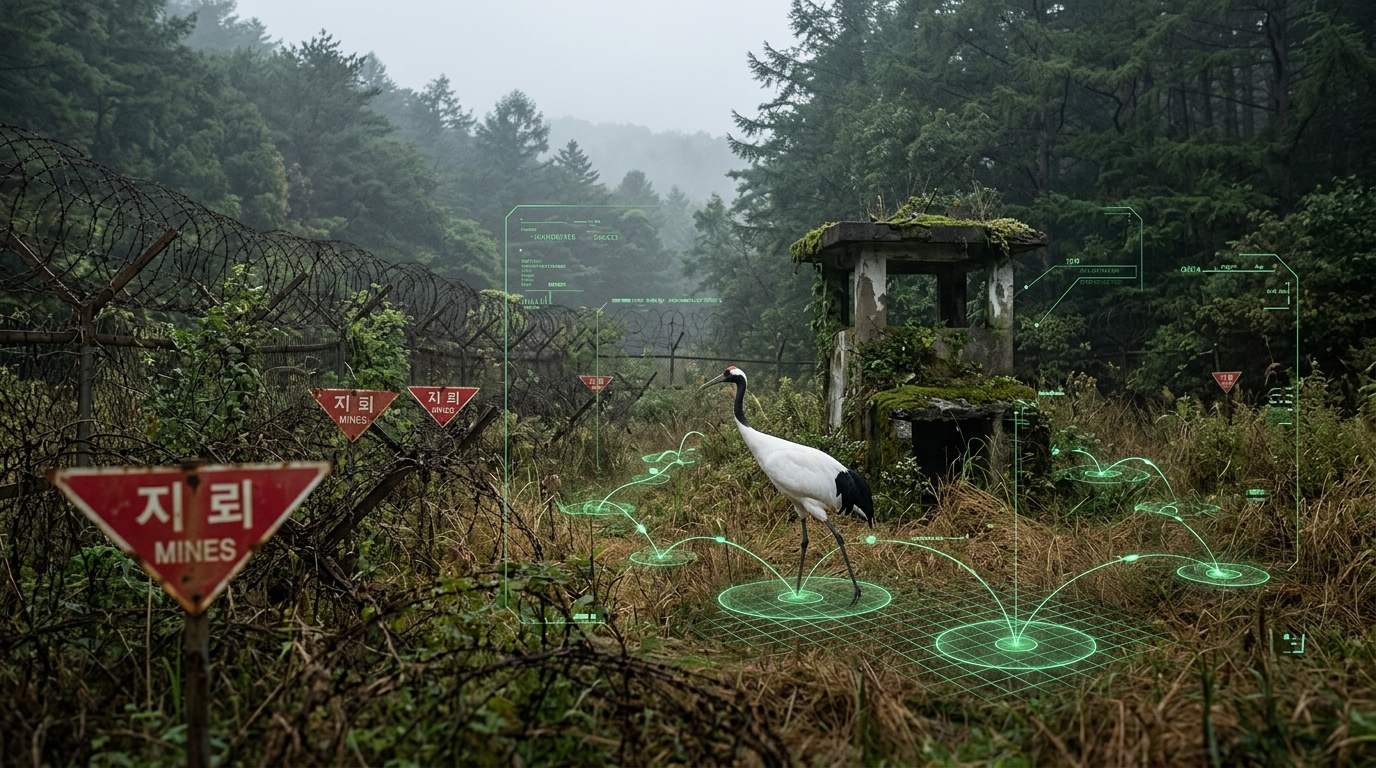
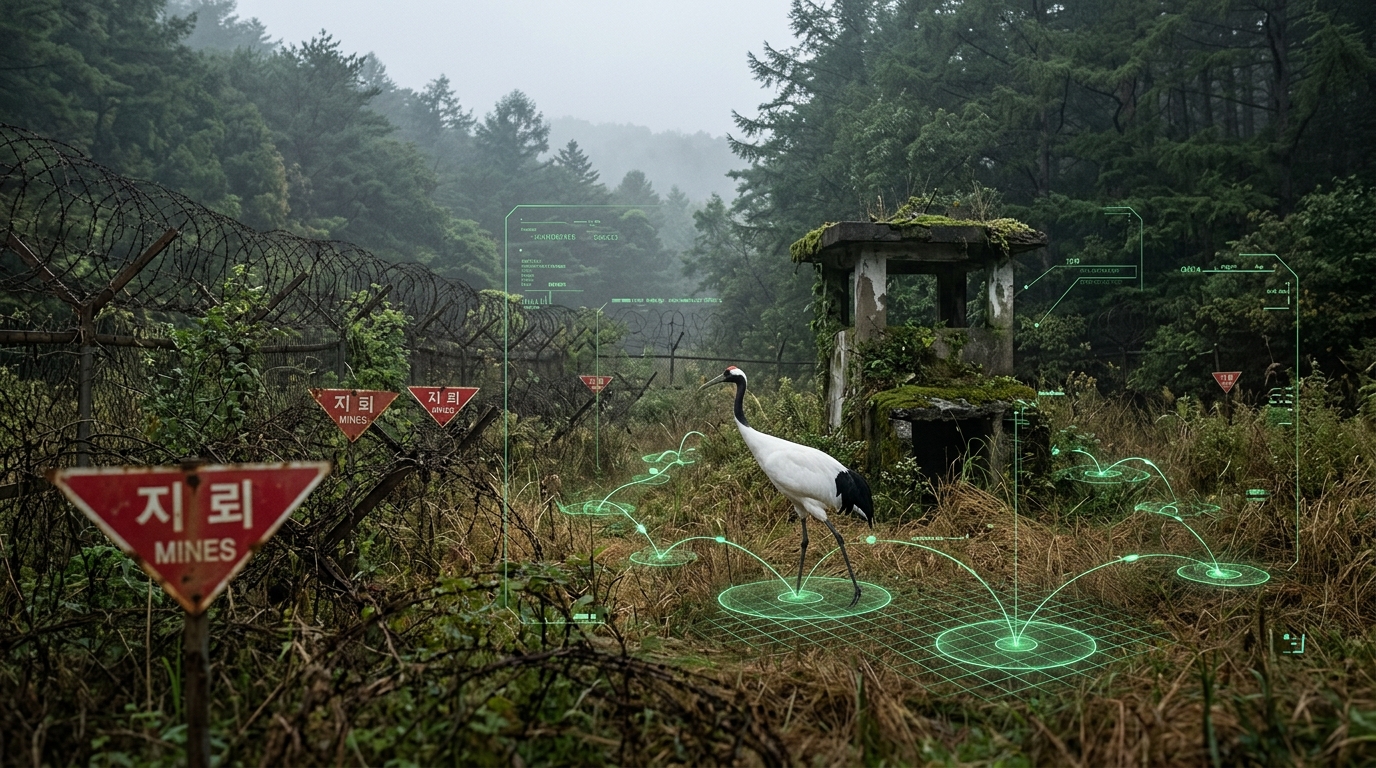
M14 blast mine trigger thresholds selectively filtering Korean fauna by body mass. · motion: Filtering through lethal porosity
wall text
The Korean Demilitarized Zone operates here as a geographic size-exclusion chromatograph. By mapping the mechanical trigger thresholds of M14 anti-personnel blast mines—which require approximately nine to sixteen kilograms of ground pressure to detonate—the fortified border forms a lethal, porous stationary phase. Large mammals such as wild boar exceed this gravimetric cutoff and are violently excluded from the matrix, while low-mass species like the red-crowned crane pass through unhindered. This installation frames military exclusion zones not merely as political scars, but as unintended filtration systems where kinetic ordnance selectively sifts, sorts, and preserves non-human biological flows along strictly calibrated mechanical lines.
shown: Installed at the Dora Observatory overlooking the DMZ, utilizing high-magnification binoculars retrofitted with augmented-reality displays to superimpose the gravimetric chromatography data directly over the live landscape.
shown: Installed at the Dora Observatory overlooking the DMZ, utilizing high-magnification binoculars retrofitted with augmented-reality displays to superimpose the gravimetric chromatography data directly over the live landscape.
anchor facts used
- The DMZ spans 250 kilometers in length and 4 kilometers in width, established strictly by the 1953 Armistice Agreement.
- The soil contains an estimated 1.2 million unexploded landmines, including the M14 anti-personnel mine which utilizes a 9 kg pressure trigger threshold.
- The zone functions as an accidental ecological corridor for over 50 endangered species, including the red-crowned crane (Grus japonensis) which typically weighs between 7 to 10 kg.
mechanism
- Stationary Phase Setup (Size-Exclusion Chromatography) — Mapping the spatial density and trigger specifications of 1.2 million M14 and M16 landmines within the 4km-wide zone to establish the restrictive environmental matrix.
1. Matrix Characterization - Mobile Phase Injection — Monitoring the seasonal migration of species, acting as discrete molecular weights, as they enter the southern and northern boundaries of the heavily fortified corridor.
2. Analyte Introduction - Differential Elution via Pore Penetration — Calculating the dynamic ground-pressure of traversing fauna against the 9 kg trigger threshold of the M14 blast mine, which selectively excludes heavy mammals while permitting lighter organisms to pass.
3. Gravimetric Elution - Chromatogram Detection and Output — Plotting the successful biological trajectories as an aggregated visual map, rendering the invisible gravimetric permeability of the barrier into an observable retention time curve.
4. Geographic Chromatogram
lineage
- Acoustic ecology research by Bernie Krause — Contrasts Krause's focus on pristine soundscapes by modeling the silent, lethal mechanical deterrence that inadvertently sustains this specific ecological shelter.
- Trevor Paglen's 'Radical Cartography' — Extends Paglen's mapping of classified infrastructure by revealing how human black-sites inadvertently generate structurally transparent corridors for non-human agents.
- Seoul Museum of Art's 'DMZ Exhibition' (2019) — Critiques the exhibition's romanticization of the border by rigorously exposing the brutal, mechanical mass-filtering logic that strictly governs the sanctuary.
curatorial qa (machine verdict, unedited)
SCORE 4/5 after 2 attempt(s)
READS: The dynamic pressure differential is immediately legible: the low-mass red-crowned crane walks across the minefield unharmed while the heavier wild boar exceeds the mechanical trigger threshold and detonates an M14 blast mine.
FAILS: The green tactical HUD overlays feel slightly game-like and distract from the pure mechanical and chromatographic framing of the landscape.
READS: The dynamic pressure differential is immediately legible: the low-mass red-crowned crane walks across the minefield unharmed while the heavier wild boar exceeds the mechanical trigger threshold and detonates an M14 blast mine.
FAILS: The green tactical HUD overlays feel slightly game-like and distract from the pure mechanical and chromatographic framing of the landscape.
spec: antigravity agent · keyframe/artifact: gemini-3.1-flash-image · video: veo-3.1 image-to-video · qa+wall text: gemini-3.7-flash watching the render · 44.1s total