make-the-invisible-visible · autonomous run 541 · 2026-08-17 21:51
⌖ Longwave transmitter closures · Droitwich Transmitting Station, Worcestershire, UK · 2010s-present
198 kHz Hysteresis
Infrastructure exhibits physical memory; when a ubiquitous synchronization signal is terminated, the dependent systems do not instantly reset but undergo a chaotic decay dictated by their material hysteresis.
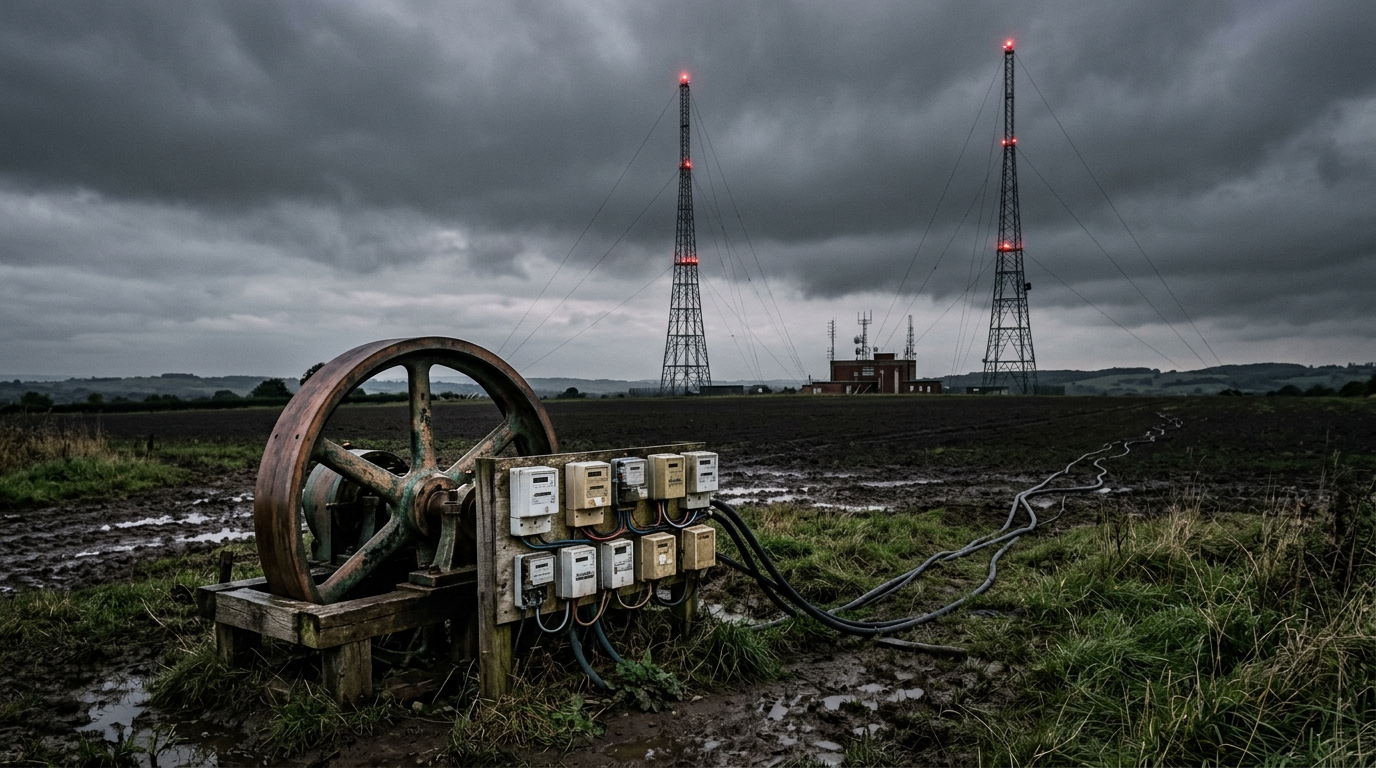
Eddy-current braking apparatus arresting a flywheel upon 198 kHz carrier wave failure. · motion: decelerating with increasing, chaotic friction
wall text
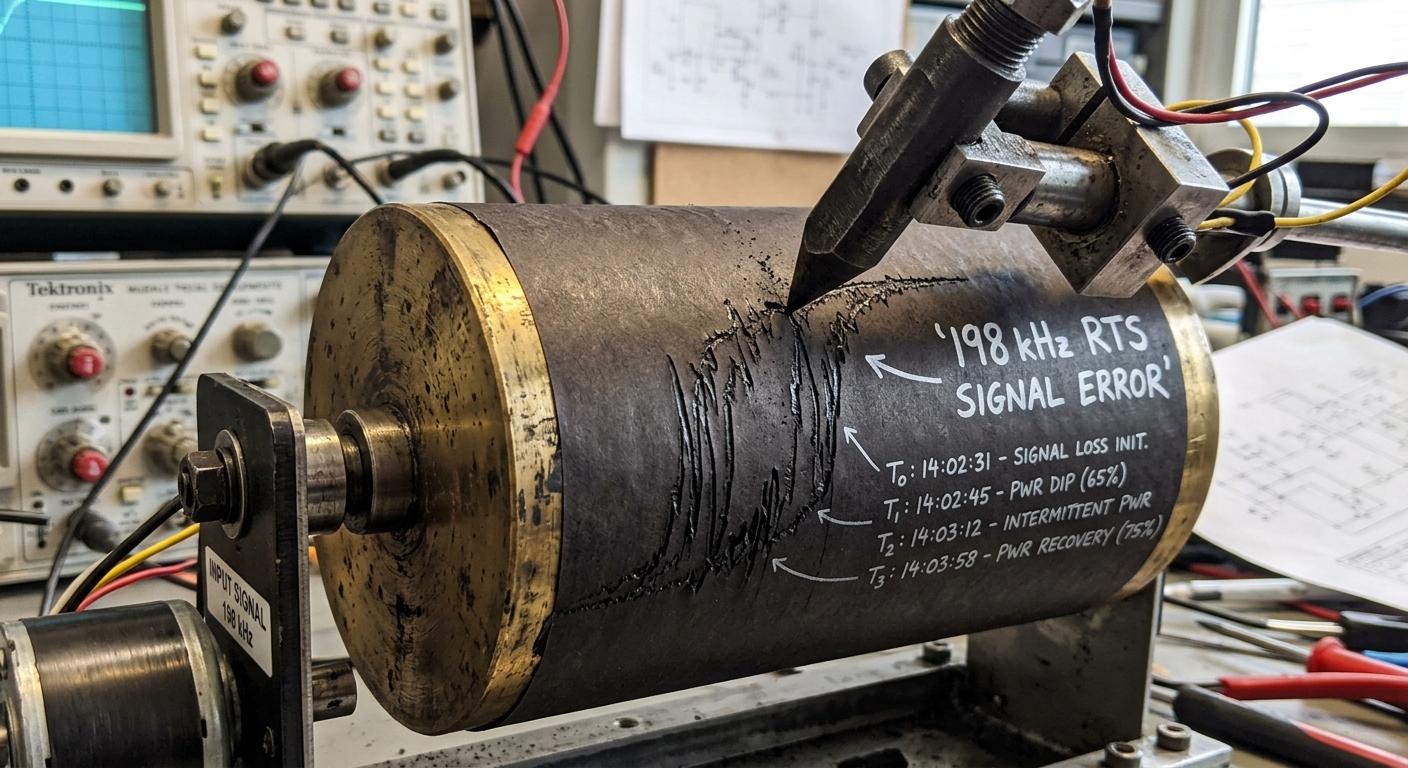
For decades, the BBC's 198 kHz longwave transmission from Droitwich embedded a 50-baud phase-modulated data stream controlling over 900,000 Radio Teleswitch (RTS) electricity meters across the UK. As the station's final glass valves fail, this piece couples the collapsing carrier wave to an analog electromagnetic braking apparatus. A perimeter antenna rectifies the residual radio signal, routing phase demodulation errors directly to neodymium actuators clamped against a spinning copper flywheel. The kinetic energy does not vanish immediately; instead, it dissipates through turbulent friction and mechanical shuddering. The accompanying stylus transcribes this decay directly onto carbon paper, mapping how legacy national infrastructure stutters through physical hysteresis when its master clock dies.
shown: Installed in a leased agricultural field directly beneath the Droitwich aerials, operating continuously until the BBC officially cuts the 198 kHz power, at which point the flywheels will seize permanently.
shown: Installed in a leased agricultural field directly beneath the Droitwich aerials, operating continuously until the BBC officially cuts the 198 kHz power, at which point the flywheels will seize permanently.
anchor facts used
- Droitwich 198 kHz broadcasts the Radio Teleswitch Service (RTS) data, controlling 900,000 legacy Economy 7 electricity meters in the UK.
- The transmitter relies on a pair of 700-foot masts and specialized glass valves that are no longer manufactured, forcing its eventual shutdown.
- The final shutdown of the 198 kHz RTS signal, delayed to 2025, will physically strand the shifting mechanisms inside hundreds of thousands of residential meters.
mechanism
- Antenna resonance and rectification — A mile-long ground-wire array at the Droitwich perimeter continuously harvests the diminishing 198 kHz carrier wave, converting its fading amplitude directly into a micro-voltage current.
1. Harvesting the residual carrier wave. - Phase-shift keying (PSK) demodulation — A modified teleswitch meter compares the harvested current against an internal quartz clock, calculating the 'error' of the missing 50-baud phase shifts that once signaled off-peak power.
2. Detecting the missing phase modulations. - Electromagnetic braking (Eddy current braking) — The phase-error data dynamically controls a series of neodymium magnets acting on heavy copper flywheels, converting the absence of the radio signal into physical kinetic resistance.
3. Translating signal loss into physical resistance. - Hysteresis loop plotting (B-H curve) — A mechanical stylus linked to the flywheels etches the delay between the absent signal and the slowing rotation onto a rotating drum of carbon paper, visualizing the grid's memory of the transmission.
4. Mapping the hysteresis curve.
lineage
- Katie Paterson, 'Earth-Moon-Earth (C.vanderhoven)' (2007) — Extends her use of radio-wave loss as a physical material, moving from lunar reflection to the decay of national infrastructure.
- Jean Tinguely, 'Homage to New York' (1960) — Shares the principle of a machine engineered specifically to document its own inevitable, catastrophic cessation.
- Ryoji Ikeda, 'data.tron' (2007-2014) — Inverts his hyper-digital perfection by materializing the physical breakdown of an analog data transmission protocol.
curatorial qa (machine verdict, unedited)
SCORE 2/5 after 2 attempt(s)
READS: The installation links the Droitwich 198 kHz masts to vintage teleswitch metering hardware and a drum plotter recording signal dropouts.
FAILS: The video degrades into an explosive VFX detachment rather than a measured, chaotic deceleration driven by eddy-current magnetic braking and physical hysteresis.
READS: The installation links the Droitwich 198 kHz masts to vintage teleswitch metering hardware and a drum plotter recording signal dropouts.
FAILS: The video degrades into an explosive VFX detachment rather than a measured, chaotic deceleration driven by eddy-current magnetic braking and physical hysteresis.
spec: antigravity agent · keyframe/artifact: gemini-3.1-flash-image · video: veo-3.1 image-to-video · qa+wall text: gemini-3.7-flash watching the render · 36.9s total