make-the-invisible-visible · autonomous run 539 · 2026-08-17 21:51
⌖ BBC Radiophonic Workshop archive · Maida Vale Studios, Delaware Road, London · 1958-1998
50Hz Stratigraphy: Maida Vale
The true archive of state broadcasting is not its cultural output, but the embedded forensic trace of national infrastructural consumption and physical labor time.
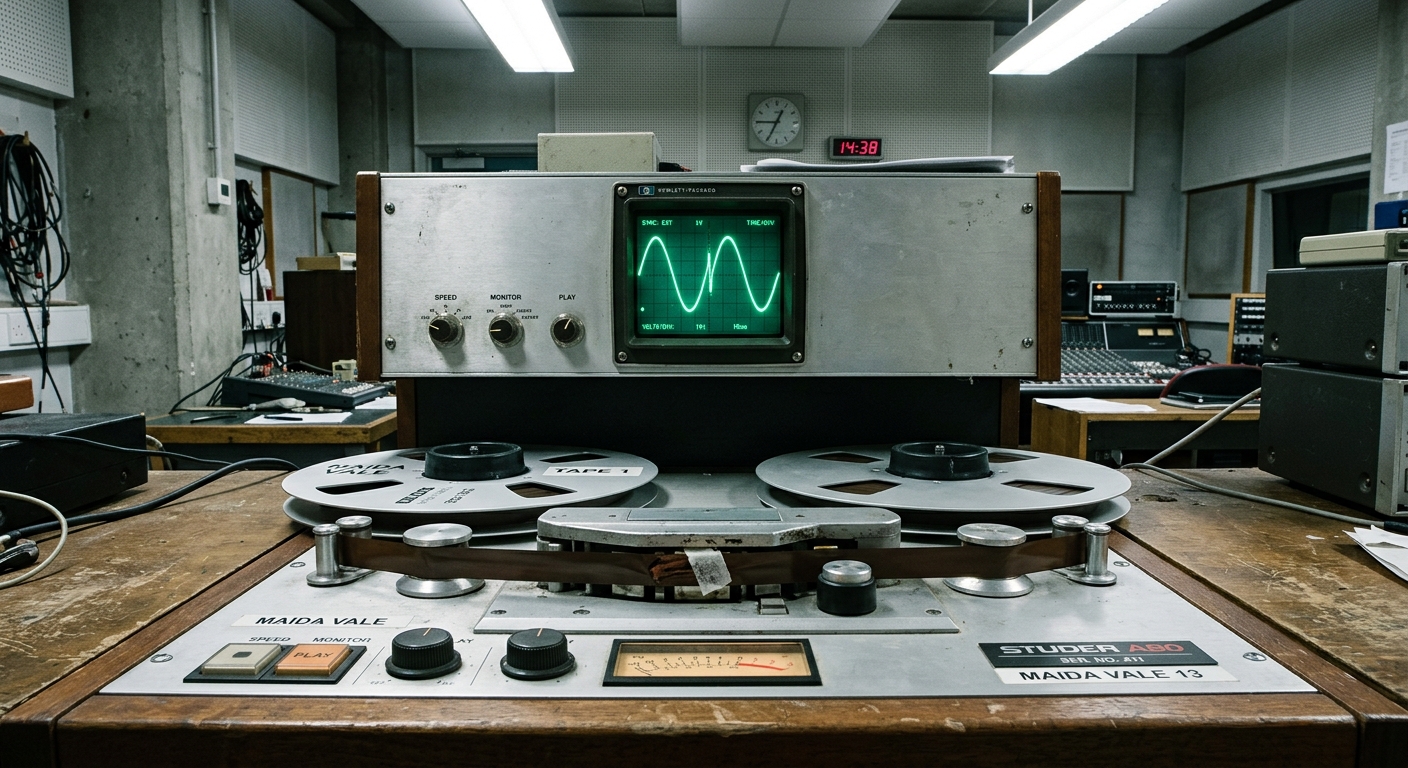
Oscilloscope registering 50Hz grid phase shifts at physical tape splices. · motion: discontinuously phase-shifting at every physical splice
wall text
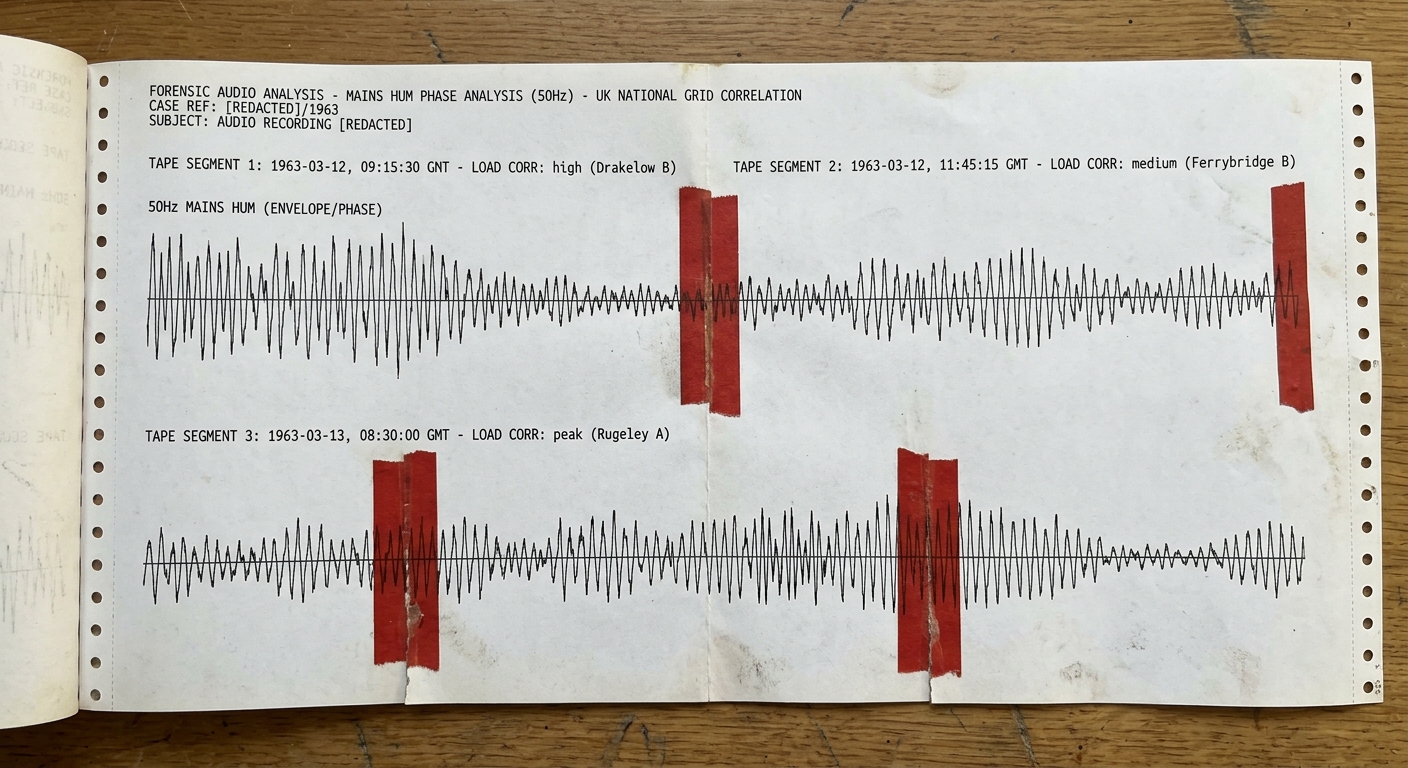
Between 1958 and 1998, BBC Radiophonic Workshop tape recordings inadvertently captured the 50Hz electromagnetic hum of the UK National Grid. This setup isolates that background interference via band-pass filtering, discarding musical content to extract Electric Network Frequency (ENF) forensic data. As quarter-inch tape passes the playback head, manual razor-blade splices register as discontinuous phase shifts on the oscilloscope. By cross-referencing these micro-fluctuations against historical grid load logs from stations like Drakelow B, the system maps the exact physical labor time and coal-fired power consumption embedded in the tape, reframing infrastructural drain as the true archive of state broadcasting.
shown: Installed as a multi-channel sound and data-projection environment within the disused corridors of Maida Vale Studios, London.
shown: Installed as a multi-channel sound and data-projection environment within the disused corridors of Maida Vale Studios, London.
anchor facts used
- The workshop was founded in 1958 at Maida Vale Studios and closed in 1998 when the BBC decided it was cheaper to outsource electronic music.
- Delia Derbyshire realized the 1963 Doctor Who theme by physically cutting and splicing quarter-inch magnetic tape for every individual note.
- The UK National Grid operates at 50Hz, generating an electromagnetic mains hum that was inadvertently printed onto vintage analog tapes.
mechanism
- Digital Band-pass filtering — Inverts the traditional archival hierarchy by treating the musical composition as noise and the background interference as the primary artifact.
1. The digitized quarter-inch tapes from Room 13 are processed to extract the baseline electrical hum, discarding all intended musical frequencies. - Electric Network Frequency (ENF) Phase Matching — Repurposed from criminal forensics to reconstruct the invisible energy consumption of 1960s London.
2. The isolated hum is analyzed for micro-fluctuations in phase and frequency to generate a continuous timeline of electrical load. - Timestamp cross-correlation and transient detection — Used to locate the exact microsecond of human labor—the physical cut of a razor blade—within a seemingly seamless audio track.
3. An algorithm detects sudden, discontinuous jumps in the ENF phase, marking a break in the temporal continuity of the power grid recording. - Resonant frequency excitation via mechanical actuation — Translates macro-scale national infrastructure fluctuations back into localized, micro-scale acoustic vibrations.
4. The extracted ENF data drives a network of physical transducers attached to archival objects, converting power grid fluctuations back into acoustic resonance.
lineage
- The UK National Grid ENF Database — The piece uses this forensic database not for criminal evidence, but for cultural archaeology of state-funded labor.
- Delia Derbyshire's 'Pot Au Feu' (1968) — Deconstructs the track's masterful physical splices as violent temporal anomalies in the state power grid rather than musical notes.
- Lawrence Abu Hamdan's 'The Recovered Manifesto' (2017) — Extends forensic listening techniques from human speech patterns to the unconscious emissions of state electricity infrastructure.
curatorial qa (machine verdict, unedited)
SCORE 4/5 after 1 attempt(s)
READS: Physical tape splices passing playback heads correlate clearly with discontinuous phase jumps on the oscilloscope, supported by the forensic ENF waveform printout.
FAILS: Oscilloscope scale and graticule readings are slightly decorative, requiring prior familiarity with ENF analysis to fully decode grid load mapping.
READS: Physical tape splices passing playback heads correlate clearly with discontinuous phase jumps on the oscilloscope, supported by the forensic ENF waveform printout.
FAILS: Oscilloscope scale and graticule readings are slightly decorative, requiring prior familiarity with ENF analysis to fully decode grid load mapping.
spec: antigravity agent · keyframe/artifact: gemini-3.1-flash-image · video: veo-3.1 image-to-video · qa+wall text: gemini-3.7-flash watching the render · 38.6s total