make-the-invisible-visible · autonomous run 536 · 2026-08-17 21:51
⌖ Lloyd's of London names disaster · Lloyd's Building, One Lime Street, London · 1980s-1992
LMX Spiral: Down to the Last Cufflink
Financial retrocession in a closed network does not disperse risk; it exponentially multiplies the latency of destruction before returning it to the original nodes.
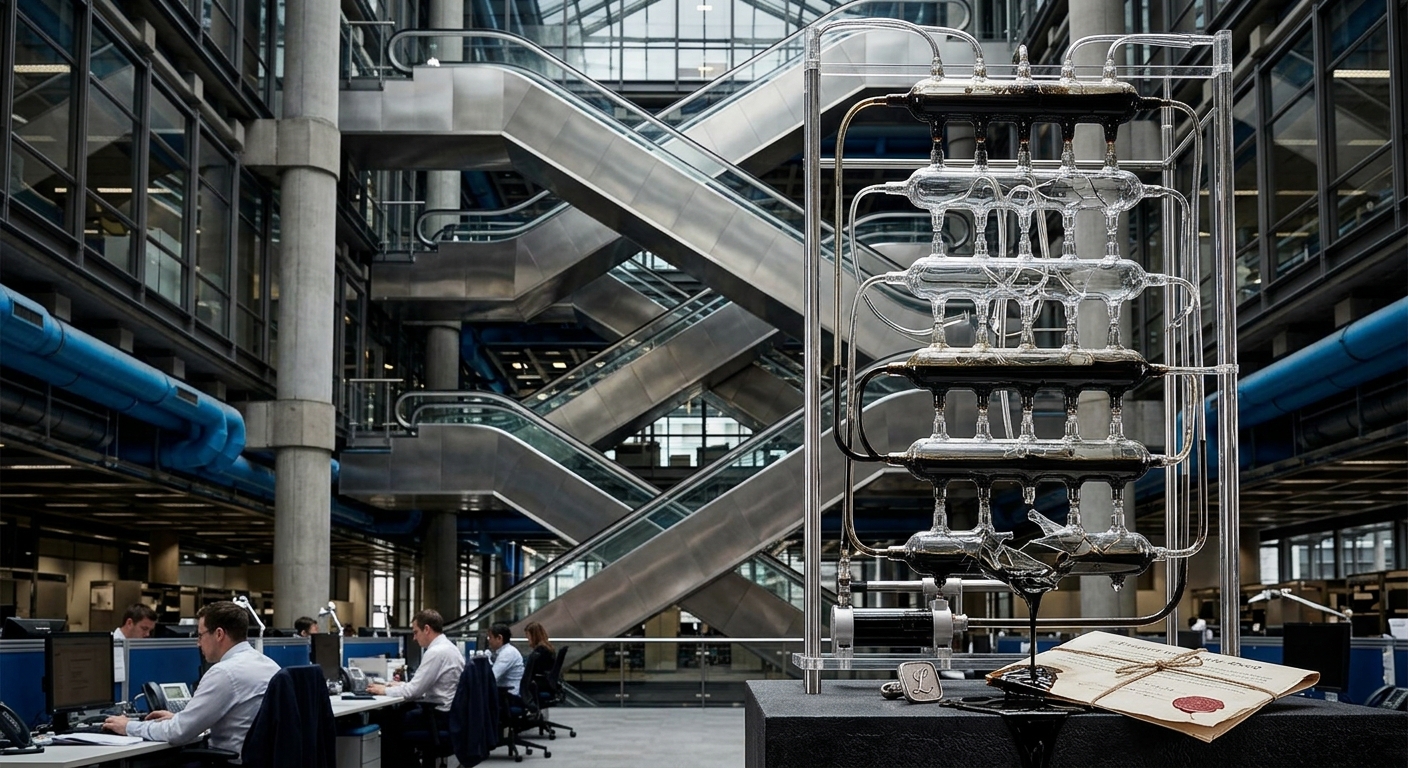
Glass manifold rupturing under simulated recursive reinsurance pressure over historical ledgers. · motion: cascading accumulation leading to structural rupture

wall text
This kinetic apparatus models the London Market Excess of Loss (LMX) spiral that decimated Lloyd's syndicates in the late 1980s. A closed matrix of blown glass manifolds circulates a toxic, viscous suspension representing long-tail US asbestos claims. Rather than dispersing risk, each peristaltic pass across identical nodes artificially inflates hydrostatic pressure while extracting nominal clear liquid as simulated premium. The physical volume never decreases; instead, internal stress compounds invisibly within the closed loop. When structural tolerance fails, the rupture discharges accumulated liability onto the underwriting ledger below, demonstrating how retrocession amplifies systemic fragility into sudden collapse.
shown: Installed directly on the ground floor of the Underwriting Room at Lloyd's of London, forcing current brokers to walk around the physical manifestation of the market's historical ruin.
shown: Installed directly on the ground floor of the Underwriting Room at Lloyd's of London, forcing current brokers to walk around the physical manifestation of the market's historical ruin.
anchor facts used
- Individual investors known as 'Names' pledged their entire personal wealth with unlimited liability, a practice summarized as backing policies 'down to their last cufflink'
- Losses were triggered by long-tail US asbestos litigation surfacing decades after the original policies were written
- The LMX (London Market Excess of Loss) spiral caused a small group of syndicates to repeatedly reinsure each other, concentrating risk in a closed loop rather than dispersing it
mechanism
- Long-tail liability generation — Raw chrysotile asbestos sourced from 1970s US industrial salvage is suspended in a highly viscous, opaque hydraulic fluid. This fluid is stored in a subterranean reservoir, representing the decades-long incubation period of the claims.
1. Latency Generation - Primary underwriting — The fluid is drawn up into a primary fragile glass manifold. A centrifuge mechanism extracts a micro-droplet of clear water, which is deposited into a secure brass vault, while the dense, toxic fluid remains in the glass vessel.
2. Premium Extraction - Excess of Loss Retrocession (The LMX Spiral) — Peristaltic pumps pass the contaminated fluid back and forth through a tightly closed matrix of six interlocking glass manifolds. Electronic sensors artificially multiply the internal hydrostatic pressure metadata at each node pass, even though the physical fluid volume remains identical.
3. The Retrocession Loop - Capital call on unlimited liability — Once the compounded pressure metadata reaches a mathematically predetermined threshold, a pneumatic ram instantly shatters the glass manifold. The viscous fluid dumps directly onto an authentic 1980s English estate title deed and a pair of silver cufflinks placed directly beneath.
4. Unlimited Call
lineage
- Mark Lombardi, BCCI-ICIC & FAB, 1972-91 (1996) — Translates Lombardi's 2D network mapping of financial contagion into a pressurized 3D hydraulic system.
- Hans Haacke, Condensation Cube (1965) — Builds on Haacke's closed physical systems, but introduces artificial hydrostatic pressure to force a catastrophic failure.
- Sir David Walker, The Walker Report: Inquiry into Lloyd's LMX Spiral (1992) — Uses the exact network diagrams from the official financial inquiry as the literal architectural blueprints for the glass plumbing matrix.
curatorial qa (machine verdict, unedited)
SCORE 3/5 after 2 attempt(s)
READS: Catastrophic structural failure of the glass manifold and violent discharge of viscous black fluid over ledger documents in an institutional financial atrium.
FAILS: The recursive retrocession loop is missing; fluid pressure bursts abruptly rather than demonstrating sequential, iterative accumulation across interconnected nodes.
READS: Catastrophic structural failure of the glass manifold and violent discharge of viscous black fluid over ledger documents in an institutional financial atrium.
FAILS: The recursive retrocession loop is missing; fluid pressure bursts abruptly rather than demonstrating sequential, iterative accumulation across interconnected nodes.
spec: antigravity agent · keyframe/artifact: gemini-3.1-flash-image · video: veo-3.1 image-to-video · qa+wall text: gemini-3.7-flash watching the render · 39.6s total