make-the-invisible-visible · autonomous run 529 · 2026-08-17 21:51
⌖ Whaling station ruins, Grytviken · South Georgia Island, South Atlantic · 1904-1964
Sinking Fund: Grytviken
The extraction of Southern Ocean biomass was not a finalized historical event but an unserviced, compounding thermodynamic debt that continues to accrue negative interest in the global carbon cycle.
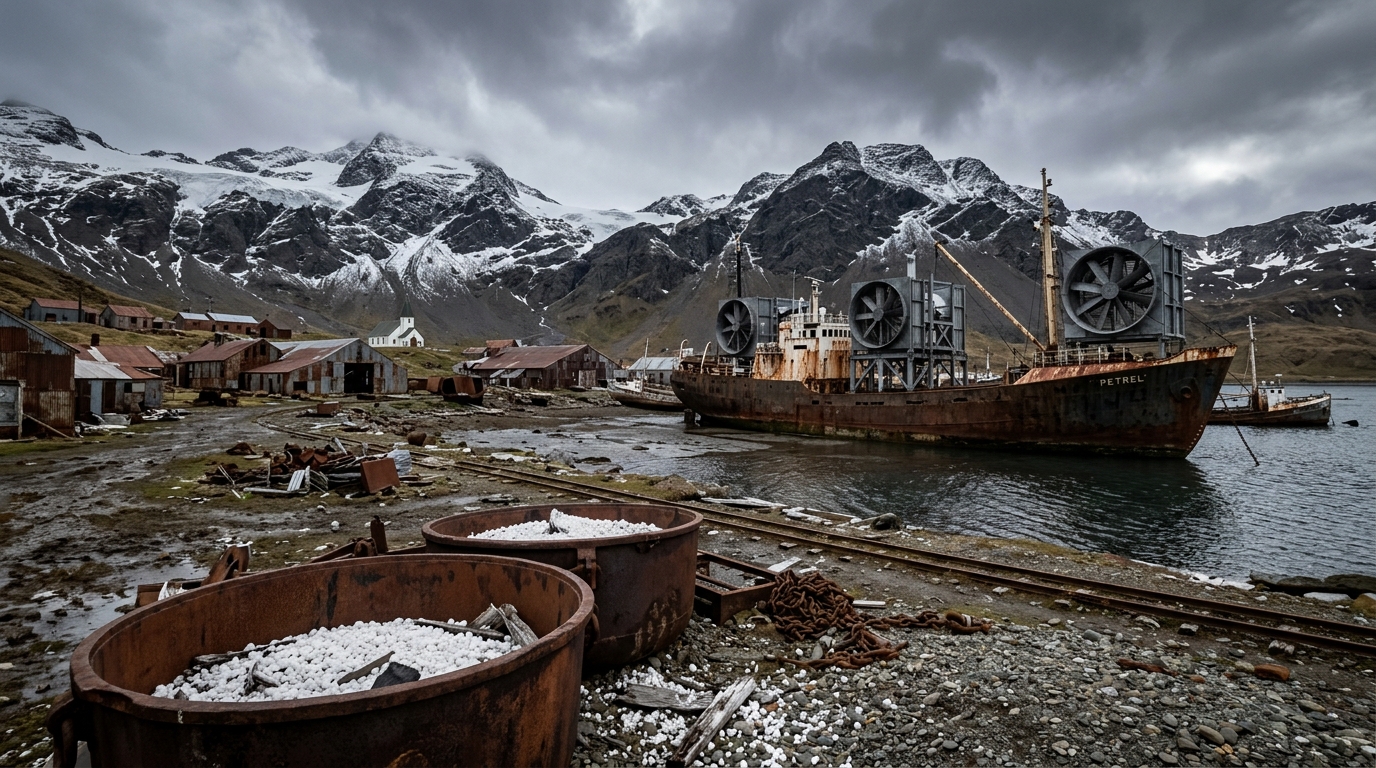
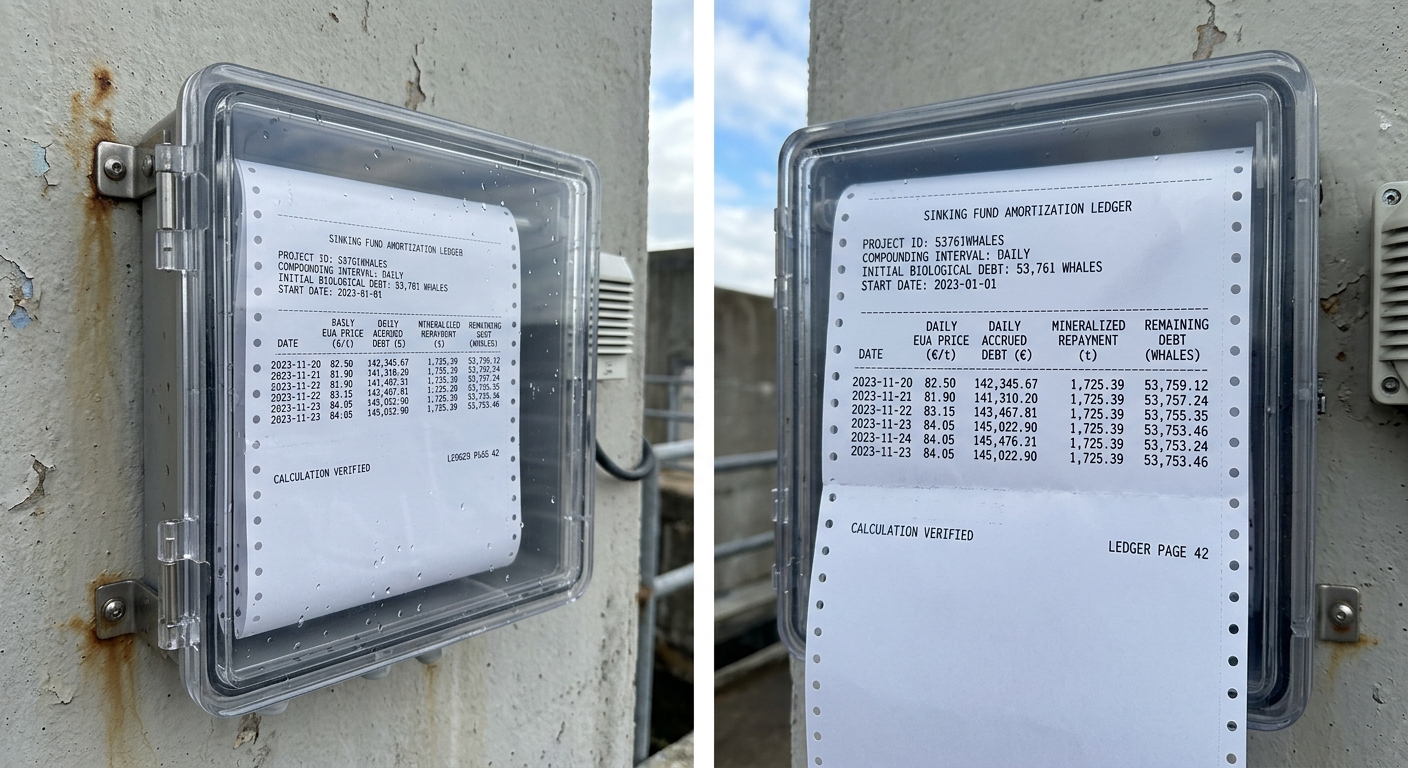
Direct air capture rig amortizing historical whale biomass debt in South Georgia. · motion: accumulating with the relentless, micro-fractional precision of compounding interest
wall text
At Grytviken, the extraction of 53,761 whales between 1904 and 1964 is framed as an unpaid carbon debt compounding over a century. Retrofitting the beached whale catcher Petrel with direct air capture fans and chemical contactors, the installation calculates the lost biological sequestration capacity against live European Union Allowance (EUA) carbon prices. Using standard loan amortization models, the system computes a daily carbon repayment quota, physically extruding proportional quantities of mineralized carbonate pellets into historical blubber vats. The work repurposes corporate net present value formulas and direct air capture infrastructure, treating industrial ecological extraction as a quantifiable, ongoing thermodynamic liability.
shown: Installed permanently amidst the ruins at Grytviken, operating autonomously via solar and katabatic wind micro-turbines until the biological debt is fully amortized.
shown: Installed permanently amidst the ruins at Grytviken, operating autonomously via solar and katabatic wind micro-turbines until the biological debt is fully amortized.
anchor facts used
- Founded in 1904 by Norwegian Carl Anton Larsen and closed in 1964.
- Station records document the exact extraction and processing of 53,761 whales.
- The site contains massive rusting pressure boilers (try-pots) used to render blubber, and the stranded whaling vessel 'Petrel'.
- Whale oil was a highly commodified global resource, physically transferring Southern Ocean biomass into European industrial capital (margarine, glycerol).
mechanism
- Net Present Value (NPV) Calculation — Transposed from corporate valuation to calculate the current financialized value of permanently removed ecological sequestration potential.
1. A weather-hardened computational array accesses live European Union Allowance (EUA) carbon market prices and pairs them with the station's historical catch log of 53,761 whales to calculate the lost biomass carbon-sink capacity. - Mortgage Amortization Schedule — Recontextualized from real estate debt servicing to intergenerational ecological debt repayment.
2. The system executes a daily repayment rate to service this accumulated carbon debt (capital extraction + 120 years of compounding thermodynamic interest) across a fixed 30-year window. - Amine-based Direct Air Capture (DAC) — Shifts DAC from speculative techno-solutionism into a localized, site-specific mechanism for historic debt repayment.
3. For each fractional ton of daily CO2 debt amortized, a proportional volume of atmospheric carbon is locally sequestered via fans drawing freezing air over potassium hydroxide contactors. - Ex-situ Carbon Mineralization — Reverses the flow of the boilers: instead of rendering biological matter into atmospheric emissions and capital, they act as silos for atmospheric emissions rendered back into stone.
4. The captured CO2 is reacted with local basaltic dust to form calcium carbonate pellets, which are pneumatically deposited into the station's original cast-iron blubber boilers.
lineage
- Tega Brain and Sam Lavigne, 'Offset' — Shares the tactic of weaponizing carbon market logic, but applies it backward to localized, historical thermodynamic debt rather than future offsets.
- Paolo Cirio, 'Loophole for All' — Adopts Cirio's rigorous application of financial structures, shifting the target from offshore tax evasion to the accounting of biological carbon sinks.
- HeHe, 'Nuage Vert' — Expands on HeHe's visualization of emissions by physically re-materializing the invisible carbon economy back into historical extraction infrastructure.
curatorial qa (machine verdict, unedited)
SCORE 4/5 after 1 attempt(s)
READS: The direct air capture array mounted on the rusting whaling ship, the continuous deposition of mineralized carbonate pellets into rendering vats, and the dot-matrix ledger translating historical biomass removal into live carbon debt.
FAILS: The direct real-time data link between the printed financial ledger and the mechanical output rate of the pellet dispensers remains conceptual rather than visibly automated.
READS: The direct air capture array mounted on the rusting whaling ship, the continuous deposition of mineralized carbonate pellets into rendering vats, and the dot-matrix ledger translating historical biomass removal into live carbon debt.
FAILS: The direct real-time data link between the printed financial ledger and the mechanical output rate of the pellet dispensers remains conceptual rather than visibly automated.
spec: antigravity agent · keyframe/artifact: gemini-3.1-flash-image · video: veo-3.1 image-to-video · qa+wall text: gemini-3.7-flash watching the render · 51.6s total