make-the-invisible-visible · autonomous run 526 · 2026-08-17 21:51
⌖ Gallagher's brickworks automation · Gallagher Group Masonry Yard, Aylesford, Kent · 2015-present
Derivative Strain: The PID Hand-Molder
The extreme dimensional standardization demanded by automated masonry systems mathematically reclassifies the human gesture of craftsmanship into a calculable, punishable error term.
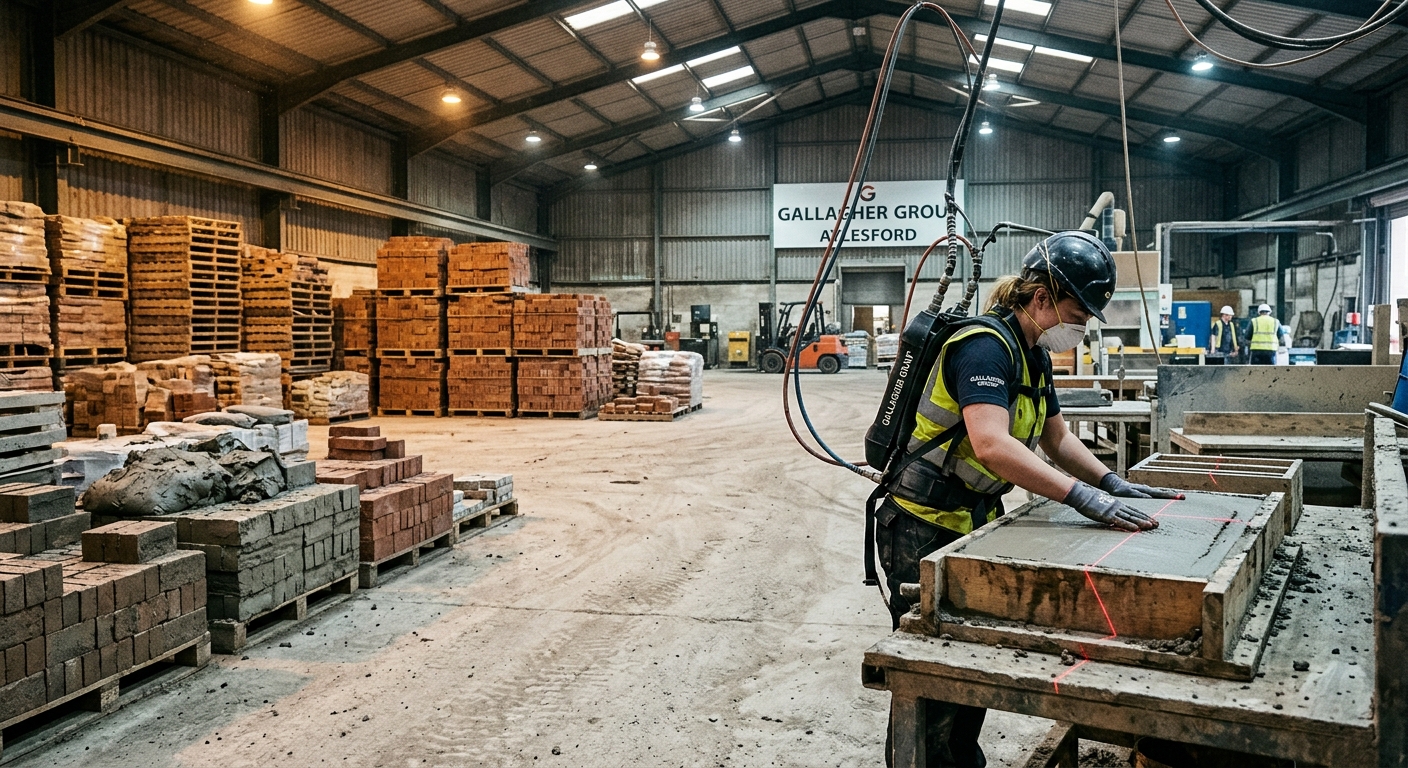
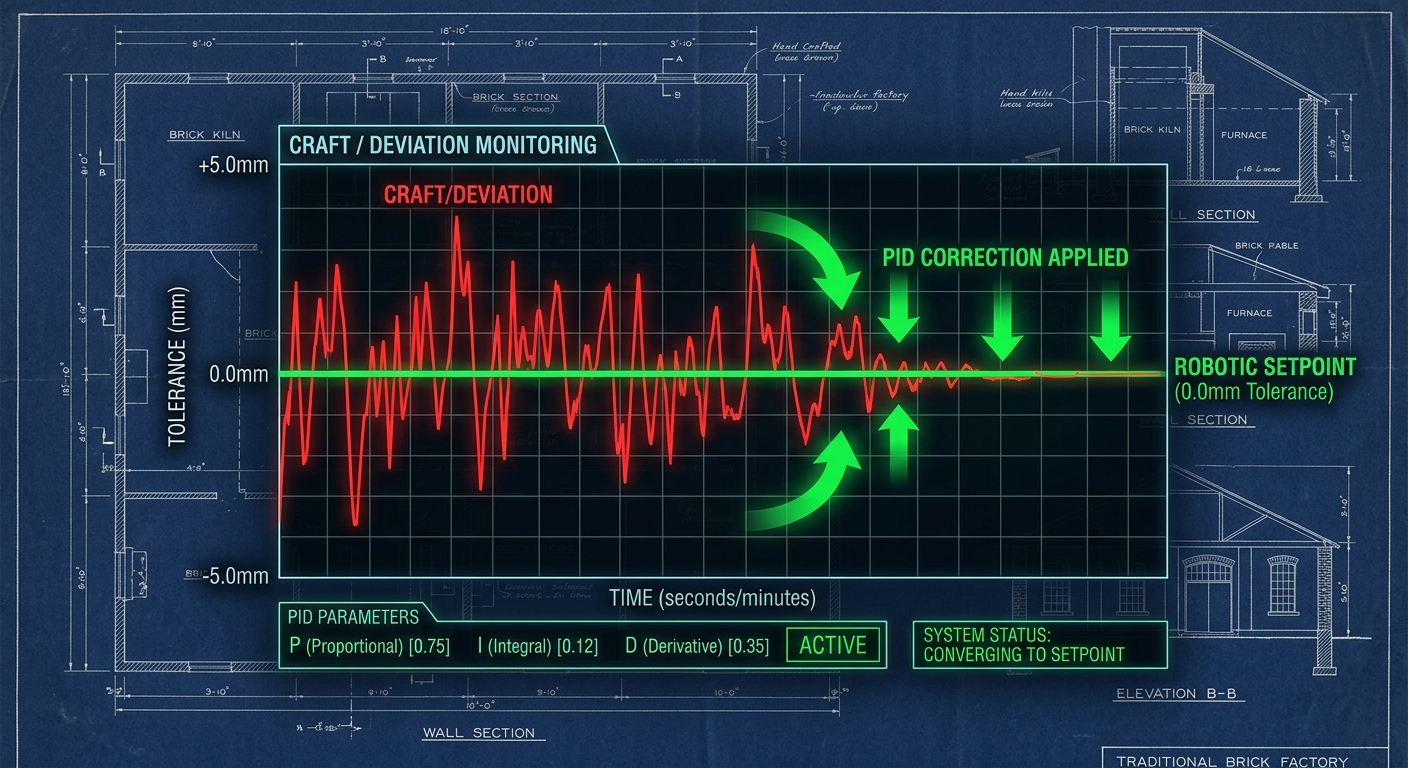
A PID control loop mechanically damping manual variation in wet clay. · motion: stuttering pneumatic correction
wall text
Robotic bricklayers like the SAM100 demand millimeter-perfect units to prevent end-effector jams, clashing with the 2–5% natural volumetric variance of hand-pressed clay. This installation transposes standard PID (proportional-integral-derivative) industrial control loops directly onto the artisan's body. Overhead laser scanning reads real-time dimensional deviation, while a wearable pneumatic exoskeleton computes gesture velocity to apply resistive braking against organic hand movements. Rather than assisting labor, the apparatus uses error-damping algorithms to mechanically suppress human nuance, transmuting centuries of tactile intuition into noise that must be filtered out before kiln firing.
shown: Installed as a grueling, 8-hour durational performance within the Hermitage Quarry masonry shed in Kent, operating alongside the mechanized commercial production line.
shown: Installed as a grueling, 8-hour durational performance within the Hermitage Quarry masonry shed in Kent, operating alongside the mechanized commercial production line.
anchor facts used
- The SAM100 (Semi-Automated Mason) robot lays up to 3,000 bricks per day, compared to a human hand-molder's 500.
- Laser-guided robotic end-effectors require uniform bricks with dimensional tolerances of less than 1mm to function without jamming.
- Traditional hand-molded bricks inherently contain irregular air pockets, causing a 2-5% unpredictable volume variance during kiln firing.
mechanism
- Proportional (P) error calculation in a PID control loop — A 3D laser scanner dynamically measures the dimensional deviation of freshly hand-molded clay against the perfect <1mm setpoint required by robotic masons, calculating the immediate spatial error.
1. Proportional Error Sensing - Integral (I) term accumulation of past errors — A hydraulic actuator beneath the work bench computes the cumulative volumetric variance of all bricks molded during the shift, increasing downward bench resistance as the day's structural irregularity compounds.
2. Integral Accumulation - Derivative (D) term calculation of the rate of error change — A pneumatic exoskeleton worn by the human molder measures the acceleration of their physical gesture, applying predictive counter-force to suppress chaotic movements and force the arm into a standardized trajectory.
3. Derivative Rate Correction - Actuator Output Variable (u) — The exoskeleton physically locks the worker's joints into the mathematically derived optimal path, extruding a brick that is a pure mechanical output, stripping the human of all biomechanical variance.
4. Control Variable Output
lineage
- Frank Gilbreth's Cyclegraphs (1914) — Reverses Gilbreth's photographic optimization by using the time-and-motion trace as an instrument of physical, pneumatic resistance rather than efficiency.
- Roxy Paine's SCUMAK (Auto Sculpture Maker) (1998) — Inverts Paine's automated, chaotic organicism by enforcing brutal, robotic standardization upon a biological human subject.
- Construction Robotics' SAM100 (2015) — Treats the actual commercial masonry robot not as a labor-saving tool, but as an invisible, disciplinary setpoint for human biomechanics.
curatorial qa (machine verdict, unedited)
SCORE 3/5 after 2 attempt(s)
READS: The pneumatic harness, laser projection crosshairs on the wet clay, and industrial brickworks setting establish the tension between hand-molding and machine tolerances.
FAILS: The physical counter-force of the derivative error correction is too gentle; the worker's hands move smoothly rather than showing visible robotic damping or pneumatic resistance fighting their movements.
READS: The pneumatic harness, laser projection crosshairs on the wet clay, and industrial brickworks setting establish the tension between hand-molding and machine tolerances.
FAILS: The physical counter-force of the derivative error correction is too gentle; the worker's hands move smoothly rather than showing visible robotic damping or pneumatic resistance fighting their movements.
spec: antigravity agent · keyframe/artifact: gemini-3.1-flash-image · video: veo-3.1 image-to-video · qa+wall text: gemini-3.7-flash watching the render · 39.3s total