make-the-invisible-visible · autonomous run 525 · 2026-08-17 21:51
⌖ Shipbreaking of the SS United States · Pier 82, Philadelphia to Mobile, Alabama · 1969-2025
Sinking Fund: Pier 82
Heritage preservation is a delayed margin call; the physical buoyancy of obsolete monumental infrastructure is directly proportional to the localized financial liquidity willing to subsidize its existence.
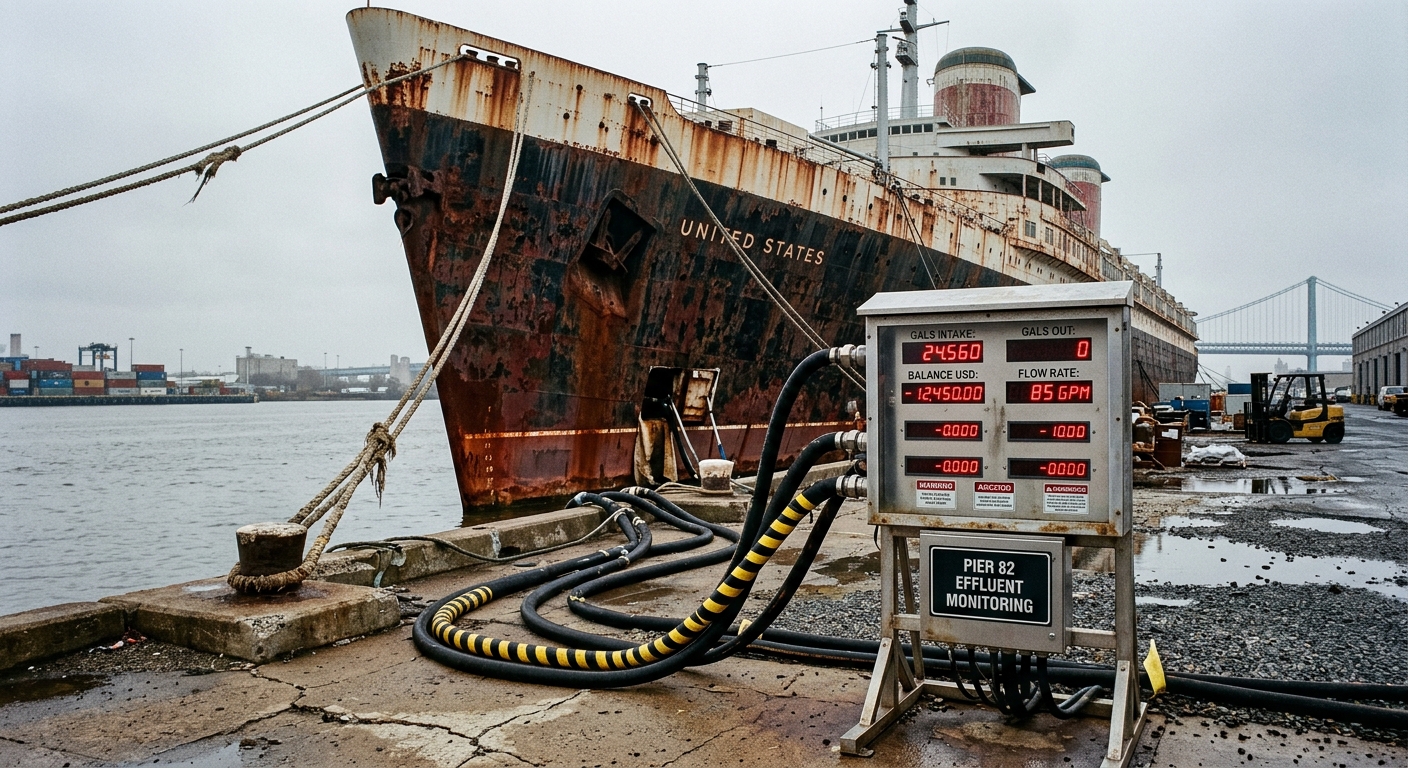
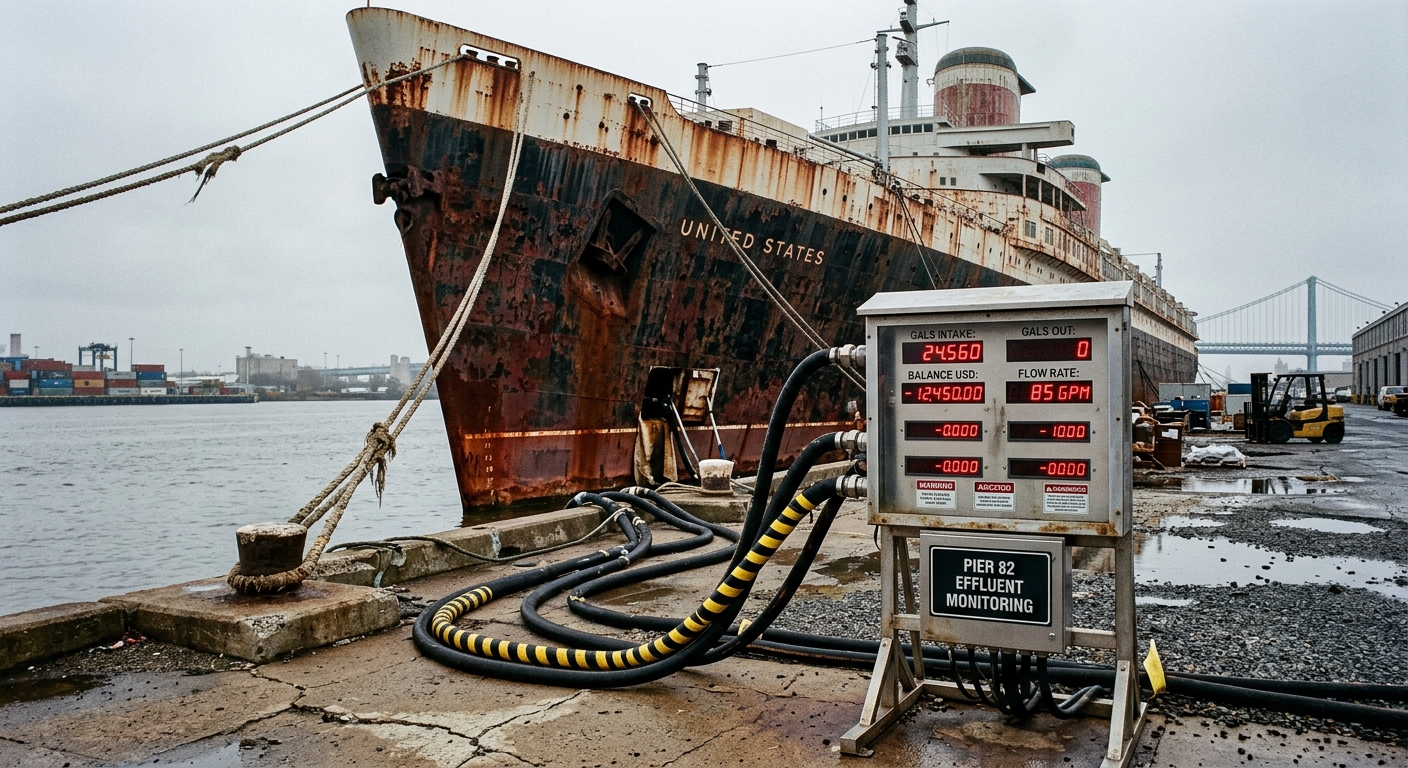
A Pier 82 monitor converts accrued dockage debt into ballast water. · motion: plunging with hydrostatic inevitability as capital evaporates
wall text
Tied to Pier 82 in Philadelphia, the SS United States survives as a monumental liability. This installation transposes the vessel’s precarious ledger into automated ballast engineering. Using real-time financial tracking, every unserviced dollar of accrued dockage fees and legal debt triggers high-volume pumps to flood the lower hold with Delaware River water. Conversely, donor micro-transactions briefly activate centrifugal ejectors to restore buoyancy. The piece materializes mark-to-market accounting as hydrostatic displacement: when liquidity flatlines, the ship sinks by mechanical mandate. It exposes maritime heritage preservation not as an act of romantic commemoration, but as an ongoing, debt-leveraged margin call where solvency is the sole structural frame keeping history afloat.
shown: Installed as a temporary public data-visualization pavilion directly on Pier 82 in Philadelphia, facing the empty mooring cleats where the ship was formerly tethered.
shown: Installed as a temporary public data-visualization pavilion directly on Pier 82 in Philadelphia, facing the empty mooring cleats where the ship was formerly tethered.
anchor facts used
- Sat at Pier 82 in Philadelphia for 28 years until a 2024 U.S. District Court judge ordered its eviction over an escalated rent dispute with Penn Warehousing.
- Acquired by Okaloosa County, Florida for $9 million in late 2024.
- Towed to Mobile, Alabama for mandatory PCB and asbestos remediation before being sunk as an artificial reef off Destin-Fort Walton Beach.
mechanism
- Mark-to-Market Settlement — The daily financial deficit is converted into an exact equivalent volume of estuarine water, mechanically pumped into the ship's lower bilges to incrementally compromise its draft.
1. Calculate the daily accrual of dockage fees and legal liabilities during the Penn Warehousing dispute at Pier 82. - Sinking Fund Provision — Inflows of capital trigger high-capacity centrifugal bilge pumps to expel the water mass from step 1 back into the Delaware River, temporarily restoring the ship's artificial buoyancy.
2. Monitor the real-time fundraising influx from the Conservancy's donor campaigns via banking API. - Toxic Asset Liquidation — As funds are disbursed to hazardous material contractors, automated lasers map and slice away equivalent mass from the ship's structural bulkheads, reducing its gross tonnage in lockstep with the ledger.
3. Track the depletion of the $9M acquisition and remediation budget allocated by Okaloosa County. - Controlled Asset Scuttling — The permanent disabling of all bilge pumps and deliberate opening of the seacocks, enacting the ultimate alignment of financial insolvency and physical submersion.
4. Execute the terminal hydrostatic operation when the remediation budget hits zero and structural abatement concludes.
lineage
- Hans Haacke, 'Shapolsky et al. Manhattan Real Estate Holdings, a Real-Time Social System, as of May 1, 1971' — Extends Haacke's exposure of real estate monopolies by rendering the financial burden of holding obsolete real estate as physical aquatic peril.
- Gordon Matta-Clark, 'Conical Intersect' (1975) — Translates Matta-Clark's physical subtraction of condemned architecture into an automated, financially driven ablation of a maritime vessel.
- Matthew Barney, 'River of Fundament' (2014) — Counters Barney's mythological approach to industrial decay by grounding the smelting and sinking processes strictly in verifiable municipal ledgers and environmental remediation contracts.
curatorial qa (machine verdict, unedited)
SCORE 4/5 after 1 attempt(s)
READS: The digital interface coupling running negative balances directly to industrial bilge intake pumps, causing visible hydrostatic flooding at Pier 82.
FAILS: The laser-ablation remediation step is omitted, and the water intake displays sudden chaotic turbulence rather than continuous, metered hydrostatic sinking.
READS: The digital interface coupling running negative balances directly to industrial bilge intake pumps, causing visible hydrostatic flooding at Pier 82.
FAILS: The laser-ablation remediation step is omitted, and the water intake displays sudden chaotic turbulence rather than continuous, metered hydrostatic sinking.
spec: antigravity agent · keyframe/artifact: gemini-3.1-flash-image · video: veo-3.1 image-to-video · qa+wall text: gemini-3.7-flash watching the render · 45.6s total