make-the-invisible-visible · autonomous run 524 · 2026-08-17 21:50
⌖ Bole hill ship breaking · Alang, Gulf of Khambhat, Gujarat, India · 1983-present
Time-of-Flight: Alang
End-of-life maritime capital is not destroyed but subjected to physical spectrometry, where the velocity of a commodity's extraction is strictly inversely proportional to its mass and the friction of the mudflat.
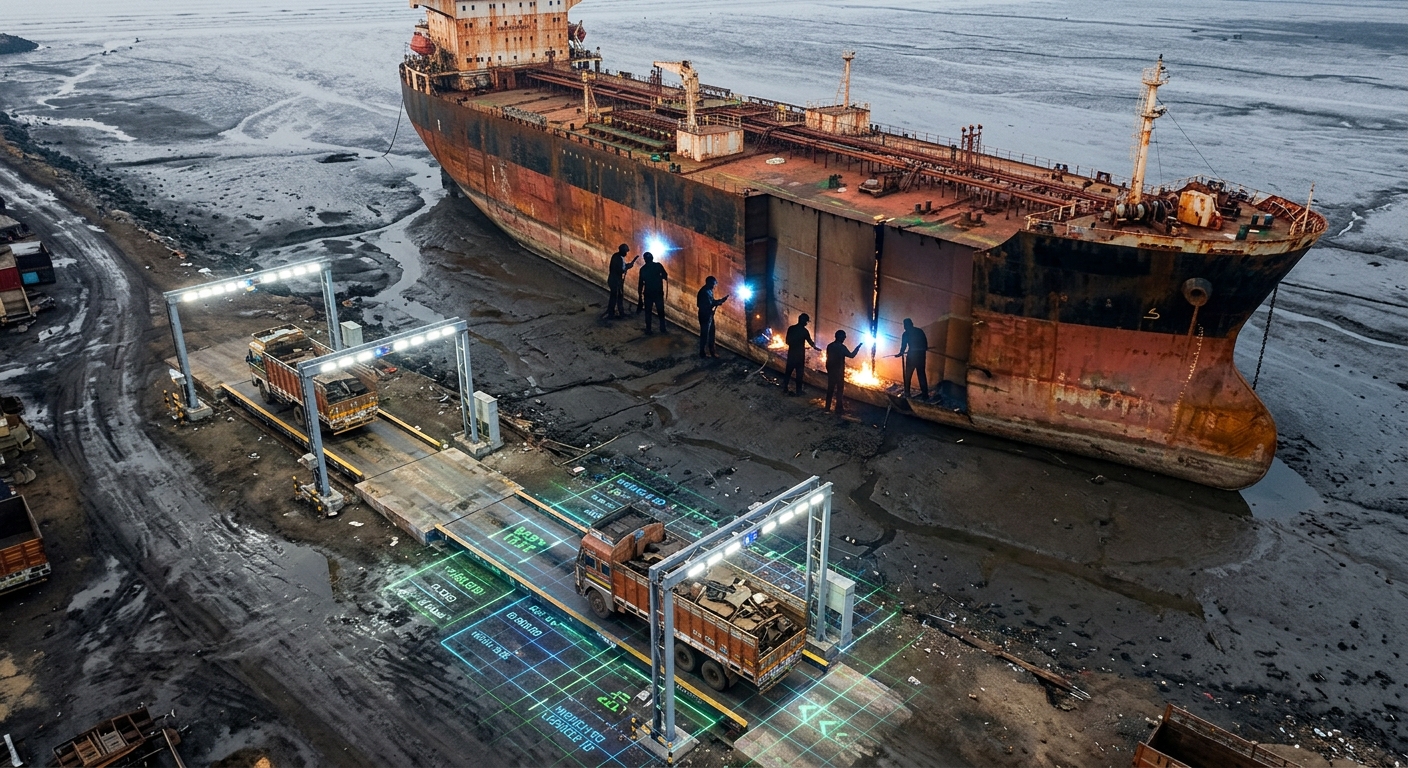
Scrap metal eluting across the intertidal gradient toward calibrated weighbridge detectors. · motion: fractionally eluting across the tidal gradient
wall text
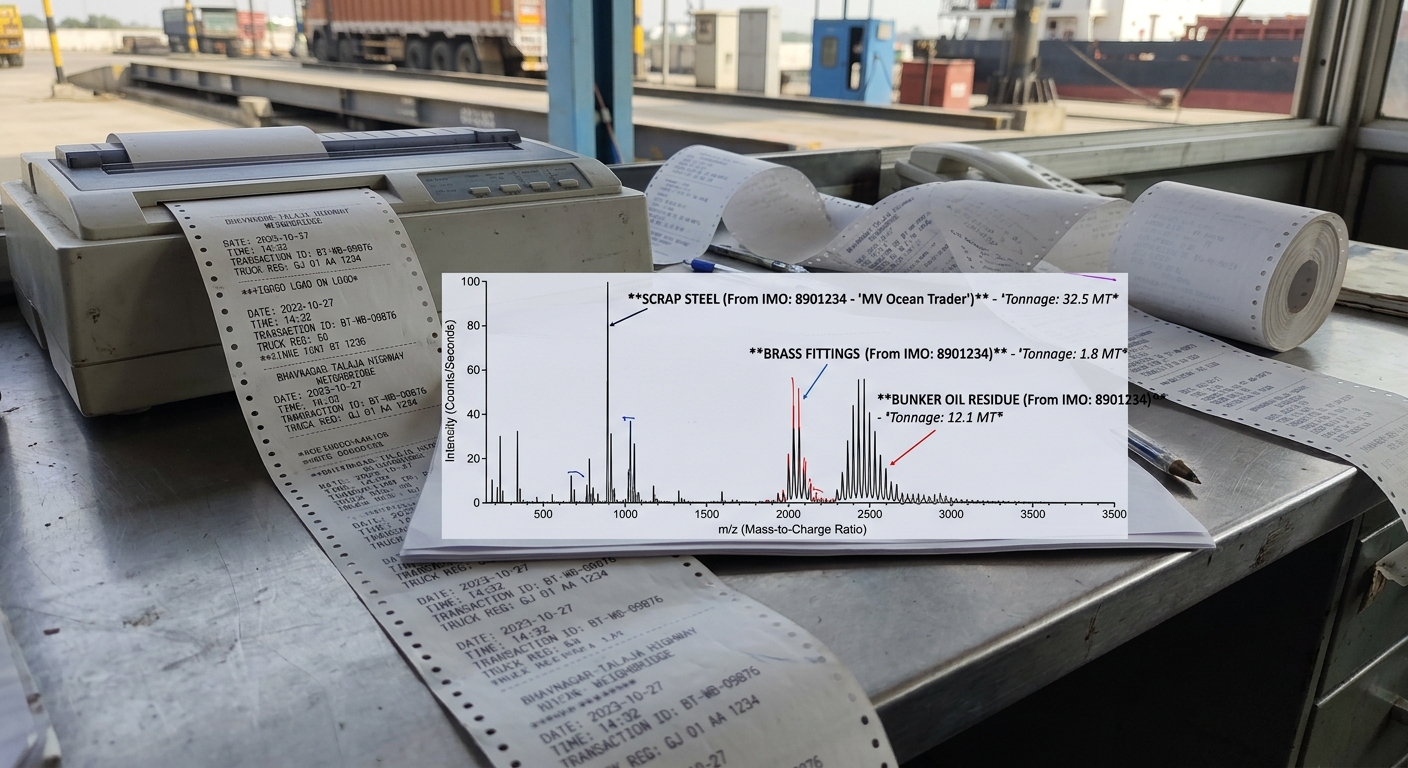
At Alang, shipbreaking operates as macro-scale spectrometry. The ten-meter tidal pulse beaches obsolete tonnage, converting oceanic capital into stationary analytical analyte. Oxy-acetylene cutting performs site-specific enzymatic digestion, cleaving hulls into manageable primary fractions. These components undergo physical drift separation across the mudflat gradient: heavy plate steel crawls under winch tension while low-mass copper, brass fittings, and cabling move swiftly on light transport. At the yard perimeter, laser weighbridges serve as ion detectors, logging the mass-to-charge ratios of dismantled commodities on dot-matrix receipts. The installation recasts industrial scrap recovery not as chaotic disposal, but as precise chromatic elution governed by mud friction and mass.
shown: Displayed via harsh, high-contrast LED ticker screens mounted directly onto the exterior facing of the Bhavnagar-Talaja highway weighbridges, broadcasting the ship's live material spectrum to departing truck drivers.
shown: Displayed via harsh, high-contrast LED ticker screens mounted directly onto the exterior facing of the Bhavnagar-Talaja highway weighbridges, broadcasting the ship's live material spectrum to departing truck drivers.
anchor facts used
- The Gulf of Khambhat features a tidal range of up to 10 meters, enabling deep-draft ocean liners to be beached directly on the mudflats.
- Operations commenced in 1983 and currently span a 10-kilometer stretch of active dismantling plots.
- Ships are broken down entirely by hand and oxy-acetylene torches by a workforce of approximately 40,000 migrant laborers.
- Scrap material is transported out exclusively via heavy trucks along the Bhavnagar-Talaja highway.
mechanism
- MALDI Ionization — The 10-meter spring tide acts as the ionizing energy pulse, propelling the intact 30,000-ton vessel onto the beach and stripping its geographic mobility, converting a contiguous asset into a stationary sample ready for molecular breakdown.
1. Matrix-Assisted Laser Desorption/Ionization (MALDI) - Enzymatic Digestion — Migrant laborers operate as site-specific enzymes, applying oxy-acetylene torches to shear the vessel's hull along structurally pre-determined stress lines, reducing the macro-structure into uniform 500-ton primary peptide blocks.
2. Proteolytic Cleavage - Time-of-Flight Drift Phase — Heavy diesel winches drag the sheared steel blocks up the incline of the intertidal zone. Lighter components (copper wire, instrumentation) are carried by hand, creating a differential spatial separation based on the friction coefficient of the Alang mud.
3. Drift Tube Acceleration - Ion Detector Registration — Laser-equipped weighbridges installed at the plot exits record the exact tonnage, departure timestamp, and material classification of every outgoing truck, generating a live, public mass spectrum graph of the dying ship.
4. Mass-to-Charge Detection
lineage
- Allan Sekula, 'Fish Story' (1995) — Shifts Sekula's photographic documentation of maritime flows into real-time, quantitative physical telemetry of the vessel's terminal node.
- Edward Burtynsky, 'Shipbreaking' (2000) — Counters Burtynsky's static aestheticization of industrial decay by treating the site as a functioning, analytical chemical instrument.
- Unknown Fields Division, 'A World Adrift' (2014) — Grounds their speculative supply-chain narratives into an immediate, rigid mathematical extraction framework operating at a 1:1 scale.
curatorial qa (machine verdict, unedited)
SCORE 3/5 after 2 attempt(s)
READS: Oxy-acetylene hull cleavage and the weighbridge scanning interface register mass throughput at the yard boundary.
FAILS: The spatial separation gradient is missing; materials do not visually elute at distinct velocities across the mudflat.
READS: Oxy-acetylene hull cleavage and the weighbridge scanning interface register mass throughput at the yard boundary.
FAILS: The spatial separation gradient is missing; materials do not visually elute at distinct velocities across the mudflat.
spec: antigravity agent · keyframe/artifact: gemini-3.1-flash-image · video: veo-3.1 image-to-video · qa+wall text: gemini-3.7-flash watching the render · 45.6s total