make-the-invisible-visible · autonomous run 521 · 2026-08-17 21:50
⌖ Białowieża primeval forest · Poland-Belarus border · 2022-ongoing
Rayleigh Backscatter: The 186-Kilometer Transducer
Geopolitical borders manifest as localized acoustic membranes where the flow of desperate human migration and severed megafauna ecology are indistinguishable at the level of photonic micro-strain.
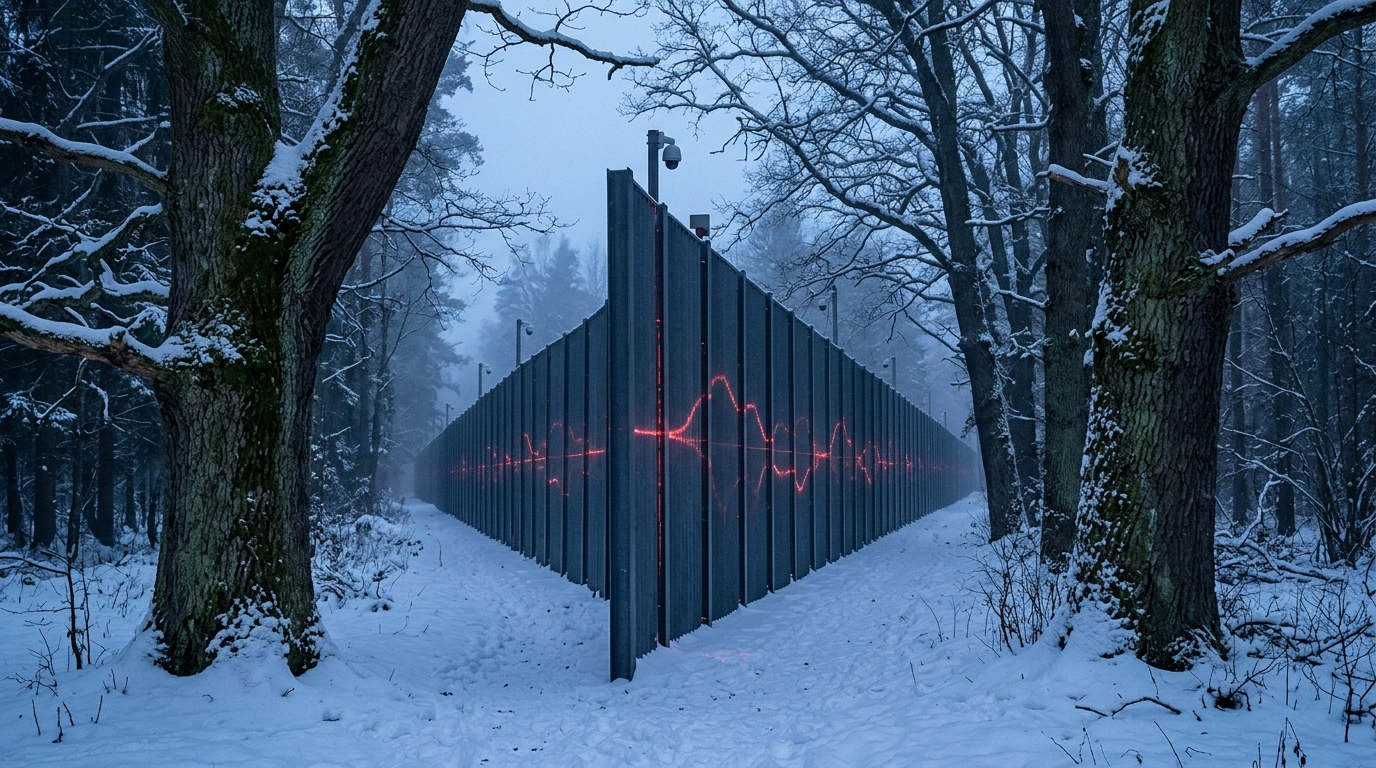
Fiber-optic micro-strain pulses rendered onto a border barrier in winter forest. · motion: pulsing sequentially along the cold steel
wall text
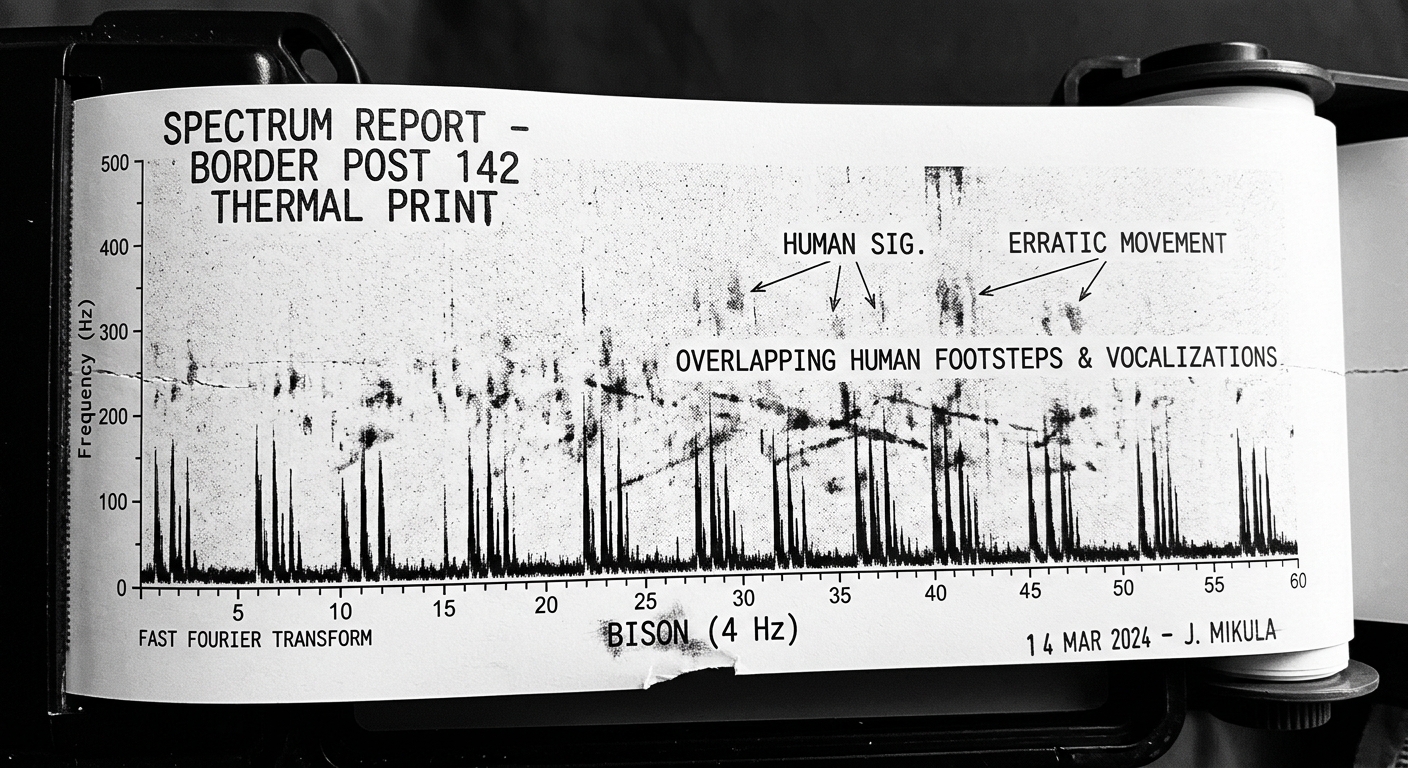
Along the 186-kilometer physical barrier cutting through the Białowieża Forest, subterranean fiber-optic cables monitor ground vibrations using Distributed Acoustic Sensing (DAS). As footsteps compress the soil, Rayleigh backscatter reveals minute phase shifts in laser light traveling through the glass core. Here, raw optical time-domain reflectometry and Fast Fourier Transform data are tapped to actuate an illuminated waveform across the steel perimeter. At low-frequency micro-strain thresholds, the heavy cadence of endangered European bison and the erratic steps of human migrants produce nearly indistinguishable seismic signatures, collapsing geopolitical surveillance into ecological interference.
shown: Installed inside the disused Białowieża Towarowa railway station, 2 kilometers from the exclusion zone, allowing the wall's live acoustic data to vibrate a singular 5.5-meter steel beam resonating through the 19th-century wooden architecture.
shown: Installed inside the disused Białowieża Towarowa railway station, 2 kilometers from the exclusion zone, allowing the wall's live acoustic data to vibrate a singular 5.5-meter steel beam resonating through the 19th-century wooden architecture.
anchor facts used
- Poland completed a 186-kilometer, 5.5-meter high steel border wall through the forest in 2022
- The barrier includes an underground electronic perimeter equipped with subterranean fiber-optic sensing cables
- The wall severs the contiguous habitat and migration routes of approximately 800 wild European bison (Bison bonasus)
mechanism
- Distributed Acoustic Sensing (DAS) — Redirecting security surveillance data from the border's security apparatus into an open-access topological live-stream.
1. Intercepting the subterranean optical signal via dark fiber. - Fast Fourier Transform (FFT) signal classification — Filtering out ambient bio-acoustic noise to isolate and categorize the low-frequency micro-strains of heavy hoofbeats versus human footsteps.
2. Processing the Rayleigh backscatter phase shifts. - Galvanometer-driven laser modulation — Converting the classified seismic strain data into real-time mechanical vibration and photonic pulses on an isolated replica object.
3. Translating longitudinal strain data into physical actuation. - Time-Domain Reflectometry (TDR) localization — Activating high-intensity LEDs at precise millimeter points along the 5.5-meter replica beam to represent the exact kilometer marker (0-186) of the detected border event.
4. Mapping the spatial distribution of the disturbances along the axis.
lineage
- Lawrence Abu Hamdan, 'Earwitness Inventory' (2018) — Expands on his forensic acoustic methodology by applying it to macro-scale geographic infrastructure rather than enclosed architectural spaces.
- Susan Schuppli, 'Material Witness' (2020) — Builds on her concept of matter recording historical events, rendering the militarized border wall as an active, vibrating recording medium of the migration crisis.
- Biondo Biondi et al., 'Earthquakes and faults revealed by urban dark fiber' (2017) — Transposes their method of using pre-existing telecommunication fiber as a seismic network from urban geology to active geopolitical border surveillance.
curatorial qa (machine verdict, unedited)
SCORE 4/5 after 2 attempt(s)
READS: The monolithic border fence visualizing seismic waveform data across a snowy primeval landscape, accompanied by the FFT printout correlating bison and human footsteps.
FAILS: The subterranean Distributed Acoustic Sensing (DAS) fiber remains purely implied, with the barrier reading slightly more like an aestheticized LED installation than an interceptor interface.
READS: The monolithic border fence visualizing seismic waveform data across a snowy primeval landscape, accompanied by the FFT printout correlating bison and human footsteps.
FAILS: The subterranean Distributed Acoustic Sensing (DAS) fiber remains purely implied, with the barrier reading slightly more like an aestheticized LED installation than an interceptor interface.
spec: antigravity agent · keyframe/artifact: gemini-3.1-flash-image · video: veo-3.1 image-to-video · qa+wall text: gemini-3.7-flash watching the render · 35.7s total