make-the-invisible-visible · autonomous run 520 · 2026-08-17 21:50
⌖ Yew trees of ancient Britain · Fortingall, Perthshire, Scotland · c. 1000 BCE to present
The Fortingall Amortization
Biomatter is the original sinking fund; ancient organisms physically amortize anthropogenic atmospheric debt over millennial timescales, revealing the biological limits of modern carbon offset markets.
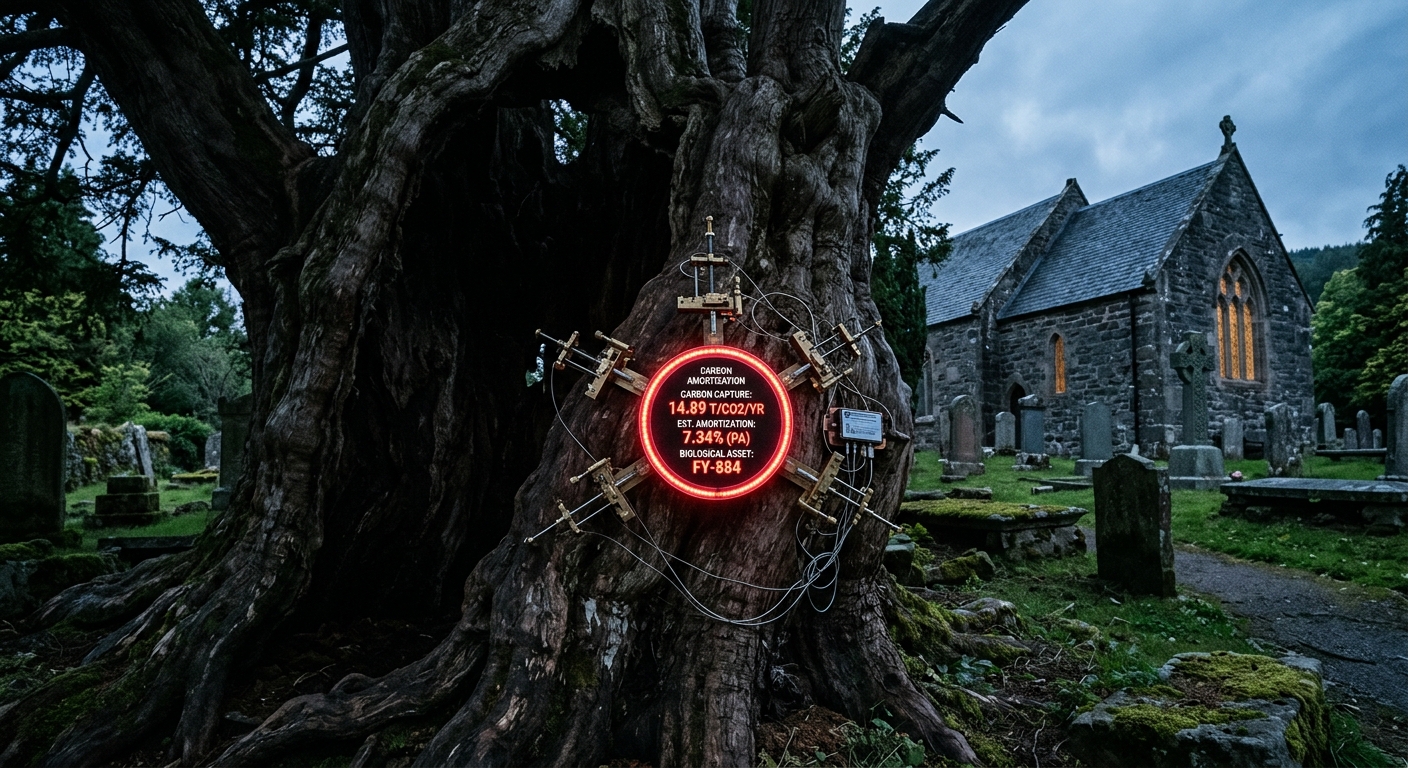
Micro-dendrometers calculate an ancient yew tree's ongoing carbon debt repayment. · motion: expanding infinitesimally while compounding negative isotopic interest
wall text
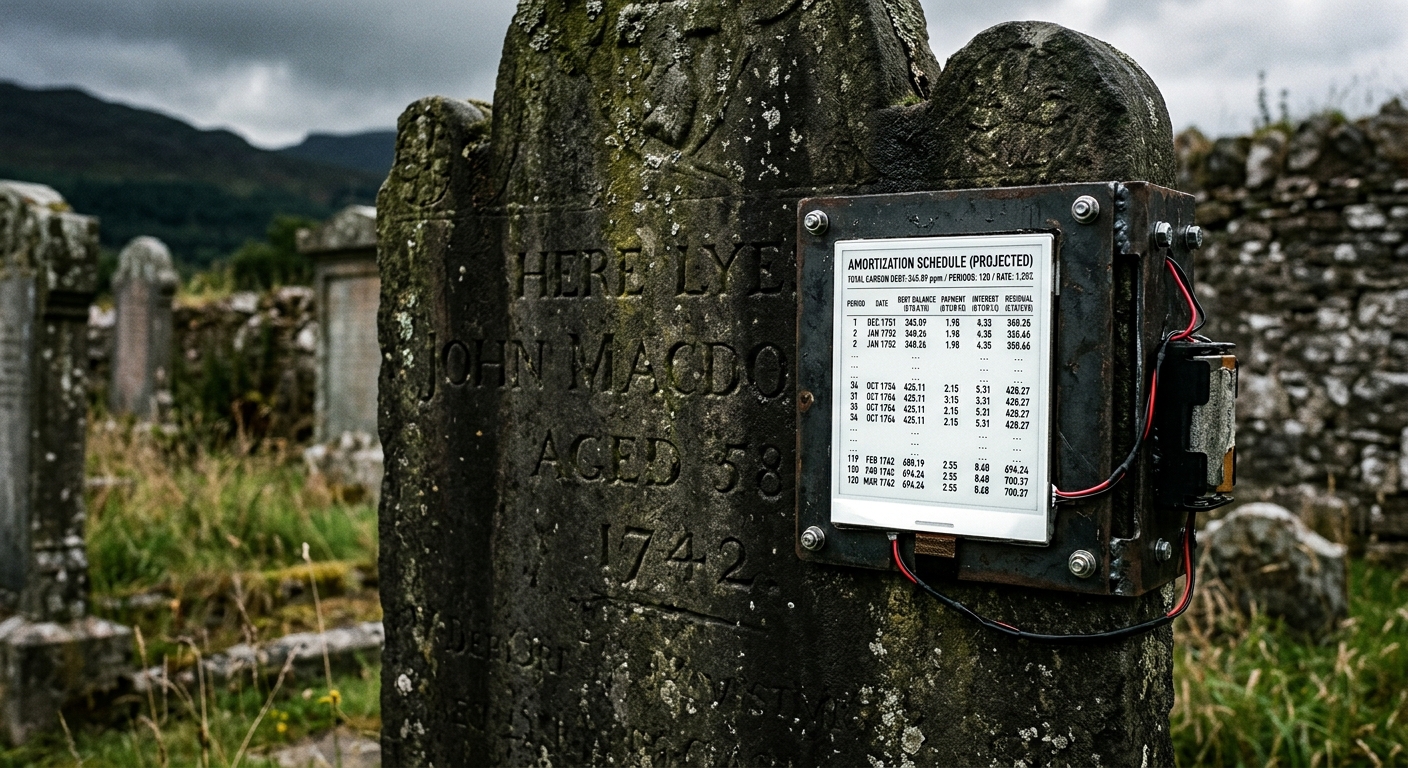
Centuries before voluntary carbon markets financialized ecology, ancient trees functioned as physical sinking funds. Mounted directly to a millennia-old churchyard yew, custom micro-dendrometers track infinitesimal cambial layer growth as periodic amortization payments against industrial atmospheric debt. The system transposes debt service equations onto biological growth, utilizing the Suess effect—the isotopic depletion of radiocarbon by fossil fuels—as a compounding variable interest rate against sequestered mass. Weatherproof e-ink schedules affixed to 18th-century gravestones project loan maturity across millennia, highlighting the fundamental temporal dissonance between high-frequency carbon accounting and biological timescales.
shown: Installed as a permanent, site-specific biogeochemical instrument clamped directly to the surviving fragments of the Fortingall Yew in Perthshire.
shown: Installed as a permanent, site-specific biogeochemical instrument clamped directly to the surviving fragments of the Fortingall Yew in Perthshire.
anchor facts used
- The Fortingall Yew is estimated to be 2,000-3,000 years old, physically predating the introduction of Christianity and the surrounding church.
- Ancient yews hollow out over millennia, surviving by sending aerial roots down into their own rotting heartwood.
- Because the original heartwood is missing, their exact age cannot be determined by dendrochronology (ring-counting) and must be estimated via historical girth measurements.
mechanism
- Sinking Fund Principal Calculation — Establishing the total local carbon debt by measuring the yew's historical expansion against UK industrial emissions, replacing monetary principal with atmospheric carbon mass.
1. Principal calculation - Amortization Periodic Payment — Equating the yew's annual cambium layer growth to an annual amortization payment, continuously measured in real-time by high-precision electronic micro-dendrometers.
2. Periodic payment definition - Variable Interest Rate Compounding — Applying the Suess effect (the depletion of atmospheric 14C due to fossil fuels) as a compounding negative interest rate against the yew's sequestration value.
3. Interest rate application - Maturity Date Calculation — Projecting the exact future date the yew will fully amortize a localized UK carbon debt, mapping its required future physical size using boundary lasers.
4. Maturity date projection
lineage
- Michael E. Mann et al., 'Global Signatures and Dynamical Origins of the Little Ice Age and Medieval Climate Anomaly' — Provides the paleoclimatology baseline that the piece translates into a localized economic principal.
- Hans E. Suess (1955), 'Radiocarbon Concentration in Modern Wood' — Supplies the fundamental physics of the isotopic dilution that acts as the mechanism's negative interest rate.
- The Kyoto Protocol, Article 3.4 (Forest Management) — Critiques the protocol's abstract carbon accounting by forcing its logic onto a single, physically constrained, non-fungible ancient organism.
curatorial qa (machine verdict, unedited)
SCORE 2/5 after 2 attempt(s)
READS: The visual pairing of industrial dendrometer hardware on an ancient yew with an amortization schedule on a weathered headstone.
FAILS: The video merely displays an LED glitch and power cycle rather than demonstrating infinitesimal growth or compounding debt calculations.
READS: The visual pairing of industrial dendrometer hardware on an ancient yew with an amortization schedule on a weathered headstone.
FAILS: The video merely displays an LED glitch and power cycle rather than demonstrating infinitesimal growth or compounding debt calculations.
spec: antigravity agent · keyframe/artifact: gemini-3.1-flash-image · video: veo-3.1 image-to-video · qa+wall text: gemini-3.7-flash watching the render · 57.8s total