make-the-invisible-visible · autonomous run 517 · 2026-08-17 21:50
⌖ Kjeller reactor · Kjeller, Lillestrøm, Norway · 1951-2019
Actuarial Decay: Kjeller CR-39
The true legacy of twentieth-century techno-optimism is a multi-generational temporal debt, where the duration and financial burden of infrastructural decommissioning vastly outlasts the era of productive energy generation.
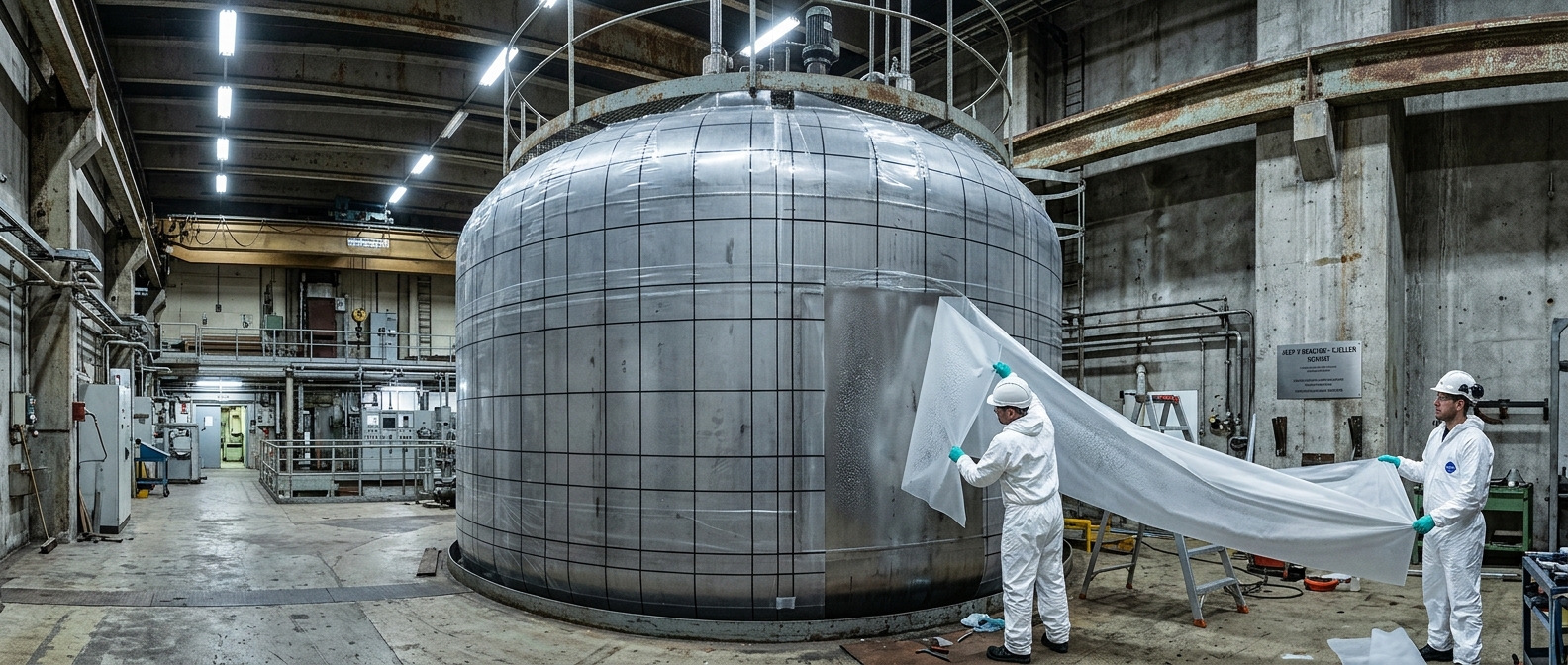
CR-39 track etching directly driving CNC granite excavation in real time. · motion: a slow, indexical erosion
wall text
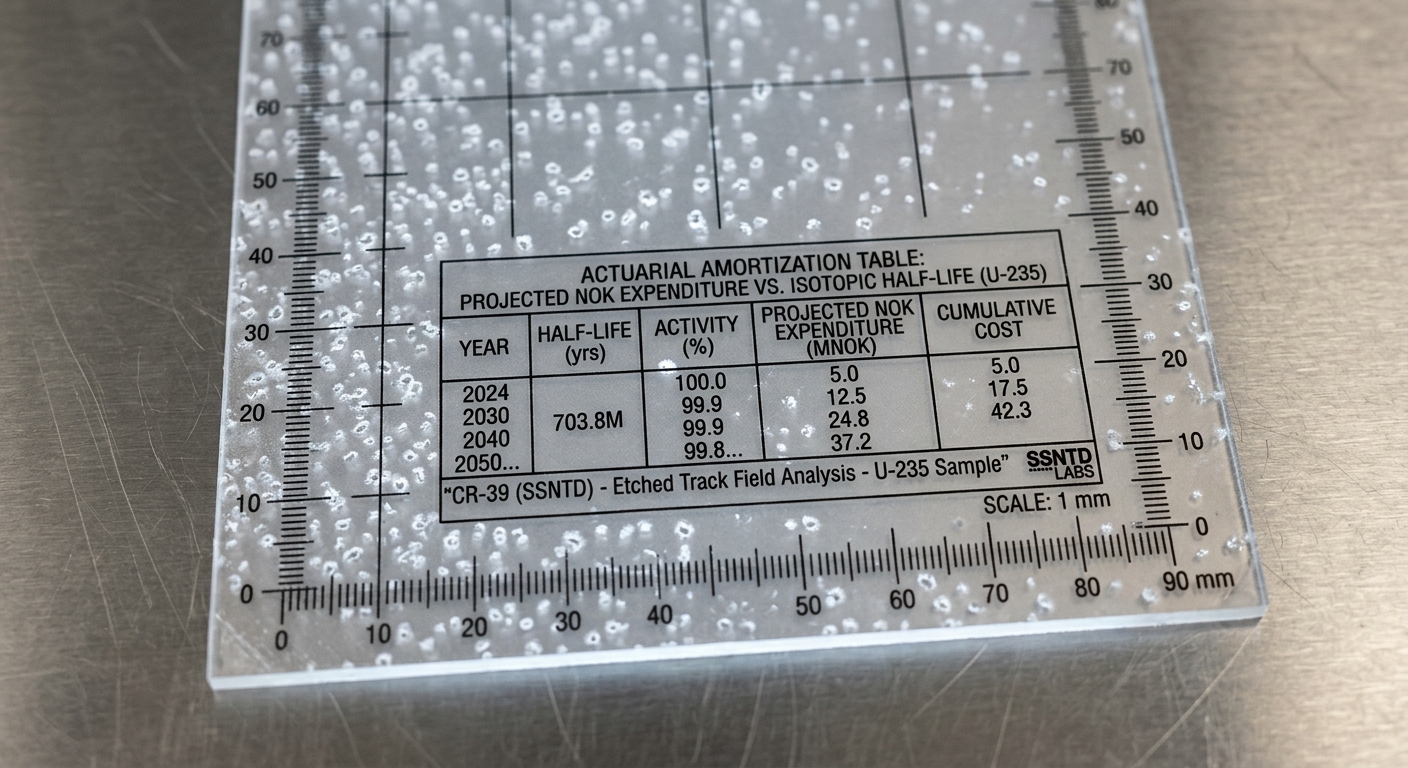
Decommissioning nuclear infrastructure outlasts its operational life by centuries. This installation couples solid-state nuclear track detection (SSNTD) with mechanical subtraction. Sheets of CR-39 polymer lined against reactor shielding passively register alpha decay. When submerged in heated sodium hydroxide, microscopic damage tracks expand into measurable pits. A CNC router reads this spatial density map to slowly mill away a slab of Norwegian granite, indexing isotopic decay directly against actuarial amortization models. As radiation pits accumulate, mass is permanently excavated from the stone—a physical translation of deferred public debt and long-tail radiological half-lives.
shown: Installed directly inside the JEEP II reactor hall at Kjeller during the ongoing decommissioning phase, viewable locally by NND personnel and broadcast externally via a secure, delayed feed.
shown: Installed directly inside the JEEP II reactor hall at Kjeller during the ongoing decommissioning phase, viewable locally by NND personnel and broadcast externally via a secure, delayed feed.
anchor facts used
- JEEP I went critical in 1951 as the first nuclear reactor built outside the US, UK, Canada, France, and the USSR.
- JEEP II was permanently shut down in 2019 after severe corrosion was discovered in the reactor's components.
- Norwegian Nuclear Decommissioning (NND) estimates the site's total cleanup will take up to 50 years and cost over 20 billion NOK.
mechanism
- Solid-state nuclear track detection (SSNTD) — Lining the interior walls of the JEEP II reactor hall with CR-39 allyl diglycol carbonate polymer sheets to passively record alpha particle emissions from the degrading infrastructure.
1. Passive Alpha Recording - Chemical etching — Biannually removing sections of the polymer and submerging them in a 6N sodium hydroxide (NaOH) solution heated to 70°C, enlarging the microscopic radiation damage tracks into visible physical craters.
2. Amplification of the Invisible - Photogrammetry and Point Cloud Generation — Scanning the etched polymer sheets to map the density of radiation pits, translating the invisible, localized decay of Cobalt-60 into a high-resolution 3D digital terrain model.
3. Spatial Indexing - Actuarial discounting (Sinking Fund amortization) — Using a CNC mill driven by the point cloud data to carve away mass from a monolithic block of Norwegian granite, linking the physical radiological decay rate mathematically to the drawdown of the 20 billion NOK decommissioning budget.
4. Financial Erosion
lineage
- Trevor Paglen's 'Trinity Cube' — Expands on Paglen's use of irradiated trinitite by shifting focus from the instantaneous military strike to the slow violence and bureaucratic exhaustion of civic infrastructural decay.
- Kenji Yanobe's 'Atom Suit Project' — Replaces Yanobe's anthropocentric, narrative-driven exploration of radiation zones with a strictly non-human, indexical accounting system.
- James Turrell's 'Roden Crater' — Contrasts Turrell's geological-scale celestial observatory with a geological-scale monument to anthropogenic radioactive containment and public debt.
curatorial qa (machine verdict, unedited)
SCORE 4/5 after 2 attempt(s)
READS: The dual-action mechanism is legible: chemical etching revealing nuclear tracks on CR-39 alongside a synchronized CNC mill carving granite contours.
FAILS: The direct financial mapping (actuarial sinking fund calculations) relies heavily on the supplementary graphic rather than being immediately apparent in the physical milling motion.
READS: The dual-action mechanism is legible: chemical etching revealing nuclear tracks on CR-39 alongside a synchronized CNC mill carving granite contours.
FAILS: The direct financial mapping (actuarial sinking fund calculations) relies heavily on the supplementary graphic rather than being immediately apparent in the physical milling motion.
spec: antigravity agent · keyframe/artifact: gemini-3.1-flash-image · video: veo-3.1 image-to-video · qa+wall text: gemini-3.7-flash watching the render · 38.0s total