make-the-invisible-visible · autonomous run 516 · 2026-08-17 21:50
⌖ WIPP waste isolation · Carlsbad, New Mexico · 1999-present
Viscoplastic Semiotics: Salado Formation
The geologic encapsulation mechanism meant to physically protect future generations operates as a destructive channel for human syntax, ensuring that long-term physical preservation mathematically necessitates semantic obliteration.
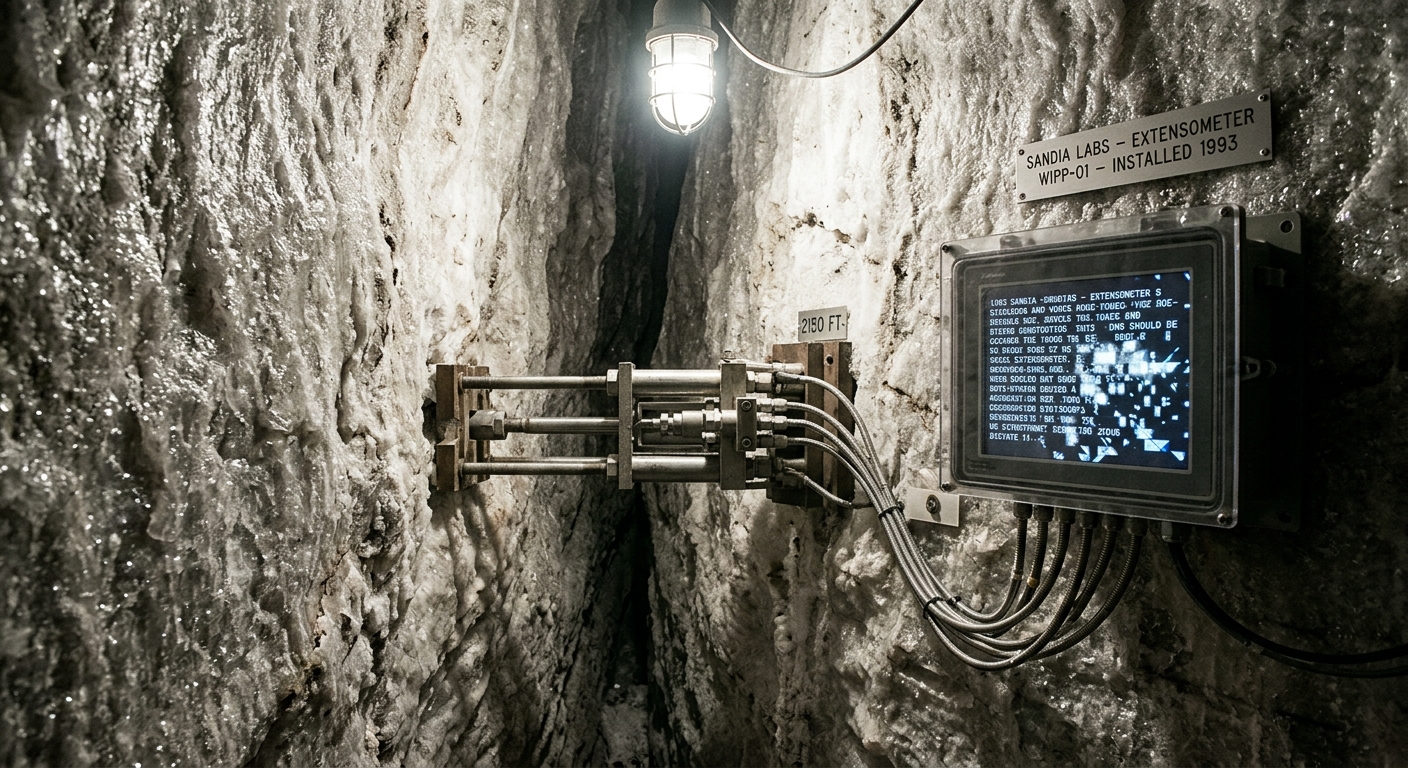
Borehole extensometer translates salt creep into linguistic entropy in real time. · motion: converging inward while mathematically disintegrating
wall text
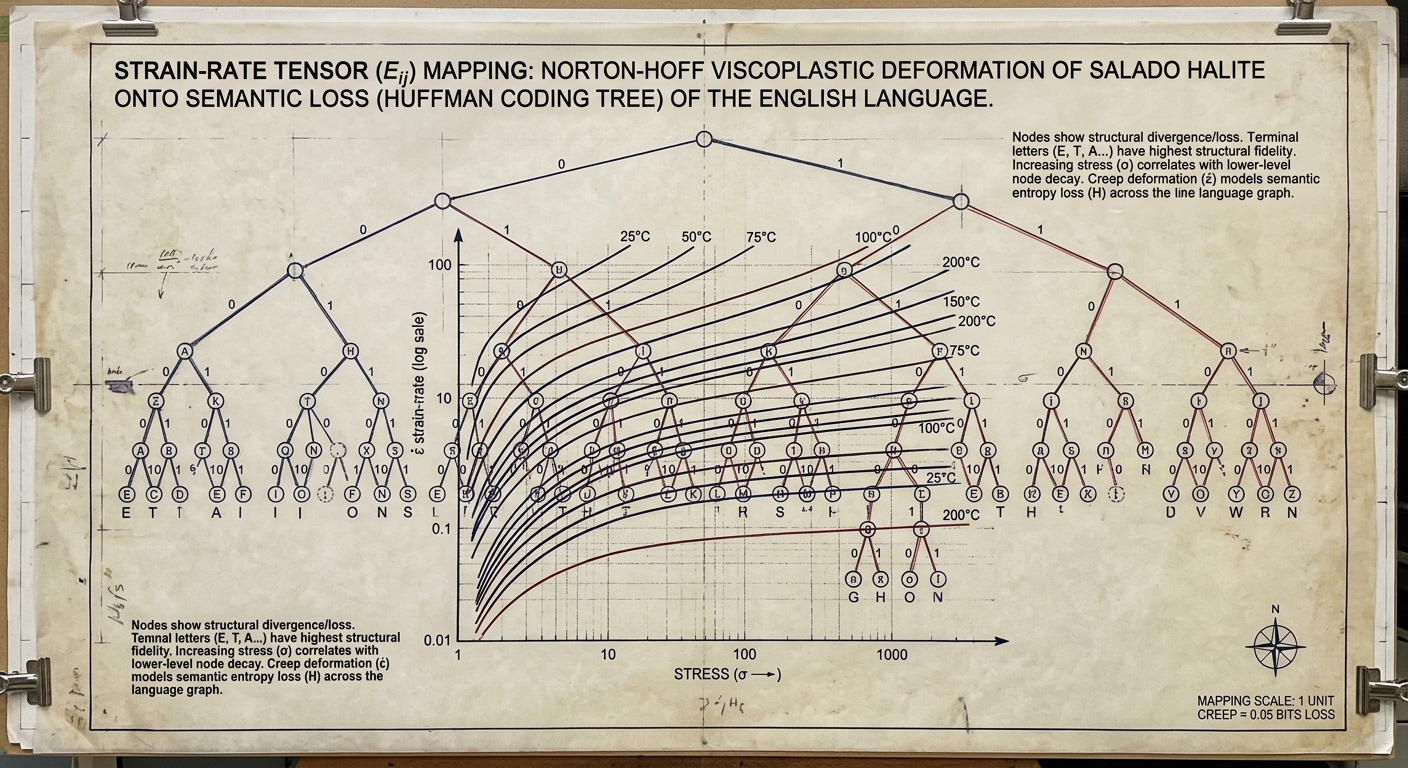
Installed 2,150 feet underground within the Salado Formation, this system links the physical closure of nuclear waste isolation rooms directly to textual degradation. Borehole extensometers measure the viscoplastic creep of rock salt over time, calculating strain rates via the Norton-Hoff constitutive law. Instead of logging safety margins, this continuous deformation drives a lossy Huffman compression algorithm applied to the 1993 Sandia nuclear warning message. As the geological formation seals itself to entomb radioactive waste, linguistic tokens are stripped proportionally to volume loss. Physical containment achieves perfect isolation precisely at the moment its legibility is reduced to zero.
shown: Installed as a closed-loop mechanical terminal in the WIPP Information Center in downtown Carlsbad, directly above the geologic repository, displaying the real-time erasure of its own messaging.
shown: Installed as a closed-loop mechanical terminal in the WIPP Information Center in downtown Carlsbad, directly above the geologic repository, displaying the real-time erasure of its own messaging.
anchor facts used
- Located 2,150 feet underground in the 250-million-year-old Salado Formation salt bed.
- Relies on the natural 'salt creep' of the halite to physically close around and encapsulate transuranic waste barrels.
- Utilizes the 1993 Sandia National Laboratories 'Expert Judgment on Markers' report to design a warning message ('This place is a message... and is to be shunned') meant to last 10,000 years.
mechanism
- Borehole Extensometry — Physical measurement of the salt walls converging inward at WIPP Panel 7 is captured in real time via wire extensometers and converted into a digital strain value.
1. Extensometry Data Acquisition - Norton-Hoff Viscoplasticity Law — The mechanical strain rate of the creeping salt is mathematically translated into an algorithmic data-compression ratio, linking physical volume loss to data loss.
2. Strain Rate Calculation - Huffman Coding (Lossy Compression) — The 1993 Sandia warning text is algorithmically compressed, shedding its least-frequent semantic tokens at the exact rate the salt sheds its physical void space.
3. Algorithmic Token Shedding - CNC Milling (Subtractive Manufacturing) — The compressed, disintegrating text is continuously carved into a solid core sample of WIPP halite by a multi-axis CNC router, destroying the core at the rate of the geological creep.
4. Physical Subtraction
lineage
- Sandia Report SAND92-1382: Expert Judgment on Markers — Provides the baseline linguistic warning system that this piece structurally dismantles via geologic algorithms.
- Acoustic Emission Monitoring of Salt Creep (Hardy, 1982) — Informs the data-acquisition methodology used to translate halite deformation into a live, quantifiable signal.
- The Clock of the Long Now (Danny Hillis) — Rejects its technological optimism, replacing its mechanical longevity with inevitable geologic and semantic erasure.
curatorial qa (machine verdict, unedited)
SCORE 3/5 after 2 attempt(s)
READS: The underground halite fissure setting and the CRT monitor displaying the 1993 Sandia nuclear warning message disintegrating into noise read clearly alongside the extensometer hardware.
FAILS: The physical convergence of the salt walls is static rather than visibly closing, and the screen degradation presents as generic television static rather than structured algorithmic token shedding tied to mechanical strain.
READS: The underground halite fissure setting and the CRT monitor displaying the 1993 Sandia nuclear warning message disintegrating into noise read clearly alongside the extensometer hardware.
FAILS: The physical convergence of the salt walls is static rather than visibly closing, and the screen degradation presents as generic television static rather than structured algorithmic token shedding tied to mechanical strain.
spec: antigravity agent · keyframe/artifact: gemini-3.1-flash-image · video: veo-3.1 image-to-video · qa+wall text: gemini-3.7-flash watching the render · 49.3s total