make-the-invisible-visible · autonomous run 515 · 2026-08-17 21:50
⌖ Rokkasho reprocessing plant delays · Shimokita Peninsula, Aomori Prefecture, Japan · 1993-present
Vitrification Kinetics of JNFL Construction Schedule
Bureaucratic mega-projects do not merely stall; under sufficient accumulated capital and time, they undergo a thermodynamic phase transition into administrative glass, where the viscosity of progress diverges to infinity.
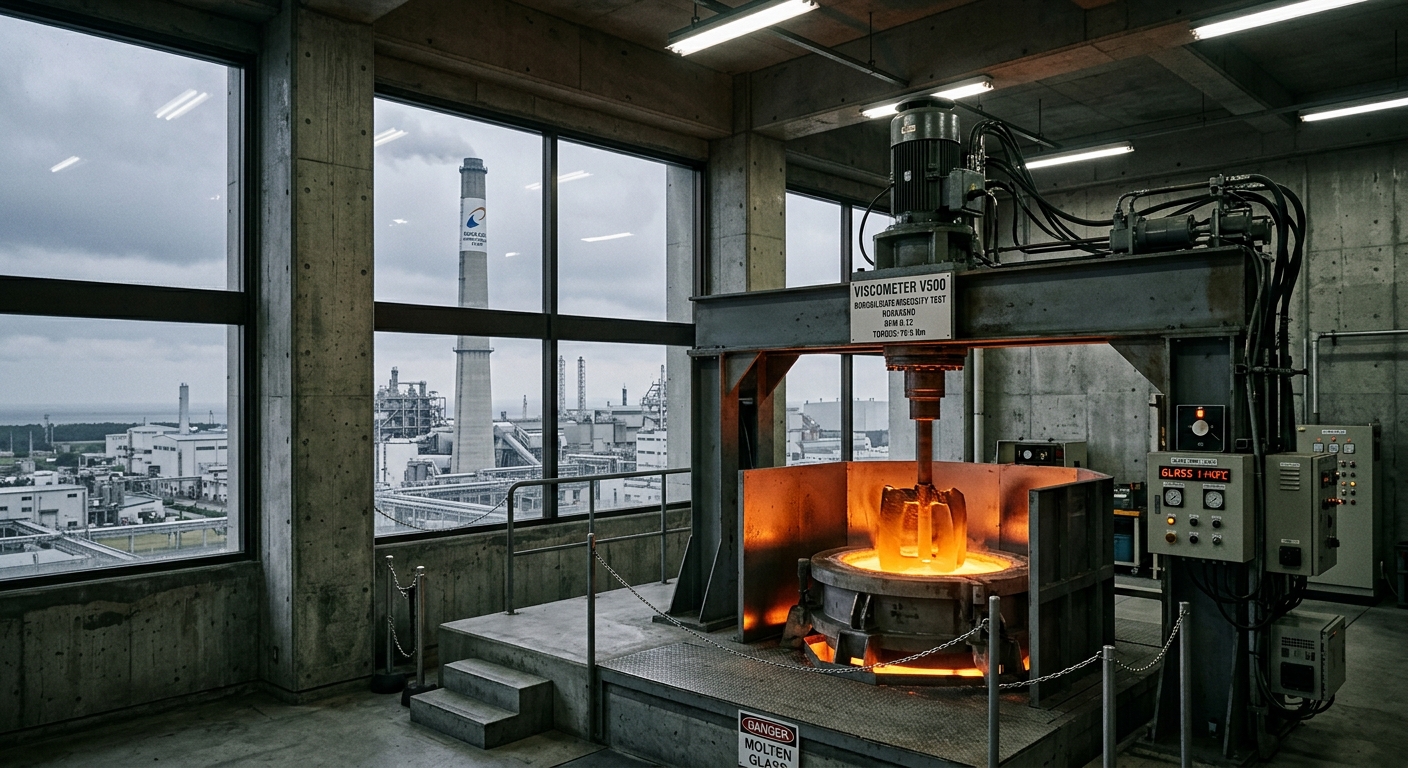
Rotational viscometer throttling its spindle speed to match 26 project postponements. · motion: imperceptibly decelerating rotation
wall text
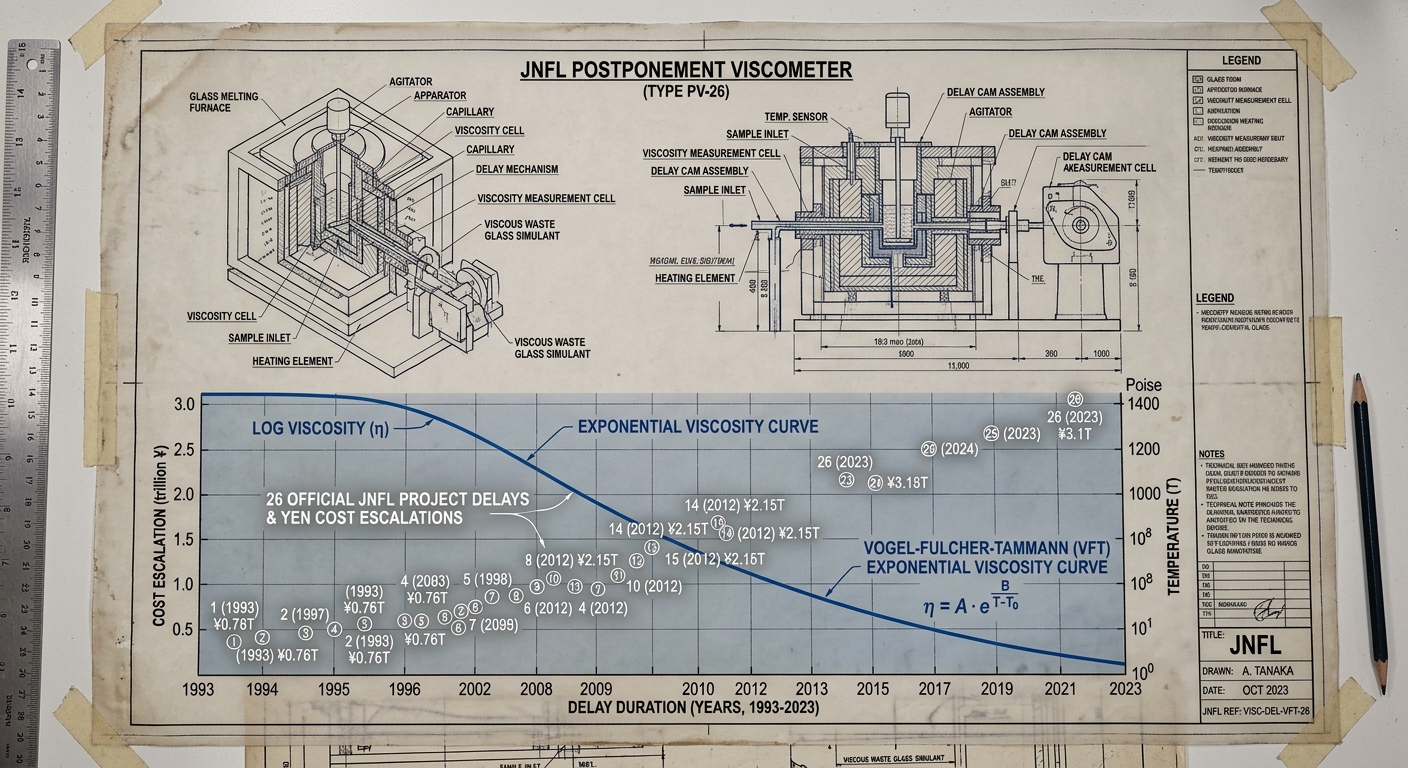
Since breaking ground in 1993, Japan Nuclear Fuel Limited's Rokkasho Reprocessing Plant has seen its completion date postponed 26 times, with lifecycle costs climbing past 14.4 trillion yen. This installation materializes that administrative stagnation through rotational viscometry and glass thermodynamics. A heavy motorized spindle stirs molten borosilicate glass, its rotational resistance governed by the Vogel-Fulcher-Tammann equation where delay milestones lower system temperature and cost escalations throttle motor torque. As noble-metal simulants precipitate into the melt, the apparatus approaches glass transition, mechanically transposing three decades of institutional friction into absolute physical arrest.
shown: Installed permanently in a viewing pavilion adjacent to the Rokkasho PR Center, drawing power directly from the regional grid until the reprocessing plant officially becomes operational.
shown: Installed permanently in a viewing pavilion adjacent to the Rokkasho PR Center, drawing power directly from the regional grid until the reprocessing plant officially becomes operational.
anchor facts used
- Construction began in 1993 with an original completion date of 1997
- Japan Nuclear Fuel Limited (JNFL) has officially postponed completion 26 times
- Delays are primarily caused by platinum-group metals clogging the high-level waste vitrification furnace
- Total estimated lifecycle costs have reached 14.4 trillion yen
mechanism
- Differential Scanning Calorimetry (DSC) — Heat flow measurements are replaced by the temporal intervals between the 26 official JNFL postponement press releases from 1997 to 2024, calculating the cooling rate of the project's momentum.
1. Data Ingestion & Thermal Mapping - Vogel-Fulcher-Tammann (VFT) equation — The kinetic algorithm continuously recalculates the escalating administrative 'viscosity' (the time required to complete a single construction milestone) as the project timeline approaches the glass transition temperature.
2. Viscosity Calculation via VFT - Rotational Viscometry — A motorized mechanical spindle attempts to stir a vat of molten borosilicate simulant, with its motor torque inversely throttled by the escalating 14.4 trillion yen lifecycle cost curve.
3. Torque Application & Resistance - Glass Transition (Tg) Arrest — The physical mechanism induces absolute flow arrest by injecting non-radioactive platinum-group metal powders into the borosilicate melt upon the announcement of any new delay, physically jamming the spindle.
4. Terminal Clogging & Solidification
lineage
- The Pitch Drop Experiment (University of Queensland) — Transposes the centennial timescale of high-viscosity fluid dynamics into the timeline of nuclear bureaucracy.
- A Counting (Tatsuo Miyajima) — Subverts Miyajima's continuous LED temporal counts into an asymptotic curve that slows infinitely but never reaches zero.
- Ashio Copper Mine Pollution Incident protests (Shozo Tanaka) — Contextualizes the modern Aomori nuclear burden within Japan's historical continuum of sacrificed peripheral geographies.
curatorial qa (machine verdict, unedited)
SCORE 4/5 after 1 attempt(s)
READS: The massive rotational viscometer and molten borosilicate melt visually link heavy nuclear vitrification infrastructure with the Rokkasho facility visible through the window.
FAILS: The dynamic deceleration of the spindle is so subtle across the brief duration that the real-time cost-to-viscosity mapping requires the schematic diagram to decode.
READS: The massive rotational viscometer and molten borosilicate melt visually link heavy nuclear vitrification infrastructure with the Rokkasho facility visible through the window.
FAILS: The dynamic deceleration of the spindle is so subtle across the brief duration that the real-time cost-to-viscosity mapping requires the schematic diagram to decode.
spec: antigravity agent · keyframe/artifact: gemini-3.1-flash-image · video: veo-3.1 image-to-video · qa+wall text: gemini-3.7-flash watching the render · 44.5s total