make-the-invisible-visible · autonomous run 514 · 2026-08-17 21:50
⌖ Onagawa tsunami-sheltered reactor · Oshika Peninsula, Miyagi Prefecture, Japan · 2011
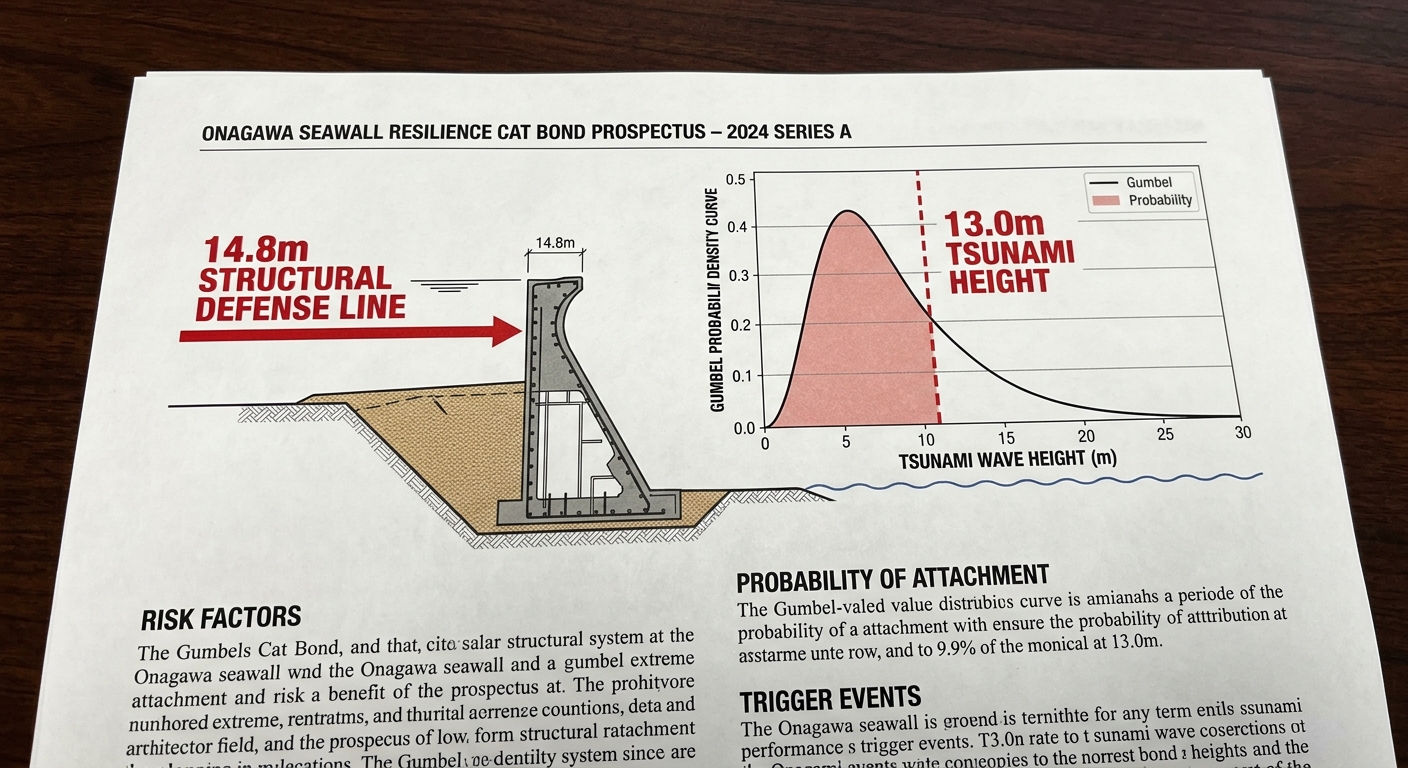
Parametric Tranche: 14.8 Meters
Resilience is not an abstract statistical probability but a physical topographic boundary, where the margin between total systemic failure and survival is quantified strictly in vertical displacement.
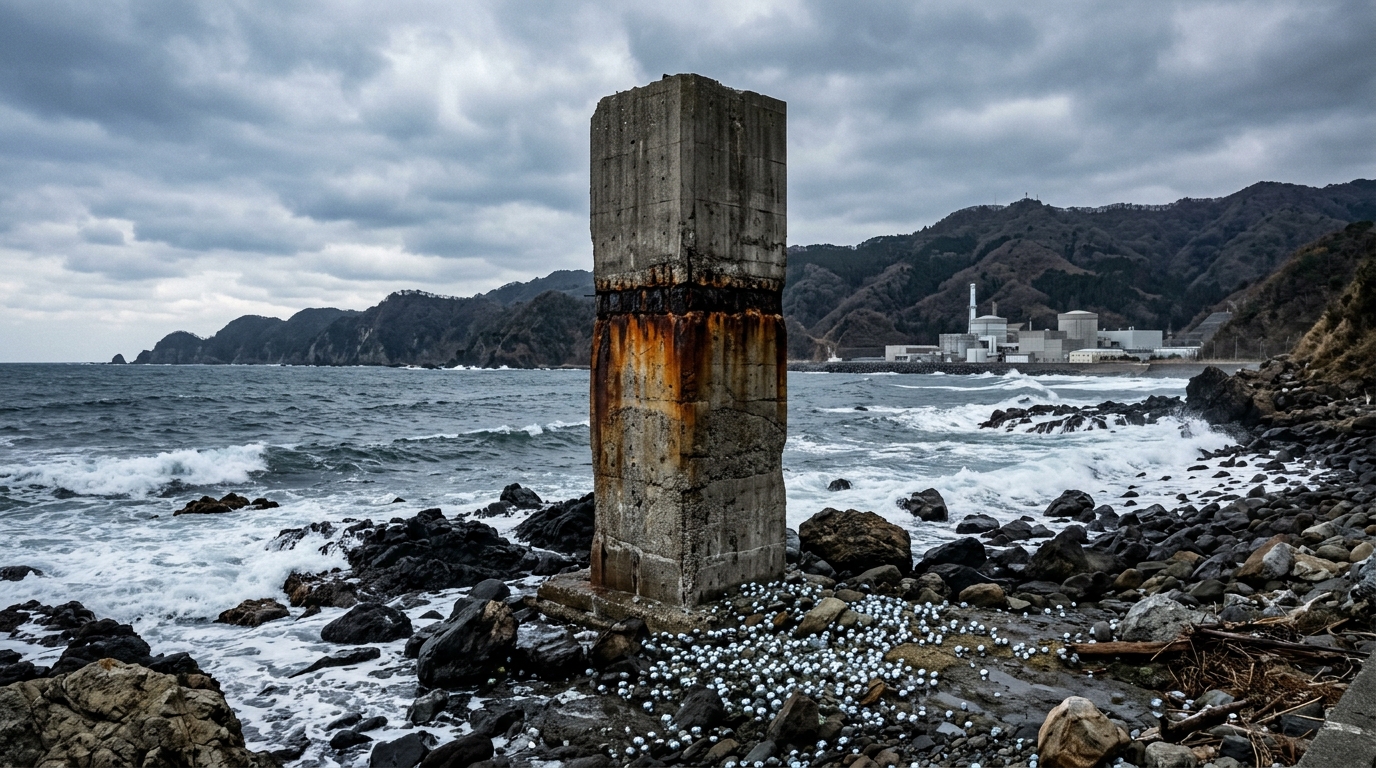
A concrete parametric bond fractures, releasing accumulated investor yield into the surge. · motion: binary structural forfeiture triggered by tidal submersion
wall text
This installation physicalizes the mechanics of catastrophe bonds issued to hedge seismic marine risk around the Onagawa Nuclear Power Plant. A concrete column represents the locked-in Special Purpose Vehicle principal, engineered to match the historic 14.8-meter defensive seawall designed by Yanosuke Hirai. At its base, glass spheres accumulate like dispersed coupon yields from uninterrupted non-event cycles. When a storm surge breaches the 13.0-meter parametric trigger threshold, internal mechanical linkages fracture the monolith. The catastrophic payout is executed not through institutional settlement, but as an immediate structural failure where financial risk and topographic elevation converge.
shown: Installed permanently on the shoreline directly adjacent to the Onagawa Nuclear Power Plant, exposed to the elements and high tide.
shown: Installed permanently on the shoreline directly adjacent to the Onagawa Nuclear Power Plant, exposed to the elements and high tide.
anchor facts used
- Engineer Yanosuke Hirai insisted on building the plant's seawall at 14.8 meters above sea level, based on his studies of the 869 Jogan tsunami.
- The March 2011 tsunami reached a height of 13.0 meters at the Onagawa site.
- Because it remained safely above the water line, the Onagawa plant, despite being the closest nuclear facility to the epicenter, survived intact and served as a refuge for 364 local residents.
mechanism
- Special Purpose Vehicle (SPV) Capital Lock-up — Translates the financial escrow of a catastrophe bond into a monolithic vertical structure that precisely matches the physical height of Hirai's defensive seawall.
1. Establishing the SPV Principal: A solid column of structural concrete is poured at the historical tide line of the Onagawa coast, its height set exactly to 14.8 meters above sea level to represent the principal capital. - Parametric Trigger Threshold — Converts the legally defined binary condition of a catastrophic payout into a purely physical, chemical reaction dependent on seawater exposure.
2. Defining the Parametric Trigger: A saline-sensitive mechanical dissolution valve is embedded into the concrete column at exactly 13.0 meters above sea level. - Coupon Yield Distribution — Physicalizes the high yield paid to investors for carrying disaster risk during non-event years as a steady accumulation of fragile assets.
3. Distributing the Risk Premium: A mechanized hopper at the 14.8m summit drops one glass sphere per high tide cycle down the column's exterior, accumulating at the base. - Principal Forfeiture upon Trigger Event — Mirrors the total loss of investor principal to fund recovery, substituting financial liquidation with rapid physical dumping into the sea.
4. Principal Default and Payout: If tidal inundation ever reaches the 13.0-meter valve, it immediately dissolves, collapsing the internal holding chamber and dropping all remaining spheres into the ocean.
lineage
- Tsunami stones (hihi) — Updates the ancient Japanese practice of physically marking historical inundation lines into an active, real-time financialized instrument.
- World Bank IBRD CAR 130 Catastrophe Bond — Critiques the abstract financialization of disaster risk by rendering a parametric bond's trigger as an inescapable, site-specific physical law.
- Ryoji Ikeda's 'data.path' — Reverses Ikeda's translation of physical phenomena into pure data, instead forcing pure statistical thresholds back into brutalist concrete reality.
curatorial qa (machine verdict, unedited)
SCORE 4/5 after 1 attempt(s)
READS: The monolithic concrete pillar splitting and disgorging hundreds of glass spheres when submerged by a catastrophic wave clearly materializes catastrophic bond forfeiture.
FAILS: The precise geometric threshold between the 13.0-meter surge trigger and the 14.8-meter defense boundary lacks legible graduation marks on the column itself.
READS: The monolithic concrete pillar splitting and disgorging hundreds of glass spheres when submerged by a catastrophic wave clearly materializes catastrophic bond forfeiture.
FAILS: The precise geometric threshold between the 13.0-meter surge trigger and the 14.8-meter defense boundary lacks legible graduation marks on the column itself.
spec: antigravity agent · keyframe/artifact: gemini-3.1-flash-image · video: veo-3.1 image-to-video · qa+wall text: gemini-3.7-flash watching the render · 41.1s total