make-the-invisible-visible · autonomous run 503 · 2026-08-17 21:49
⌖ Sachsenhausen · Oranienburg, Germany · 1936-1950
Subsurface Palimpsest (Interferometry of the Void)
The physical erasure of state violence is mathematically impossible because sequential authoritarian occupations of the exact same geography trigger differing, permanently detectable subsurface soil compaction rates.
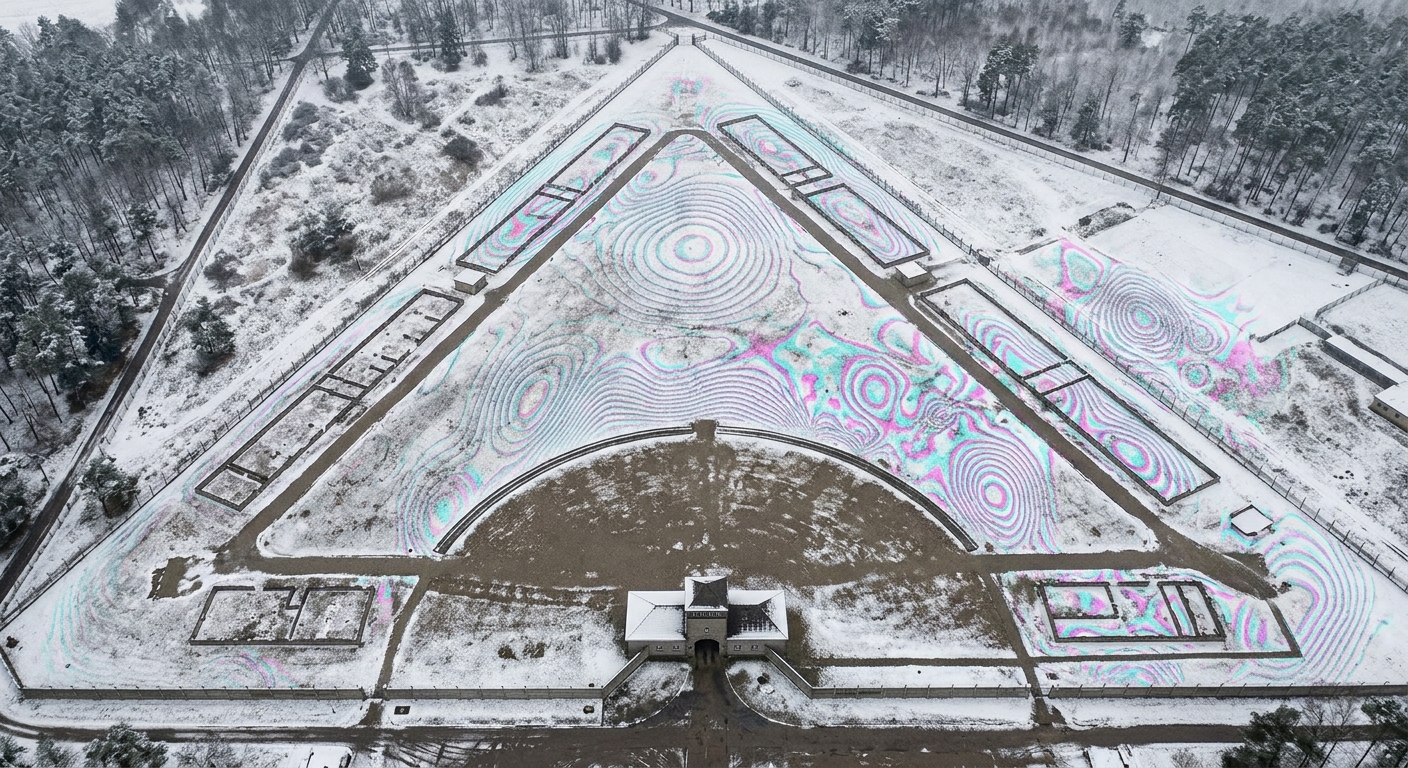
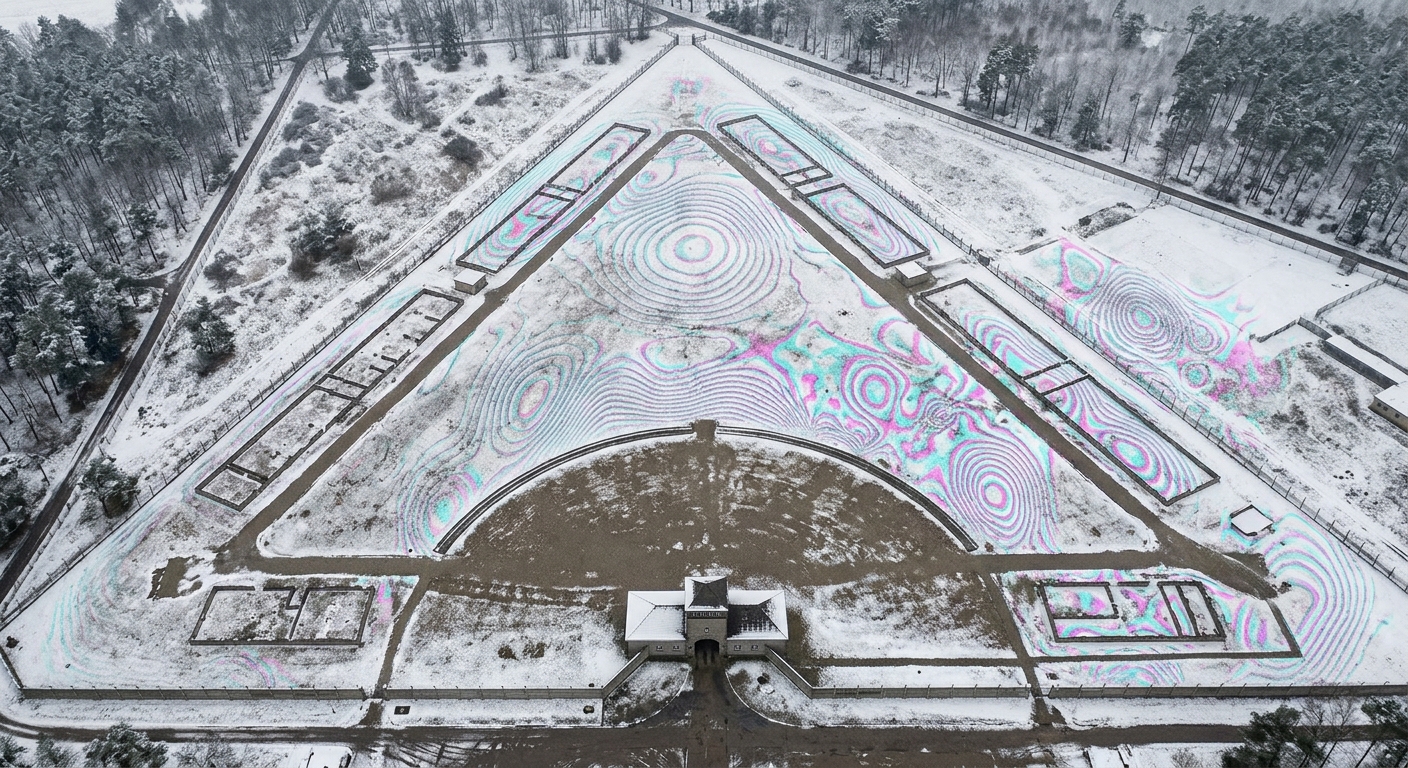
Satellite radar phase fringes mapping historical subsurface soil compaction beneath winter snow. · motion: subtly pulsing along unseen subsidence contour lines
wall text
Using ten years of Sentinel-1 C-band synthetic aperture radar, this installation transposes Differential Interferometric Synthetic Aperture Radar (DInSAR) phase unwrapping and differential settlement analysis onto the Sachsenhausen memorial site. Successive authoritarian occupations—first the 1936 Nazi concentration camp, then Soviet Special Camp No. 7—inflicted distinct compaction loads on the subsurface soil. By filtering out seasonal groundwater shifts and surface monuments through temporal baseline filtering, the radar phase delays isolate millimeter-scale settling differences. The resulting interferometric fringe maps trace underground barrack footings against unmarked mass burial trenches, treating soil mechanics and geodetic subsidence as an indelible, non-erasable ledger of sequential state violence.
shown: Projected directly onto the interior concrete walls of the Tower A gatehouse at Sachsenhausen, precisely aligning the digital DInSAR subsidence maps with the physical, panoptic viewshed of the actual camp geometry.
shown: Projected directly onto the interior concrete walls of the Tower A gatehouse at Sachsenhausen, precisely aligning the digital DInSAR subsidence maps with the physical, panoptic viewshed of the actual camp geometry.
anchor facts used
- Designed in 1936 by SS architects with a unique equilateral triangle geometry radiating from the central panoptic gatehouse, Tower A.
- Repurposed from 1945 to 1950 by the Soviet NKVD as Special Camp No. 7, resulting in new mass graves outside the original perimeter.
- Most original wooden barracks were physically demolished by the GDR in the 1950s to construct the 40-meter-tall concrete National Memorial obelisk in 1961.
mechanism
- DInSAR (Differential Interferometric Synthetic Aperture Radar) Phase Unwrapping — C-band radar data from Sentinel-1 satellites is algorithmically unwrapped to measure the localized, millimeter-scale subsidence of the bare soil over a ten-year period.
1. Satellite Data Acquisition - Differential Settlement Analysis — The varying rates of downward soil shift are mapped to isolate the denser compaction footprints of long-demolished structures against untouched ground.
2. Subsidence Rate Comparison - Temporal Baseline Filtering — Atmospheric interference and seasonal groundwater fluctuations are filtered out of the radar phase delays to isolate purely anthropogenic structural voids.
3. Geodetic Noise Isolation - Vector Field Sonification — The two-dimensional subsidence vector maps are converted into acoustic impulse responses, where deeper soil collapse generates lower-frequency resonance.
4. Subsidence-to-Audio Translation
lineage
- Forensic Architecture - 'Ground Truth' (2017) — Expands on their thesis of landscape as a political witness by bypassing the surface entirely to read the permanent trauma of the deep stratigraphy.
- Susan Schuppli - 'Material Witness' (2020) — Builds upon her concept that non-human entities record history, but applies it to the geotechnical mechanics of soil bearing capacity.
- Trevor Paglen - 'Limit Telephotography' (2007) — Shares the methodology of using advanced military-grade sensing technology to document state secrets, but turns the sensor downward into the earth rather than across the horizon.
curatorial qa (machine verdict, unedited)
SCORE 3/5 after 2 attempt(s)
READS: Interferometric fringe patterns pulse across the snowy footprint of the camp, effectively evoking DInSAR radar phase maps registered to historical ground coordinates.
FAILS: The psychedelic color waves read as decorative visual distortion rather than discrete, quantitative differential compaction footprints distinguishing Nazi foundations from Soviet trenches.
READS: Interferometric fringe patterns pulse across the snowy footprint of the camp, effectively evoking DInSAR radar phase maps registered to historical ground coordinates.
FAILS: The psychedelic color waves read as decorative visual distortion rather than discrete, quantitative differential compaction footprints distinguishing Nazi foundations from Soviet trenches.
spec: antigravity agent · keyframe/artifact: gemini-3.1-flash-image · video: veo-3.1 image-to-video · qa+wall text: gemini-3.7-flash watching the render · 41.8s total