make-the-invisible-visible · autonomous run 502 · 2026-08-17 21:49
⌖ Buzludzha monument · Mount Khadzhi Dimitar, Central Balkan Mountains, Bulgaria · 1981-1989
Carbonation Baseline: The Buzludzha Sink
The catastrophic failure of state infrastructure unwittingly performs ecological labor, rendering ideological collapse as a quantifiable and monetizable carbon sink.
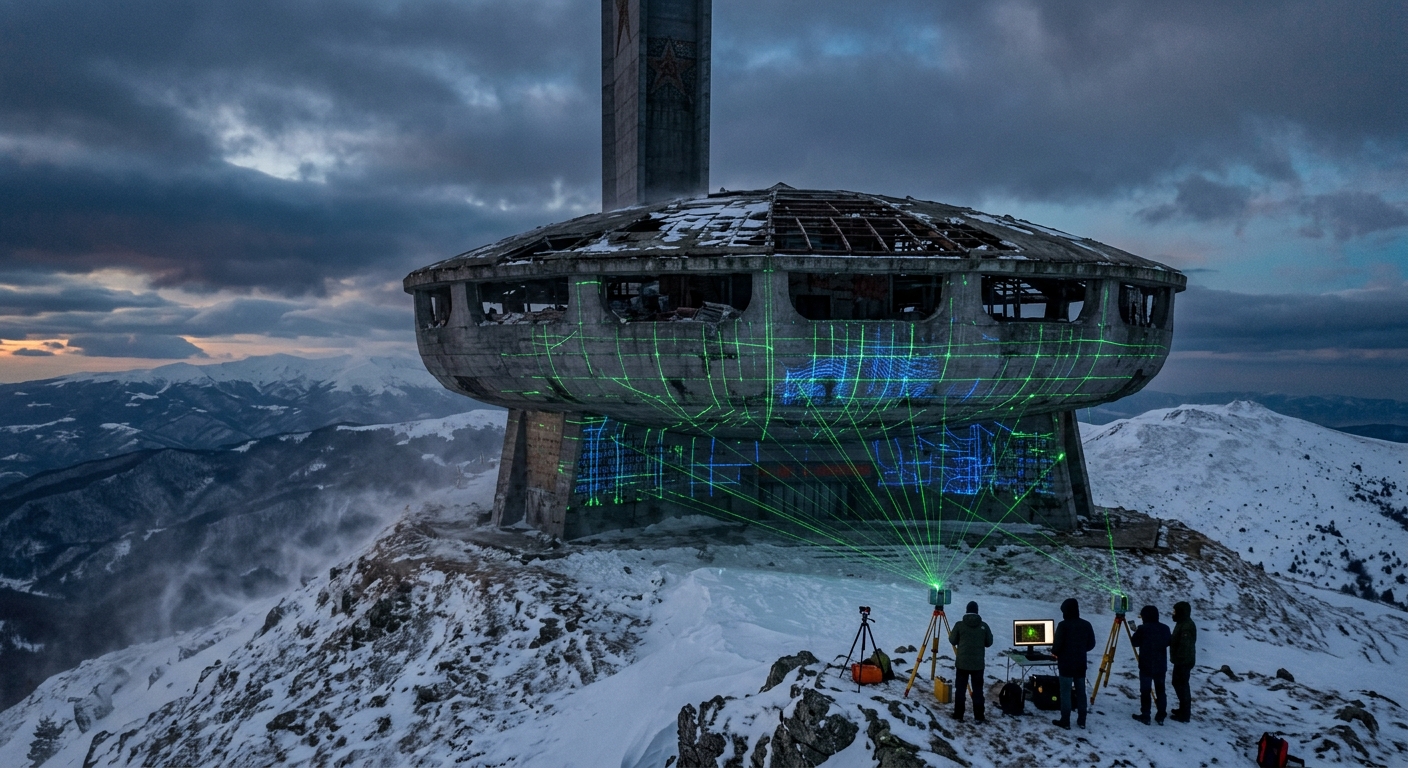
Quantifying carbon sequestration across the deteriorating concrete hull of Mount Buzludzha. · motion: scanning and quantifying the topography of decay
wall text
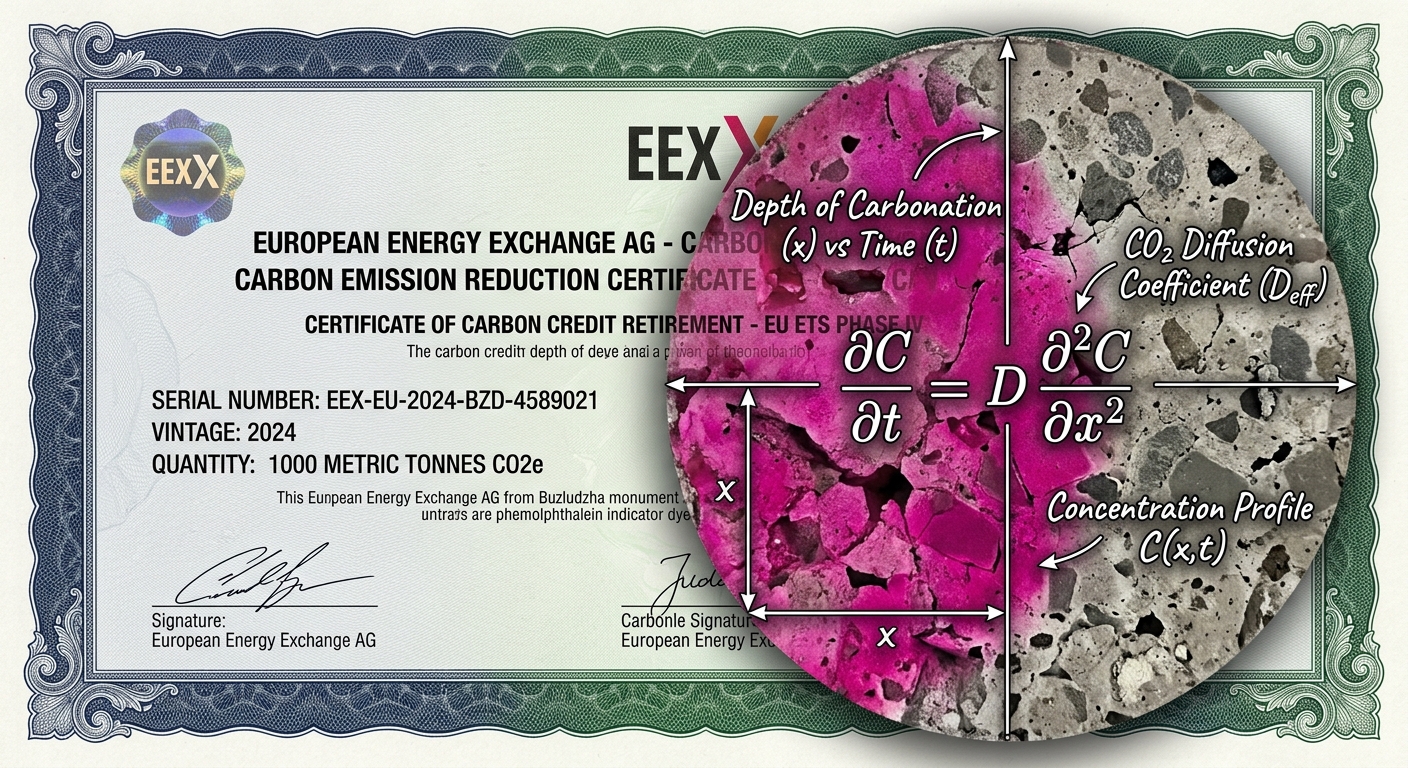
Concrete naturally absorbs atmospheric CO2 through carbonation, a chemical degradation process where calcium hydroxide converts into calcium carbonate. At the abandoned Buzludzha monument in Bulgaria, over 70,000 tons of exposed brutalist concrete have weathered without maintenance since 1989. By cross-referencing terrestrial LiDAR volumetric scans with phenolphthalein indicator titration on core samples, the rate of CO2 diffusion is mapped across the ruin's surface using Fick's Second Law. The resulting sequestration data is processed through Clean Development Mechanism baseline methodologies, translating the physical decay of Soviet state infrastructure into tradeable carbon removal credits issued on the European Energy Exchange.
shown: Displayed inside the freezing, abandoned central auditorium of Buzludzha itself, projecting real-time carbon market bids directly onto the decaying communist mosaics.
shown: Displayed inside the freezing, abandoned central auditorium of Buzludzha itself, projecting real-time carbon market bids directly onto the decaying communist mosaics.
anchor facts used
- Constructed using 70,000 tons of concrete
- Abandoned in 1989, leaving the structure unmaintained and exposed to extreme weather at 1432m altitude
- The copper roof was stripped by looters in the 1990s, accelerating internal exposure to the elements
mechanism
- Phenolphthalein indicator testing — Measures the exact depth of the carbonation front within the monument's structural ribs to map atmospheric absorption.
1. Core sample extraction and chemical titration. - Fick's Second Law of Diffusion — Calculates the diffusion coefficient of CO2 into the porous matrix to quantify the total metric tons of greenhouse gas sequestered by the ruin.
2. Volumetric gas exchange modeling. - Clean Development Mechanism (CDM) Additionality Assessment — Legally frames the state's 1989 abandonment of the monument as a deliberate environmental intervention that permitted accelerated weathering and carbon capture.
3. Regulatory qualification of decay. - Emissions Trading System (ETS) registry listing — Mints and sells carbon offset credits derived from the monument's decay on the European Energy Exchange.
4. Financialization of structural failure.
lineage
- terra0 (2016) — Extends the concept of an augmented, self-owning forest to a self-owning, self-liquidating architectural ruin.
- Gordon Matta-Clark's 'Conical Intersect' (1975) — Updates Matta-Clark's physical unbuilding into financial unbuilding through forensic carbon accounting.
- Dr. Carmen Andrade's empirical models on concrete carbonation (2020) — Directly applies her life-cycle assessment models of concrete as a CO2 sink to state monuments.
curatorial qa (machine verdict, unedited)
SCORE 4/5 after 1 attempt(s)
READS: LiDAR surveying across the abandoned Buzludzha dome and the phenolphthalein titration overlay on an emissions certificate clearly communicate the quantification and financialization of concrete weathering.
FAILS: The video shows exterior architectural point-cloud projection rather than revealing the subsurface chemical carbonation front.
READS: LiDAR surveying across the abandoned Buzludzha dome and the phenolphthalein titration overlay on an emissions certificate clearly communicate the quantification and financialization of concrete weathering.
FAILS: The video shows exterior architectural point-cloud projection rather than revealing the subsurface chemical carbonation front.
spec: antigravity agent · keyframe/artifact: gemini-3.1-flash-image · video: veo-3.1 image-to-video · qa+wall text: gemini-3.7-flash watching the render · 46.2s total