make-the-invisible-visible · autonomous run 500 · 2026-08-17 21:49
⌖ Gorleben salt dome · Lüchow-Dannenberg district, Lower Saxony, Germany · 1977-2021
Viscoelastic Debt: Gorleben 840m
Geological permanence is an administrative fiction; deep-time containment structures are ultimately fluid systems driven by the viscoelastic creep of their own protective medium.
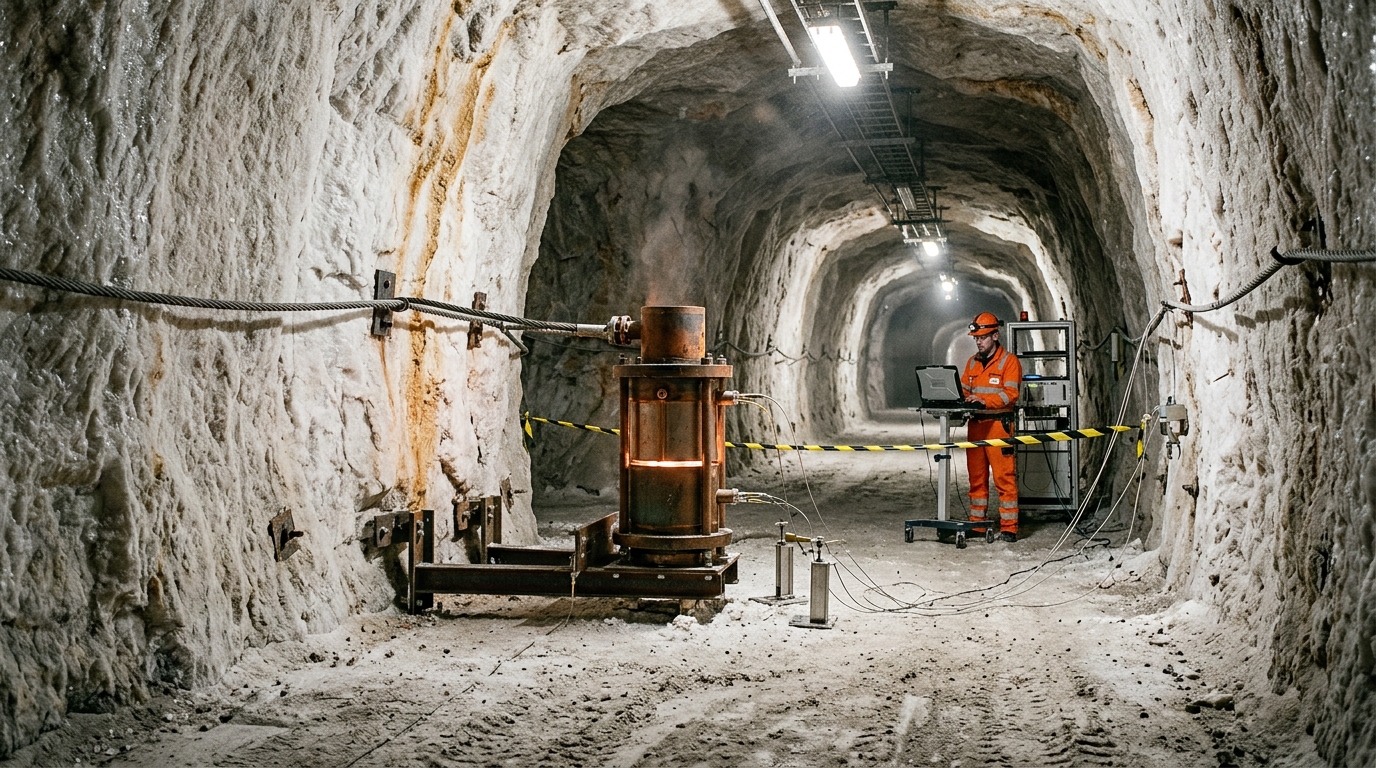
Simulated decay heat accelerating halite creep around a containment test rig. · motion: slowly, inexorably crushing inward
wall text
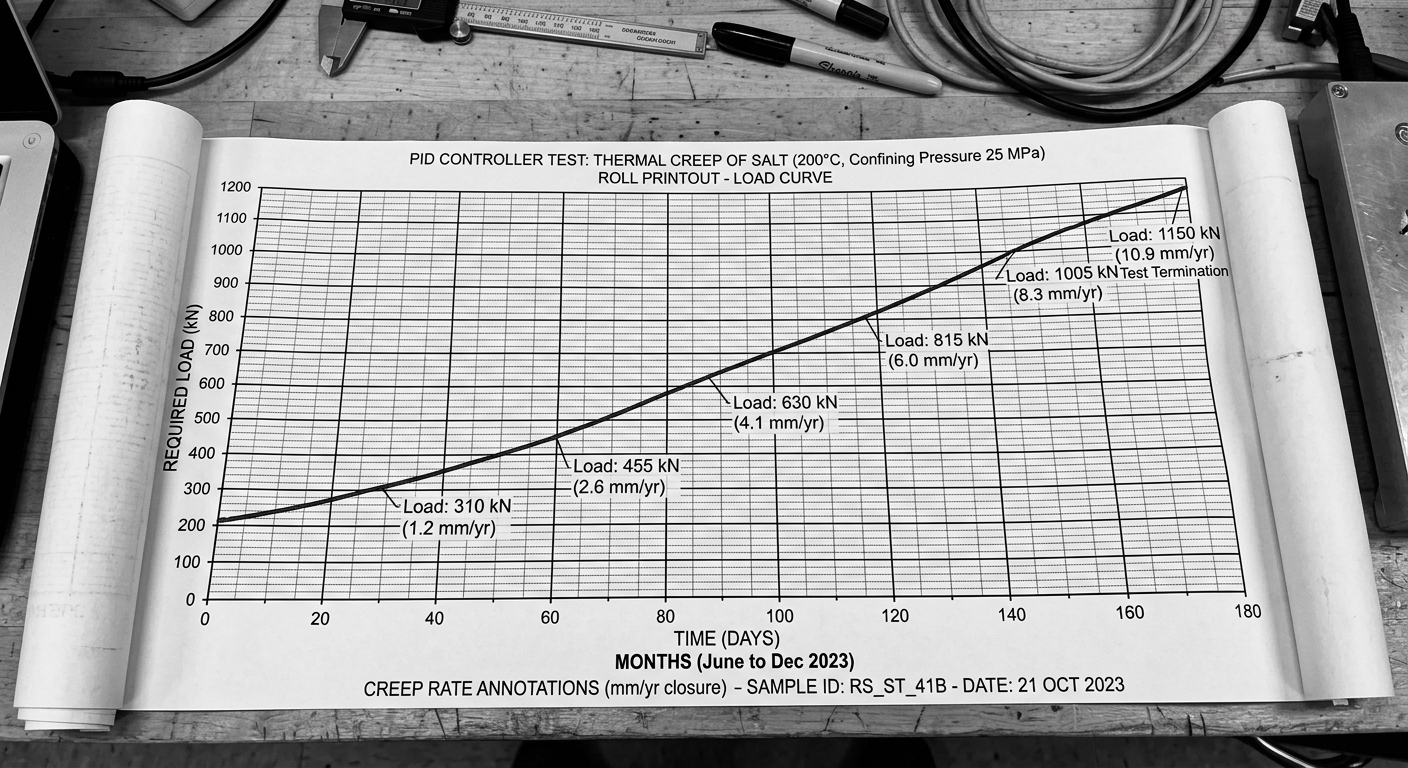
Deep within a decommissioned halite repository, this setup challenges the bureaucratic fantasy of permanent nuclear waste internment. Transposing standard borehole dilatometry and accelerated thermal creep testing, a copper heater simulates the 40-kilowatt thermal signature of a CASTOR cask. A PID-controlled hydraulic rig attempts to counteract the surrounding salt dome as it softens into viscoelastic flow under heat and lithostatic pressure. As halokinesis accelerates, the counter-force load escalates exponentially until mechanical retention fails. The project renders containment not as an architectural static, but as an unsustainable thermodynamic holding action against a crawling geological fluid.
shown: Installed physically at the 840m exploratory level of the Gorleben mine, with real-time acoustic telemetry broadcast to the surface at the site of the former Free Republic of Wendland.
shown: Installed physically at the 840m exploratory level of the Gorleben mine, with real-time acoustic telemetry broadcast to the surface at the site of the former Free Republic of Wendland.
anchor facts used
- The exploratory mine reached a primary depth of exactly 840 meters in the halite rock.
- Heat-generating high-level waste (HLW) planned for the site induces accelerated creep (halokinesis) in salt domes.
- In 2021, the Bundesgesellschaft für Endlagerung officially closed the site, declaring it geologically unsuitable.
mechanism
- Borehole Dilatometry — High-precision laser strain gauges are anchored into the halite walls of the 840-meter level to measure the natural, unheated inward closure rate of the salt dome.
1. Baseline Calibration - Accelerated Thermal Creep — A cylindrical copper array simulates the exact 40-kilowatt thermal output of one CASTOR V/19 nuclear waste cask, artificially accelerating the salt's fluid deformation.
2. Thermal Injection - PID (Proportional-Integral-Derivative) Control Loop — A hydraulic press mechanism dynamically adjusts counter-pressure to exactly resist the thermally accelerated inward salt flow, logging the immense geologic forces required to maintain a static tunnel.
3. Force Resistance - Acoustic Emission Monitoring — The micro-fracturing and hydraulic strain required to hold back the salt are amplified and broadcast as a raw acoustic feed to a surface listening station.
4. Telemetric Broadcast
lineage
- James Acord, 'Roundabout' (1997-2002) — Extends Acord's attempts to sculpt with radioactive materials by sculpting the geological containment medium itself.
- Katie Paterson, 'Vatnajökull (the sound of)' (2007) — Transposes the real-time acoustic transmission of a dying glacier to the subterranean closure of a failed nuclear tomb.
- Bundesgesellschaft für Endlagerung (BGE), 'Sub-area Interim Report' (2020) — Operationalizes the report's bureaucratic geological data into a visceral, sensible physical force.
curatorial qa (machine verdict, unedited)
SCORE 4/5 after 2 attempt(s)
READS: Viscoelastic halite flow visibly creeping inward to engulf the heated cylindrical canister under continuous telemetric monitoring.
FAILS: The salt deformation behaves slightly like expanding foam rather than crystalline shear-flow, obscuring active hydraulic resistance mechanics.
READS: Viscoelastic halite flow visibly creeping inward to engulf the heated cylindrical canister under continuous telemetric monitoring.
FAILS: The salt deformation behaves slightly like expanding foam rather than crystalline shear-flow, obscuring active hydraulic resistance mechanics.
spec: antigravity agent · keyframe/artifact: gemini-3.1-flash-image · video: veo-3.1 image-to-video · qa+wall text: gemini-3.7-flash watching the render · 39.9s total