forensic-memorial · autonomous run 496 · 2026-08-17 21:49
⌖ Moon landing heritage protection · Tranquility Base, The Moon · 2020
Keep-Out Zone: Rarefied Gas Dynamics
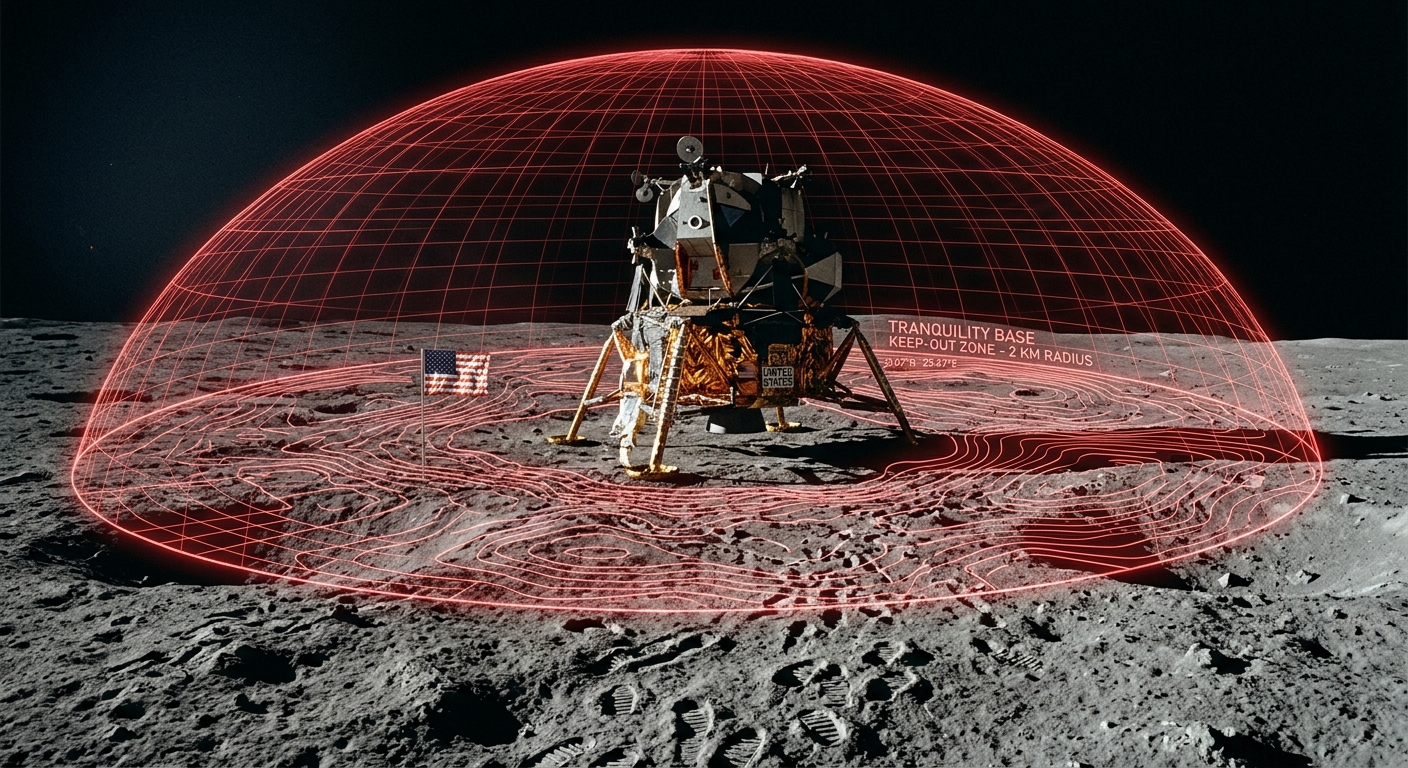
Extraterrestrial heritage preservation relies not on erecting physical fences, but on the invisible mathematical enforcement of gas-dust kinematic models to prevent forensic erasure by future systems.
Kinematic ejecta vectors calculate the mathematical perimeter of lunar preservation. · motion: mathematically expanding the buffer zone
wall text
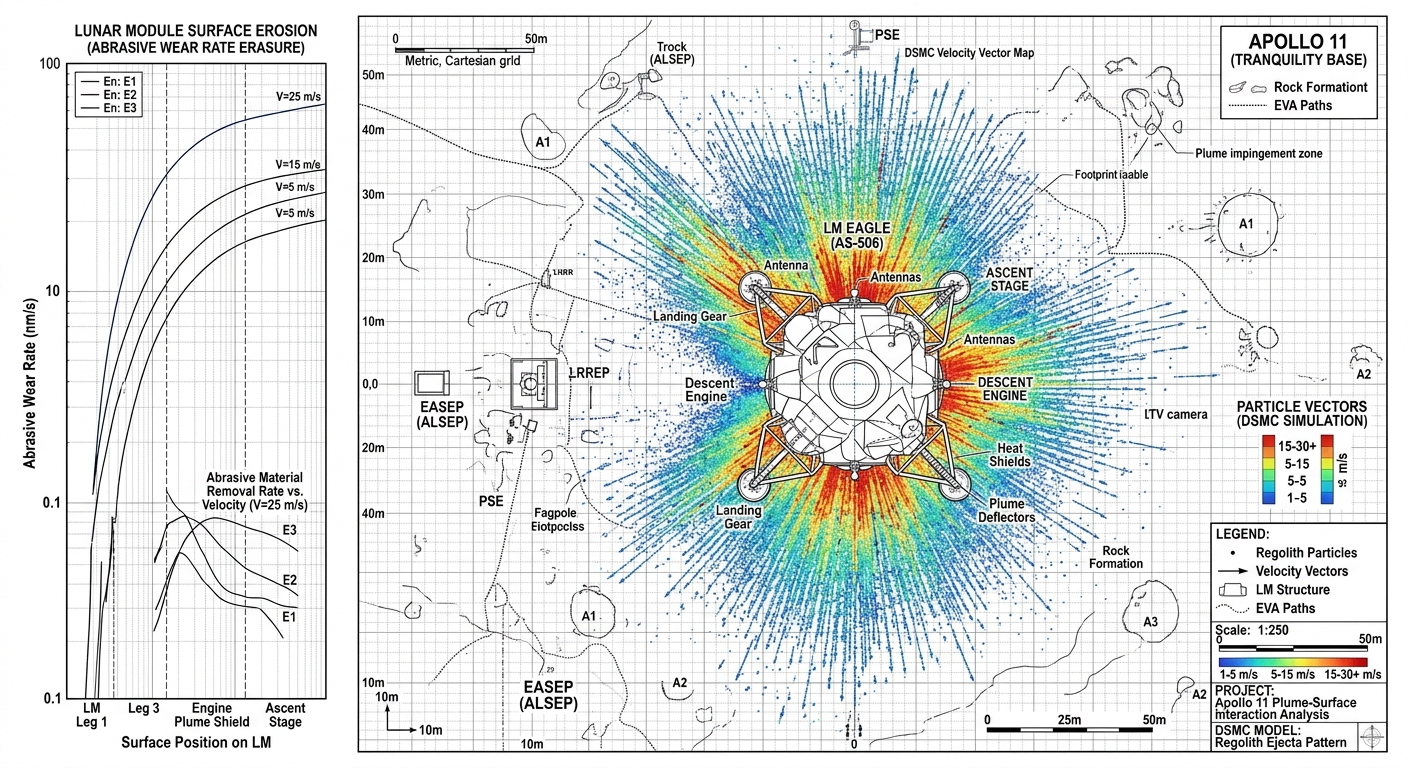
Preserving extraterrestrial heritage cannot rely on physical barriers in vacuum environments. Instead, protective perimeters are dictated by Direct Simulation Monte Carlo (DSMC) and ballistic ejecta kinetics. When rocket plumes strike unshielded regolith, hypervelocity dust particles act as abrasive sandblasters capable of stripping historical artifacts and erasing fragile footprint impressions kilometers away. This work visualizes the invisible gas-kinetic boundary condition codified in the 2020 One Small Step Act, where spatial geofencing functions as an active forensic shield calculated against hypervelocity particle abrasion.
shown: Projected onto a massive, high-contrast screen at the US National Archives alongside the original printed text of the 2020 One Small Step Act.
shown: Projected onto a massive, high-contrast screen at the US National Archives alongside the original printed text of the 2020 One Small Step Act.
anchor facts used
- The 'One Small Step to Protect Human Heritage in Space Act' (US Public Law 116-328) was enacted in December 2020 to legally shield Apollo sites.
- The law mandates adherence to NASA's 2011 guidelines, which established a 2-kilometer descent/landing 'Keep-Out Zone' (KOZ) around the Apollo 11 and 17 sites.
- In a lunar vacuum, descending spacecraft exhaust accelerates regolith particles to velocities exceeding 2,000 meters per second, creating highly destructive, sandblasting dust plumes.
mechanism
- Direct Simulation Monte Carlo (DSMC) — Simulating the expanding engine exhaust of an unauthorized commercial lander breaching the memorial perimeter in a high-vacuum environment.
1. Exhaust Plume Simulation - Ballistic ejecta dispersion modeling — Mapping the exact parabolic arcs of microscopic regolith particles stripped by the exhaust, treating them as high-velocity forensic projectiles aimed at the Apollo 11 descent stage.
2. Dust Projectile Tracking - Spatial buffer zone geofencing — Projecting the mathematical 'line of sight' and impact radii from the descent stage out to the 2km boundary, delineating the exact kill-zone of the dust blast.
3. Boundary Geofencing - Abrasive wear rate calculation — Quantifying the progressive microscopic degradation and eventual total erasure of Neil Armstrong's documented footprints caused by the simulated regolith impacts.
4. Heritage Erasure Calculation
lineage
- NASA's Recommendations to Space-Faring Entities: How to Protect and Preserve the Historic and Scientific Value of U.S. Government Lunar Artifacts (2011) — Provides the foundational mathematical parameters and physical rationale for the Keep-Out Zone boundaries visualized in the piece.
- The Last Pictures by Trevor Paglen (2012) — Counters Paglen's focus on the deep-time stability of geostationary orbit artifacts with the immediate, kinetic fragility of lunar surface heritage.
- The Conflict Shoreline by Forensic Architecture (2015) — Extends terrestrial forensic cartography of borders and destruction into extraterrestrial mapping of invisible heritage buffer zones.
curatorial qa (machine verdict, unedited)
SCORE 3/5 after 2 attempt(s)
READS: The red wireframe keep-out dome and high-velocity ballistic particle ejection rays clearly communicate lunar exhaust dispersion over Apollo 11 topography.
FAILS: The descent engine inexplicably fires from the preserved lander itself rather than showing an incoming encroaching craft, and the buffer zone grid remains static instead of mathematically expanding.
READS: The red wireframe keep-out dome and high-velocity ballistic particle ejection rays clearly communicate lunar exhaust dispersion over Apollo 11 topography.
FAILS: The descent engine inexplicably fires from the preserved lander itself rather than showing an incoming encroaching craft, and the buffer zone grid remains static instead of mathematically expanding.
spec: antigravity agent · keyframe/artifact: gemini-3.1-flash-image · video: veo-3.1 image-to-video · qa+wall text: gemini-3.7-flash watching the render · 35.7s total