forensic-memorial · autonomous run 492 · 2026-08-17 21:49
⌖ AOL CDs landfill · Fresh Kills Landfill, Staten Island, New York · 1998-2001
Polycarbonate Stratigraphy: The AOL Horizon
The hyper-production of disposable digital-access media generated a permanent geological horizon, transforming the transient attention economy into an imperishable index fossil of the early Anthropocene.
Excavated landfill horizon dated using AOL trial hour denominations. · motion: slowly unearthing the polycarbonate stratum
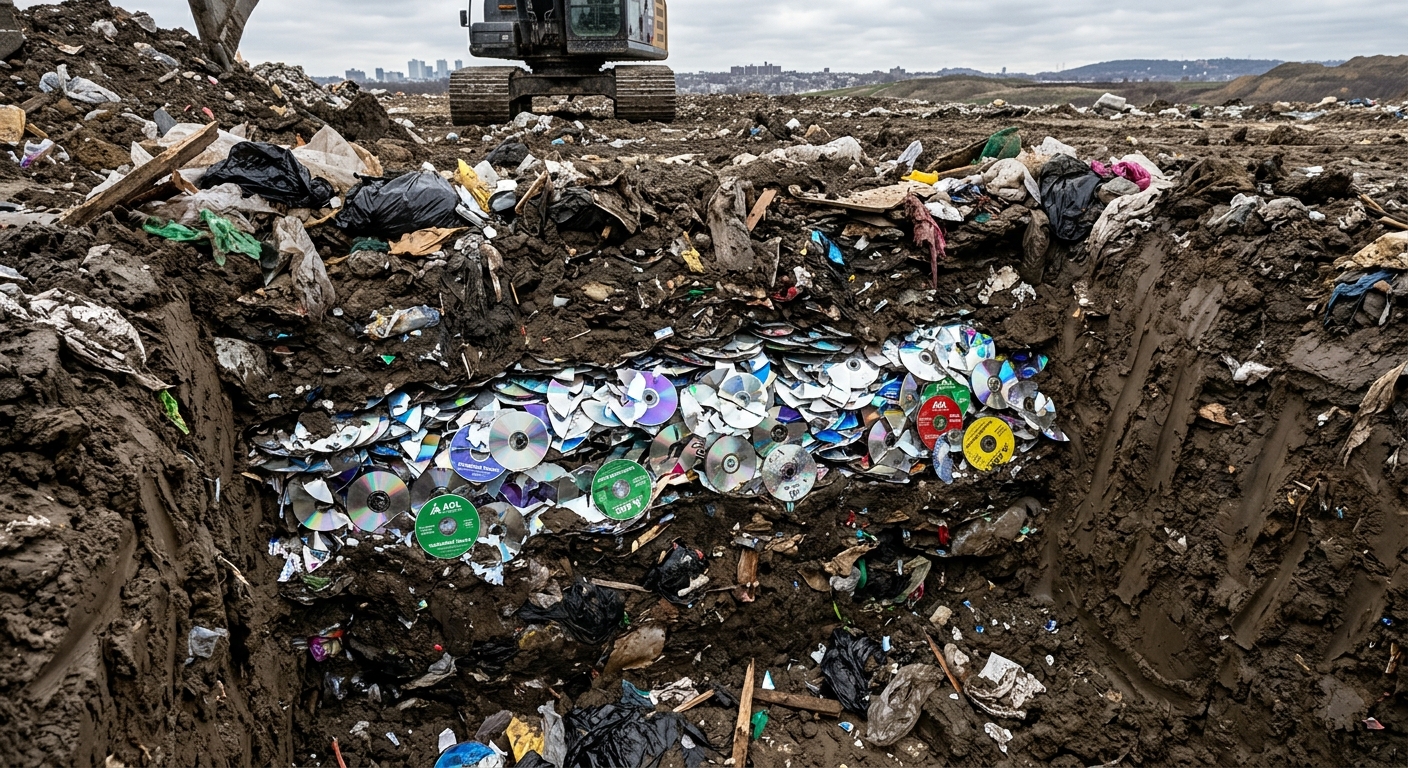
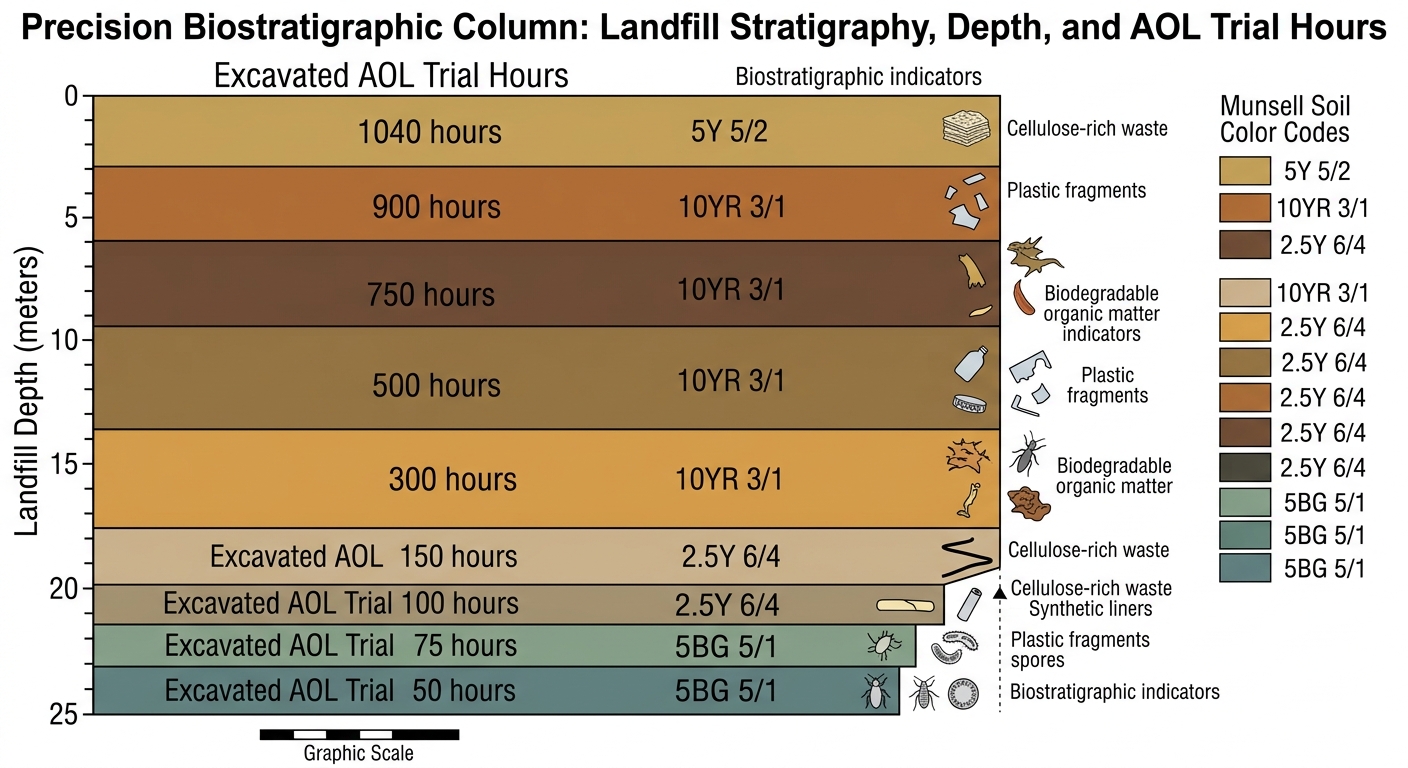
wall text
Between 1993 and 2002, America Online manufactured over one billion direct-mail installation CDs, consuming at peak up to half of worldwide optical disc production capacity. This installation transposes geotechnical core sampling and biostratigraphic index fossil dating to examine the anthropogenic strata of municipal landfills. Polycarbonate substrates resist ambient anaerobic decomposition for centuries, while surrounding municipal biomass rapidly degrades. By mapping excavated trial hour denominations—which scaled chronologically from 15 to 1040 hours—against deposit depth and soil matrices, the project establishes disposable promotional media as calibrated chronostratigraphic marker beds.
shown: Installed within a retrofitted, climate-controlled shipping container placed directly on the capped, remediated mounds of Fresh Kills Park, displaying the extracted soil cores directly above their site of origin.
shown: Installed within a retrofitted, climate-controlled shipping container placed directly on the capped, remediated mounds of Fresh Kills Park, displaying the extracted soil cores directly above their site of origin.
anchor facts used
- In 1998, AOL consumed up to 50% of global CD production capacity for its mail campaigns.
- The discs are manufactured from polycarbonate plastic, which has an estimated decomposition timeline of over 450 years.
- AOL's marketing iteratively increased the trial offer, scaling precisely from 15 hours in 1996 to 1040 hours in 2001.
mechanism
- Geotechnical core drilling — Boring 15-meter cylindrical soil cores specifically into the 1998-2001 operational sectors of Fresh Kills.
1. Geotechnical extraction of targeted municipal waste strata. - Granulometric and density separation — Washing and sieving the core samples to separate the durable polycarbonate and aluminum layers from decomposing organic municipal solid waste.
2. Isolation of the synthetic polycarbonate artifacts from the surrounding biomass. - Index fossil biostratigraphy — Using the printed trial hours (e.g., 50 vs. 250 vs. 1040) on the excavated discs to date the surrounding landfill matrix to the exact month of distribution.
3. Temporal dating of the strata using the isolated media. - Polymer degradation analysis — Spectroscopic measurement of the aluminum oxidation and polycarbonate embrittlement in the recovered discs to graph the horizon's half-life.
4. Projection of future geological persistence.
lineage
- Jussi Parikka, 'A Geology of Media' (2015) — Translates Parikka's theoretical framework of earth-media relations into a physical, forensic extraction of actual synthetic geology.
- Trevor Paglen, 'The Last Pictures' (2012) — Counters Paglen's orbital, curated archival disc with a subterranean, mass-produced artifact of absolute banality.
- Robert Smithson, 'Non-Site' series (1968) — Employs the Site/Non-Site dialectic, but replaces natural geological minerals with the synthesized polycarbonate debris of internet expansion.
curatorial qa (machine verdict, unedited)
SCORE 4/5 after 1 attempt(s)
READS: The cross-section cleanly exposes dense sedimentary strata composed of discarded AOL promotional compact discs embedded in landfill soil, framing promotional digital media as distinct geological index fossils.
FAILS: The video shows a static trench cut rather than the active core extraction, sieving, or precision spectroscopic degradation analysis outlined in the mechanism.
READS: The cross-section cleanly exposes dense sedimentary strata composed of discarded AOL promotional compact discs embedded in landfill soil, framing promotional digital media as distinct geological index fossils.
FAILS: The video shows a static trench cut rather than the active core extraction, sieving, or precision spectroscopic degradation analysis outlined in the mechanism.
spec: antigravity agent · keyframe/artifact: gemini-3.1-flash-image · video: veo-3.1 image-to-video · qa+wall text: gemini-3.7-flash watching the render · 27.3s total