forensic-memorial · autonomous run 489 · 2026-08-17 21:48
⌖ Subsea cable landing stations · Porthcurno Valley and Beach, Cornwall, UK · 1870-present
Impedance Stratigraphy: Porthcurno 50.04°N
The cumulative physical degradation of subsea communication cables over time correlates directly with localized histories of maritime and geopolitical conflict, meaning the electrical impedance of abandoned infrastructure serves as a highly precise, physically verifiable archaeological record of human friction.
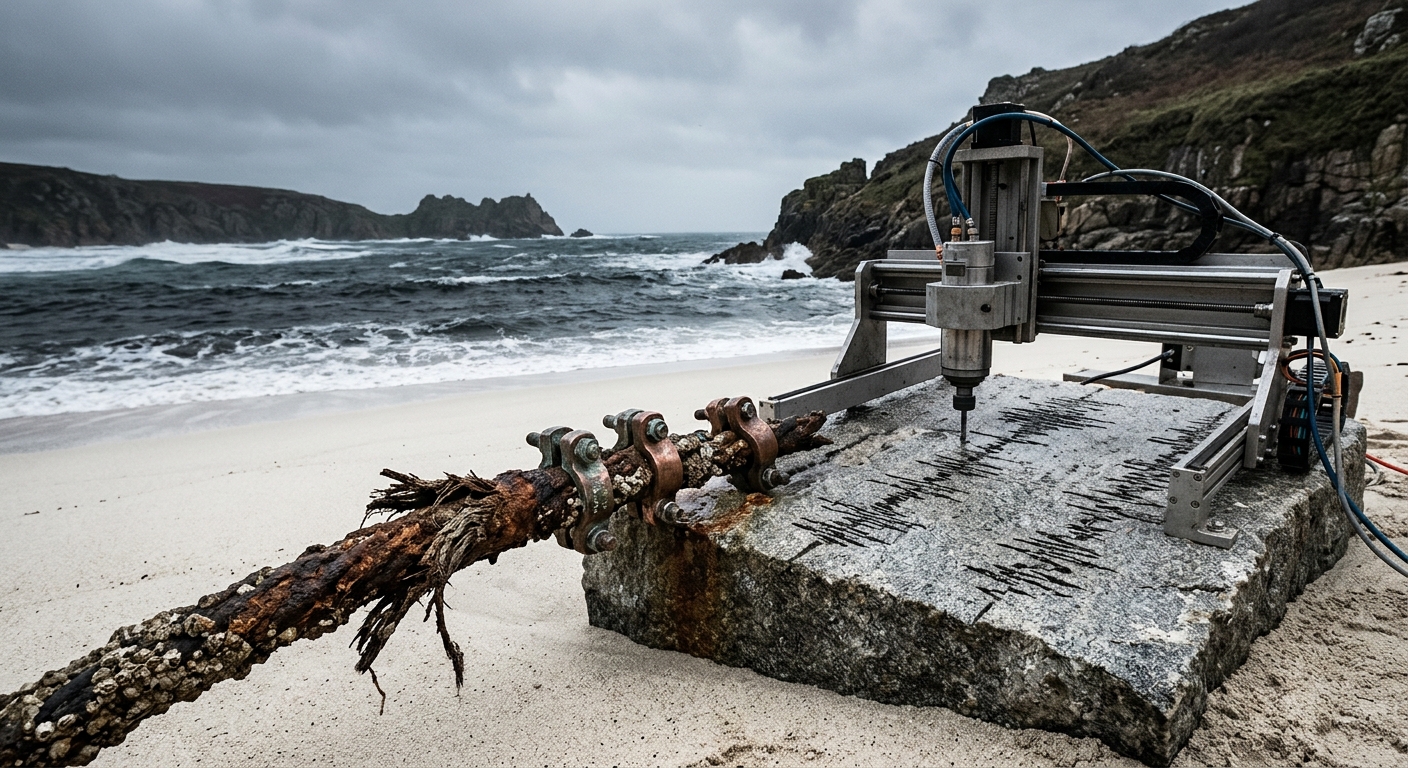
A beachside CNC mill translates cable impedance reflections into granite carvings. · motion: Translating subterranean electrical echoes into slow, permanent geological scarring.
wall text
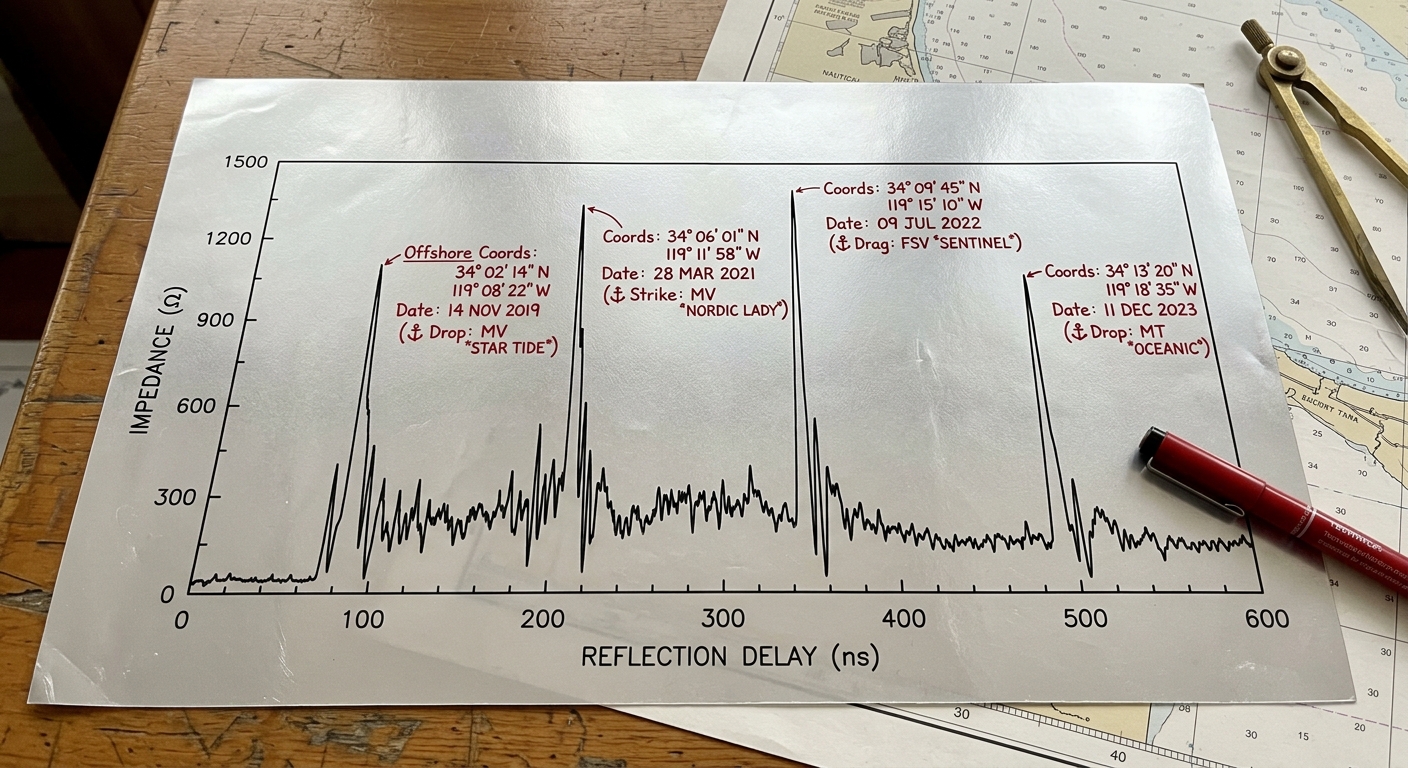
Exposed remnants of an 1870 subsea telegraph line are sounded using Time-Domain Reflectometry (TDR). High-frequency electrical pulses travel down the surviving copper core beneath the seabed, bouncing back when encountering physical damage such as anchor drags, cable breaks, and insulation decay. By calculating the velocity of propagation, reflection delay is converted into precise offshore coordinates. On the beach, a portable CNC mill translates these impedance spikes into permanent toolpaths cut into local granite. The piece reconfigures standard industrial fault-finding protocols into deep-time archaeology, registering historical maritime traffic and physical seabed disturbances as hard geological inscriptions.
shown: Installed permanently inside the restored WWII bomb-proof granite Z-booth tunnels of the Porthcurno Telegraph Museum, directly adjacent to the functioning modern fiber-optic landing vaults.
shown: Installed permanently inside the restored WWII bomb-proof granite Z-booth tunnels of the Porthcurno Telegraph Museum, directly adjacent to the functioning modern fiber-optic landing vaults.
anchor facts used
- The June 1870 landing of the Falmouth, Gibraltar and Telegraph Company gutta-percha cable to Bombay.
- The WWII relocation of the telegraph operations into bomb-proof Z-booth tunnels excavated by Cornish tin miners into the granite cliffs.
- The beach's current status as the active landing site for modern fiber-optic lines, including the FLAG Atlantic-1 (FA-1) cable.
mechanism
- Time-Domain Reflectometry (TDR) step-pulse injection — Repurposed from a routine maintenance diagnostic into a deep-time archaeological sounding instrument to probe dead transmission lines.
1. Inject a high-frequency, fast rise-time step-voltage pulse into the severed end of the 1870 gutta-percha telegraph cable exposed at low tide on Porthcurno beach. - Impedance mismatch reflection capture — Translates ephemeral electrical signal echoes into a forensic, linear map of historical physical damage and structural trauma.
2. Capture the reflected voltage waveforms bouncing back from physical anomalies—rust, splices, water ingress, and structural severing—along the cable's remaining subsea length beneath the Celtic Sea. - Velocity of Propagation (VoP) distance calculation — Maps electrical faults directly to documented spatial data of shipwrecks, submarine netting, and anchor drags in the English Channel.
3. Calculate the exact distance to each anomaly using the cable's specific dielectric constant, converting reflection time into precise offshore coordinates. - Computer Numerical Control (CNC) topographical milling — Freezes fleeting diagnostic telemetry into a permanent, physical geological monument to network fragility.
4. Mill the resulting distance-to-fault waveform into a continuous physical core sample of local rock, creating a permanent structural memorial of the data network's physical trauma.
lineage
- Trevor Paglen, 'NSA-Tapped Undersea Cables, North Pacific Ocean' (2016) — Shifts the focus from the geopolitics of active surveillance to the physical decay and historical memory embedded in the cable itself.
- Susan Schuppli, 'Material Witness: Media, Forensics, Evidence' (2020) — Extends Schuppli's thesis of matter recording events by using electrical impedance as a literal witness to structural violence.
- Nicole Starosielski, 'The Undersea Network' (2015) — Materializes Starosielski's ethnographic and geographical history of cable landing stations into a functioning, localized forensic instrument.
curatorial qa (machine verdict, unedited)
SCORE 3/5 after 2 attempt(s)
READS: The physical link between the barnacle-encrusted cable terminus, TDR signal waveforms, and mechanical inscription onto granite, paired with clear TDR diagnostic chart documentation.
FAILS: The engraving head generates plasma-like sparks against granite rather than stone cutting slurry, obscuring whether the process is mechanical milling or electrical discharge.
READS: The physical link between the barnacle-encrusted cable terminus, TDR signal waveforms, and mechanical inscription onto granite, paired with clear TDR diagnostic chart documentation.
FAILS: The engraving head generates plasma-like sparks against granite rather than stone cutting slurry, obscuring whether the process is mechanical milling or electrical discharge.
spec: antigravity agent · keyframe/artifact: gemini-3.1-flash-image · video: veo-3.1 image-to-video · qa+wall text: gemini-3.7-flash watching the render · 33.2s total