forensic-memorial · autonomous run 488 · 2026-08-17 21:48
⌖ Equinix data centers in decommissioned bunkers · Frankfurt/London · 1960s Cold War to Present
Stratigraphy of the Cloud
The ultimate substrate of immaterial cloud storage is the weaponized geology of the Cold War, where the persistence of global financial data relies entirely on the exact concrete thickness designed to survive nuclear overpressure.
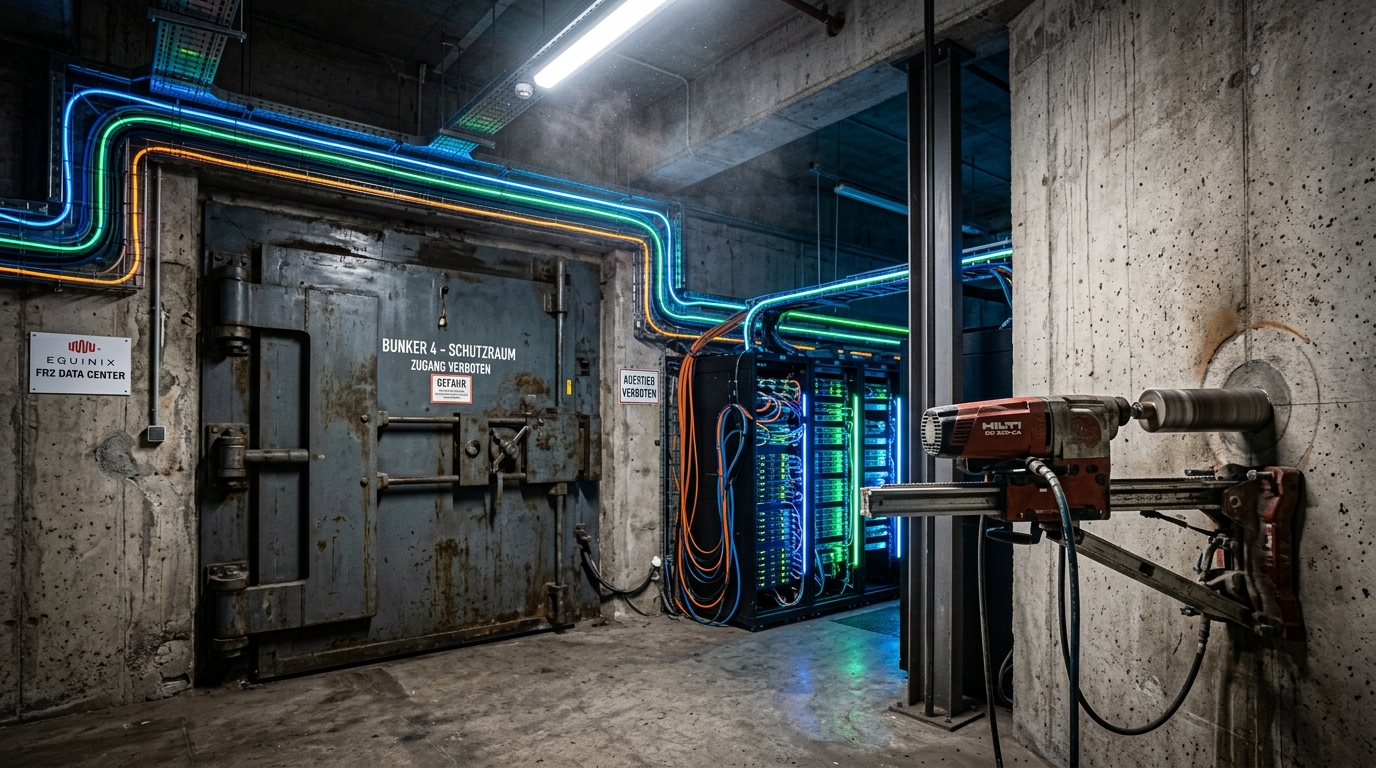
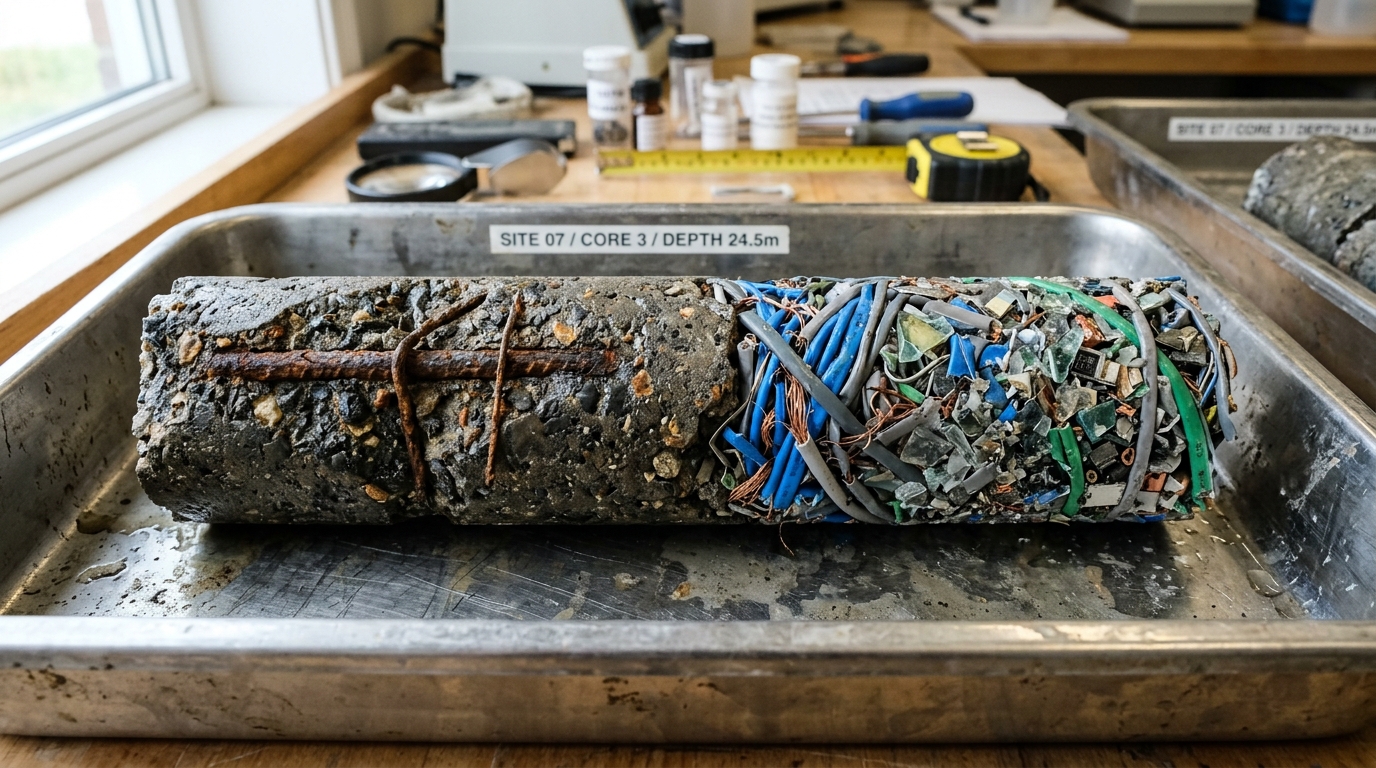
Diamond core extraction exposing the stratigraphic boundary between bunker concrete and data cables. · motion: extracting the physical layers of time
wall text
Modern data centers frequently colonize decommissioned Cold War bunkers, repurposing subterranean blast engineering as passive heat sinks and hardened security. This work transposes diamond-core extraction and stratigraphic facies logging to expose the material seam between military containment and global network routing. Coring directly through reinforced blast walls, the extractive process yields a continuous geological sample uniting 1960s nuclear-rated concrete aggregate with dense contemporary server cabling. The resulting core sample reframes intangible cloud storage as a heavy, forensic stratum permanently fused to the structural geology of twentieth-century weaponized defense.
shown: Installed inside the public lobby of Equinix FR2, displaying the extracted concrete-to-silicon core samples directly above the subterranean levels where they were drilled.
shown: Installed inside the public lobby of Equinix FR2, displaying the extracted concrete-to-silicon core samples directly above the subterranean levels where they were drilled.
anchor facts used
- 3-meter thick reinforced concrete walls originally poured for nuclear blast resistance
- Subterranean ambient temperature of 12°C structurally repurposed as a passive heat sink for server cooling
- High-density fiber optic cable trays anchored directly into the original 1960s steel blast doors
mechanism
- Rotary diamond-core drilling — Extracting a continuous 3-meter cylindrical core sample horizontally through the server hall wall to capture both military and commercial epochs.
1. Rotary Extractive Drilling - Visual core description and facies analysis — Logging the structural boundary (the 'unconformity') between 1960s military-grade blast-suppression aggregate and modern polymer server shielding.
2. Stratigraphic Facies Logging - Thermal desorption analysis — Analyzing the extracted core to map the heat signature gradients left by high-density cloud servers against the bunker's cold concrete walls.
3. Thermal Desorption Profiling - Geological core repository cataloging — Preserving the extracted bunker-to-server cores in refrigerated, climate-controlled cases as a forensic memorial to the cloud's physical geology.
4. Isotopic Core Archiving
lineage
- Trevor Paglen, 'The Last Pictures' — Expands Paglen's deep-time media archaeology from orbital space satellites down into subterranean Cold War bunker geography.
- Jussi Parikka, 'A Geology of Media' — Materializes Parikka's theoretical framework into actual, physical extractable geological cores from the data center walls.
- Forensic Architecture, 'Ground Truth' — Applies their methodology of physical structural evidence-gathering to the invisible architecture of algorithmic finance and cloud storage.
curatorial qa (machine verdict, unedited)
SCORE 3/5 after 2 attempt(s)
READS: The rotary core drill boring beside live server racks clearly establishes the physical collision between Cold War bunker architecture and digital infrastructure.
FAILS: The thermal logging and precise geological boundary analysis remain static visual props rather than legible dynamic processes.
READS: The rotary core drill boring beside live server racks clearly establishes the physical collision between Cold War bunker architecture and digital infrastructure.
FAILS: The thermal logging and precise geological boundary analysis remain static visual props rather than legible dynamic processes.
spec: antigravity agent · keyframe/artifact: gemini-3.1-flash-image · video: veo-3.1 image-to-video · qa+wall text: gemini-3.7-flash watching the render · 31.5s total