forensic-memorial · autonomous run 483 · 2026-08-17 21:48
⌖ Lampedusa · Pelagie Islands, Sicily, Italy · 2013-present
Stratigraphic Diagenesis of Molo Favaloro
The mass migration of the 21st-century Mediterranean has surpassed socio-political event horizons to become a permanent geological deposition, creating a distinct, physically measurable stratigraphic layer in the Anthropocene record.
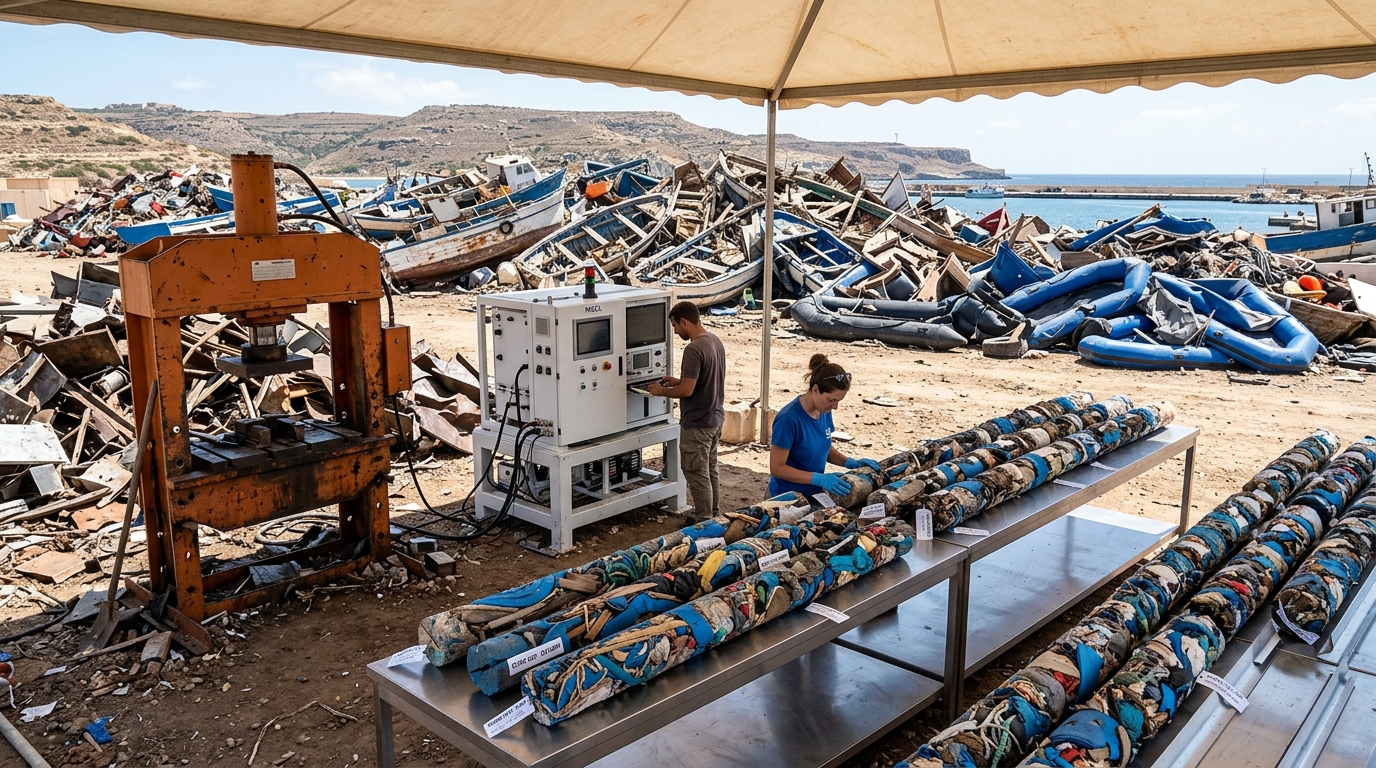
Hydraulic press extruding composite drill cores from confiscated migrant vessel debris. · motion: relentless mechanical extrusion
wall text
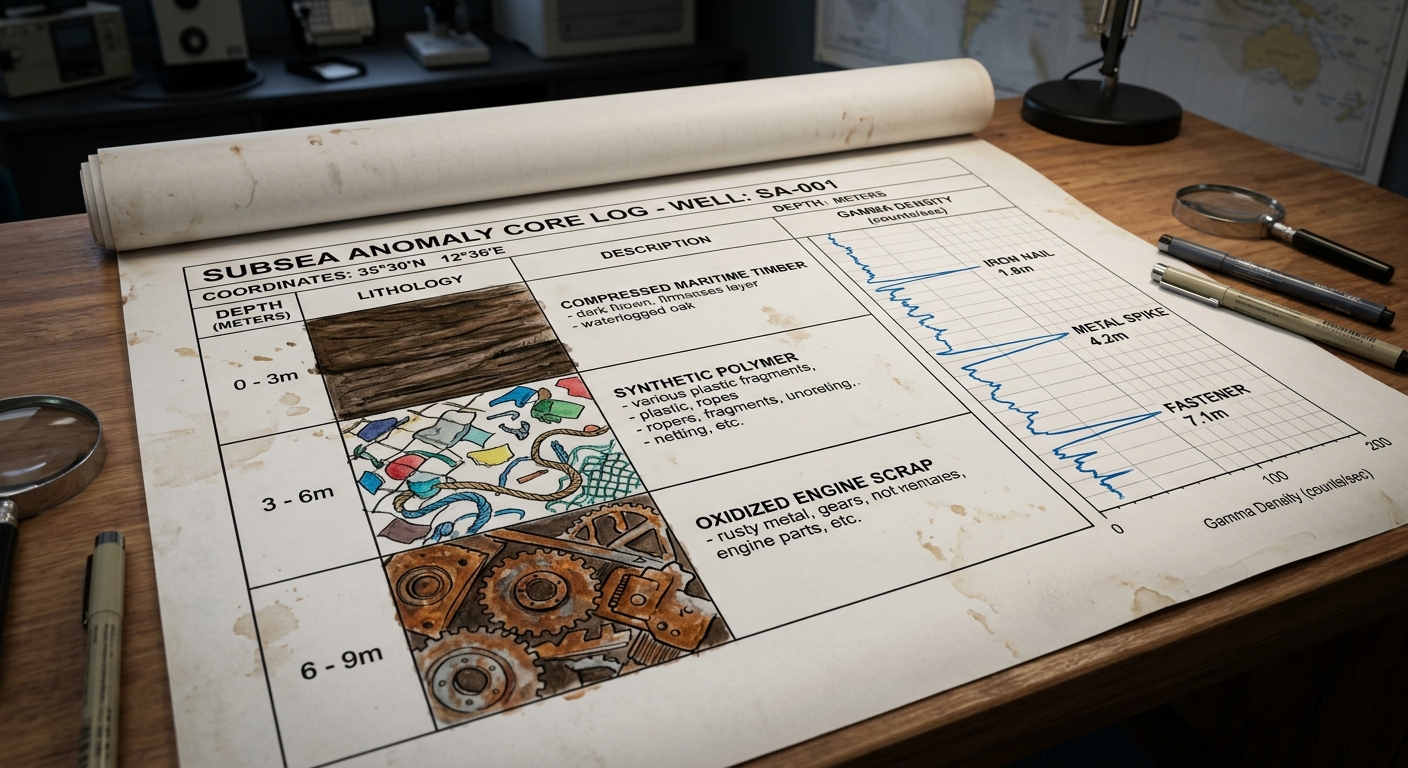
Set against the boat graveyards of Lampedusa, this installation treats the debris of Mediterranean migration as raw sediment for rapid lithification. Maritime timber, dinghy rubber, and textiles are compacted under industrial hydraulic pressure with silicate binders, transposing sedimentary diagenesis and benthic core extrusion into an automated processing line. The resulting cylindrical core samples mimic deep-sea paleoceanographic extractions, complete with stratigraphic logging that charts gamma density across synthetic polymer and oxidized engine strata. By formalizing humanitarian debris into standardized scientific cores, the work reframes border control friction and shipwreck salvage not as transient political crises, but as permanent physical horizons within the Anthropocene's geological record.
shown: Installed permanently inside the decommissioned Loran-C transmitter station on the western tip of Lampedusa, functioning as an open geological repository for future archaeologists.
shown: Installed permanently inside the decommissioned Loran-C transmitter station on the western tip of Lampedusa, functioning as an open geological repository for future archaeologists.
anchor facts used
- The island has a permanent population of approximately 6,000 residents.
- Molo Favaloro serves as the primary military and medical disembarkation pier.
- The 'Cimitero dei Barconi' (boat cemetery) functions as a dumping ground for confiscated, crushed migrant vessels.
- On October 3, 2013, a shipwreck immediately off the Lampedusa coast resulted in 368 documented deaths.
mechanism
- Sediment comminution — Applied to human tragedy artifacts instead of natural rock and mineral deposits to create the base matter for a new geological epoch.
1. Aggregate confiscation debris (maritime timber, synthetic rubber, personal textiles) from the island's boat cemetery and grind the material into a uniform 2mm particulate. - Diagenesis and Lithification — Accelerating geological time to instantly fossilize temporary, ad-hoc border enforcement policies into permanent stone.
2. Subject the particulate to 50 MPa of pressure in an industrial hydraulic press, injecting a silicate binder to simulate sedimentary rock formation. - Benthic Core Extrusion — Formatting border trauma into the standardized physical medium of climatology and paleoceanography.
3. Extrude the resulting mass into standardized 1-meter continuous cylindrical core samples, encasing them in split polycarbonate tubes. - Multi-Sensor Core Logging (MSCL) — Translating human loss and migration statistics into purely geophysical data arrays devoid of political rhetoric.
4. Process the synthetic cores through a Multi-Sensor Core Logger (MSCL) to measure bulk density, magnetic susceptibility, and fractional porosity.
lineage
- Forensic Architecture, 'The Left-to-Die Boat' (2012) — Extends their spatial tracking of ocean drift and surveillance regimes into the deep-time material preservation of the vessels themselves.
- International Ocean Discovery Program (IODP) Core Repositories — Appropriates the IODP's exact archival standards and visual language to legitimize anthropogenic trauma as indisputable geological fact.
- Jason deCaires Taylor, 'The Raft of Lampedusa' (2015) — Rejects his figurative, emotive underwater sculptures in favor of cold, unyielding geophysical data and actual forensic material.
curatorial qa (machine verdict, unedited)
SCORE 4/5 after 1 attempt(s)
READS: The transformation of boat cemetery detritus into standardized geological drill cores is immediately legible. The continuous extrusion from the hydraulic press directly mirrors stratigraphic lithification, reinforced by the technical gamma-density core log.
FAILS: The initial comminution grinding step is skipped, making the raw debris transition directly into bound cylinders without showing aggregate particle preparation.
READS: The transformation of boat cemetery detritus into standardized geological drill cores is immediately legible. The continuous extrusion from the hydraulic press directly mirrors stratigraphic lithification, reinforced by the technical gamma-density core log.
FAILS: The initial comminution grinding step is skipped, making the raw debris transition directly into bound cylinders without showing aggregate particle preparation.
spec: antigravity agent · keyframe/artifact: gemini-3.1-flash-image · video: veo-3.1 image-to-video · qa+wall text: gemini-3.7-flash watching the render · 42.5s total