forensic-memorial · autonomous run 482 · 2026-08-17 21:48
⌖ Lanzarote malpais vineyards · La Geria, Lanzarote, Canary Islands · 1730s-present
La Geria Chromatogram: Horizon 1730
Traumatic geological erasure functions as a high-fidelity preservation medium; the agricultural landscape is fundamentally a slow-motion chromatography column outputting delayed paleoclimatic data.
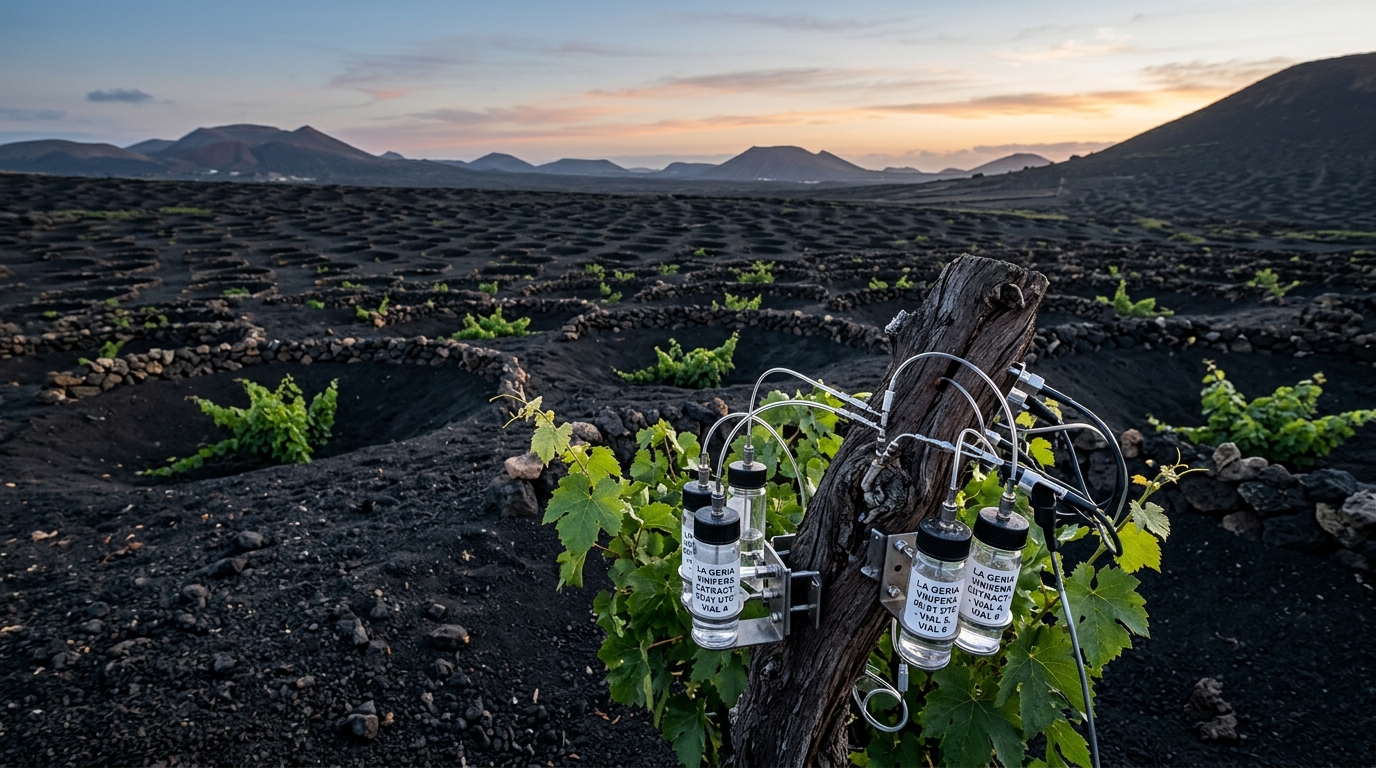
Fraction collection from pre-1730 paleosols via Malvasía vine capillaries in La Geria. · motion: slow upward capillary drawing against gravity
wall text
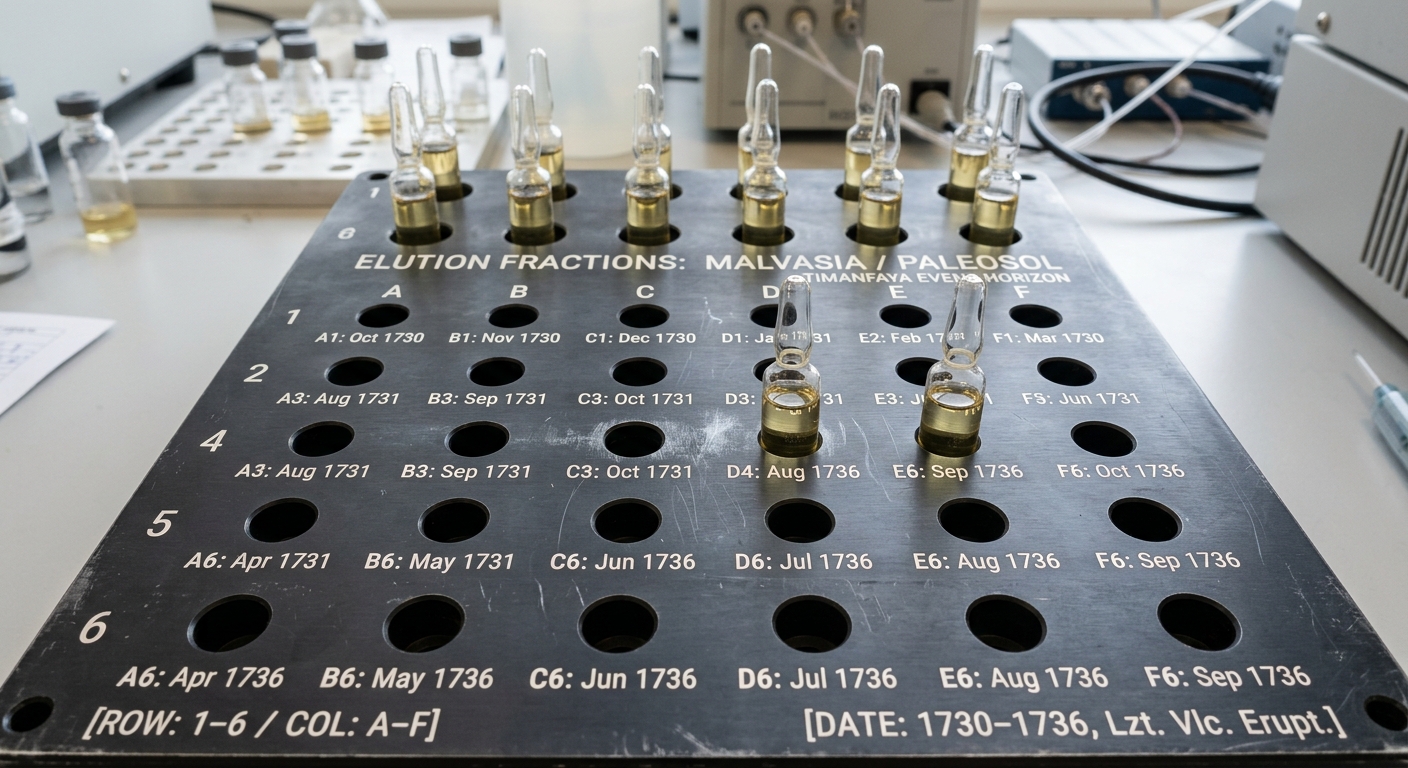
In Lanzarote's La Geria, the 1730–1736 Timanfaya eruptions buried fertile topsoil beneath meters of basaltic lapilli. This work reframes the sunken viticulture system as a slow-motion liquid chromatography column. Atmospheric dew condensed by the porous gravel acts as the mobile phase eluent, steadily percolating downward through the volcanic ash bed. Rooted directly into the sealed pre-eruption paleosol, Malvasía vines function as capillary extraction conduits. Rather than yielding wine, the transpirational stream is diverted into fraction collection vials, archiving discrete chemical readouts of a buried 18th-century horizon.
shown: Installed permanently within an abandoned bodegas at the edge of the Timanfaya National Park exclusion zone, presenting the archived fraction-vials in sterile climate-controlled racks alongside core samples of the lapilli.
shown: Installed permanently within an abandoned bodegas at the edge of the Timanfaya National Park exclusion zone, presenting the archived fraction-vials in sterile climate-controlled racks alongside core samples of the lapilli.
anchor facts used
- Between 1730 and 1736, the Timanfaya eruptions buried a quarter of the island's topsoil under lapilli (picón) ash up to 3 meters deep.
- Farmers dig conical hollows (hoyos) through the ash to reach the buried paleosol to plant Malvasia Volcanica vines.
- The volcanic lapilli acts as a hygroscopic mulch, trapping atmospheric dew from the Saharan trade winds (Alisios) to permit dry-farming in a 150mm/year rainfall climate.
- Semicircular dry-stone walls (zocos) are constructed around each vine on the windward side to protect them from the drying winds.
mechanism
- Mobile phase percolation (Column Chromatography) — Atmospheric dew harvested by the hygroscopic lapilli acts as the continuous mobile phase solvent, percolating downward over 290 years.
1. Eluent Application - Adsorption to the solid stationary phase bed — The massive stratum of 1730 volcanic ash functions as the solid stationary phase, filtering and retarding the chemical signature of the buried world.
2. Stationary Phase Retardation - Analyte extraction via capillary action — The central trunks of the Malvasia vines serve as extraction capillaries, drawing the isolated chemical compounds of the 1730 paleosol up through the ash bed.
3. Analyte Elution - Fraction collection and spectroscopic readout — The annual grape harvest is diverted from consumption into sealed geological core-vials, archiving discrete chronological fractions of the 18th-century soil profile.
4. Fraction Collection
lineage
- Center for Land Use Interpretation (CLUI), 'Terminal Lake Exploration' — Expands CLUI's forensic survey of endorheic basins into a vertical chronostratigraphy of an agricultural sacrifice zone.
- Katie Paterson, 'Vatnajökull (the sound of)' — Shifts the memorialization of environmental phase-change from live acoustic transmission to slow biochemical data extraction.
- Amy Balkin, 'A People's Archive of Sinking and Melting' — Replaces the distributed public archive of climate loss with a rigidly structured geological extraction protocol from a single surviving paleosol.
curatorial qa (machine verdict, unedited)
SCORE 4/5 after 1 attempt(s)
READS: Upward capillary pull against gravity through vine tubing into labeled sample vials across Lanzarote's volcanic landscape.
FAILS: The fluid has an overly intense luminous glow rather than resembling natural paleosol extract or sap.
READS: Upward capillary pull against gravity through vine tubing into labeled sample vials across Lanzarote's volcanic landscape.
FAILS: The fluid has an overly intense luminous glow rather than resembling natural paleosol extract or sap.
spec: antigravity agent · keyframe/artifact: gemini-3.1-flash-image · video: veo-3.1 image-to-video · qa+wall text: gemini-3.7-flash watching the render · 55.4s total