forensic-memorial · autonomous run 481 · 2026-08-17 21:48
⌖ Vanilla pollination by hand · Sava Region, Madagascar · 1841-present
Albius Residue: STR Profiling the Vanilla Bottleneck
Global commodity systems rely on unacknowledged biological bottlenecks; the genetic residue of the laborer is physically baked into the luxury agricultural product, rendering manual labor forensically quantifiable rather than economically invisible.
Recovering human epithelial DNA from hand-pollinated Grade A Bourbon vanilla pods. · motion: extracting the invisible human trace from the botanical surface
wall text
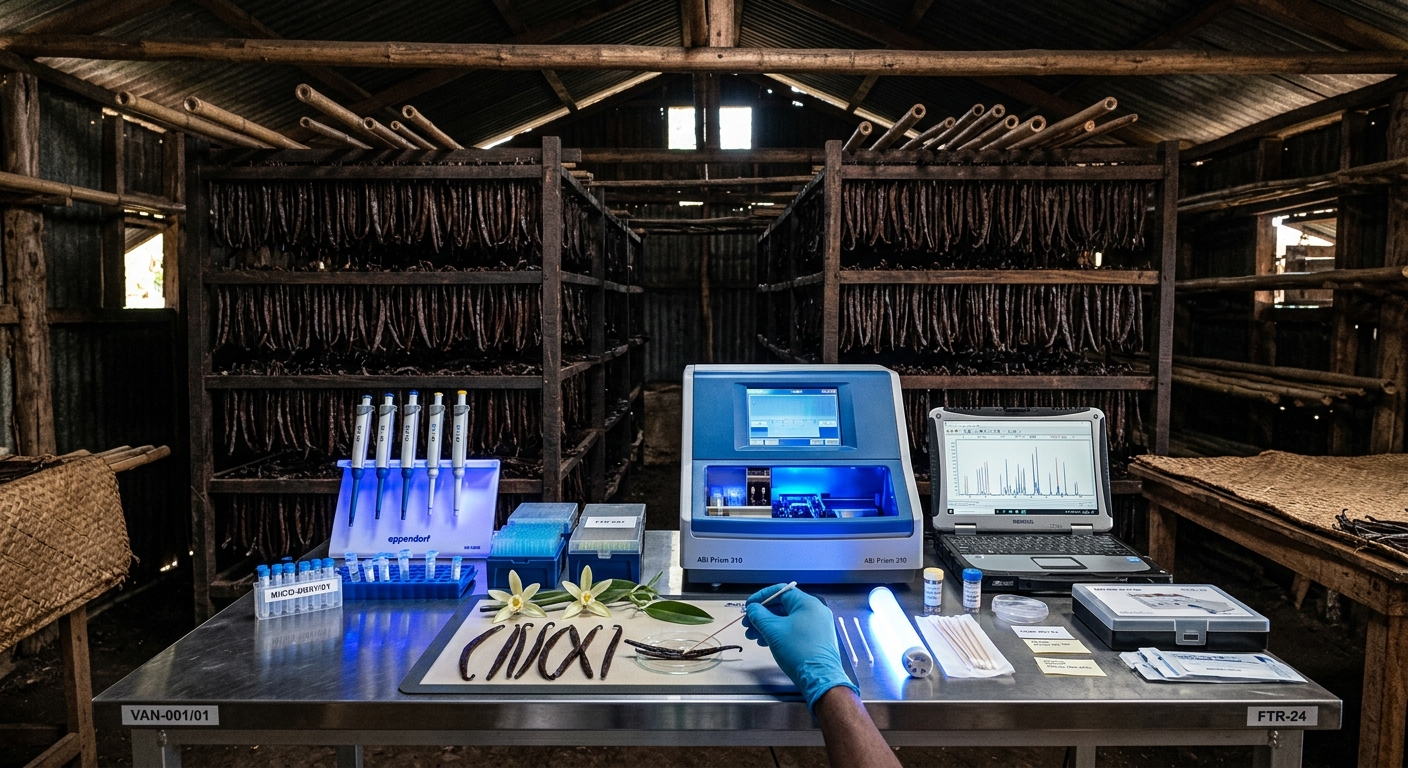
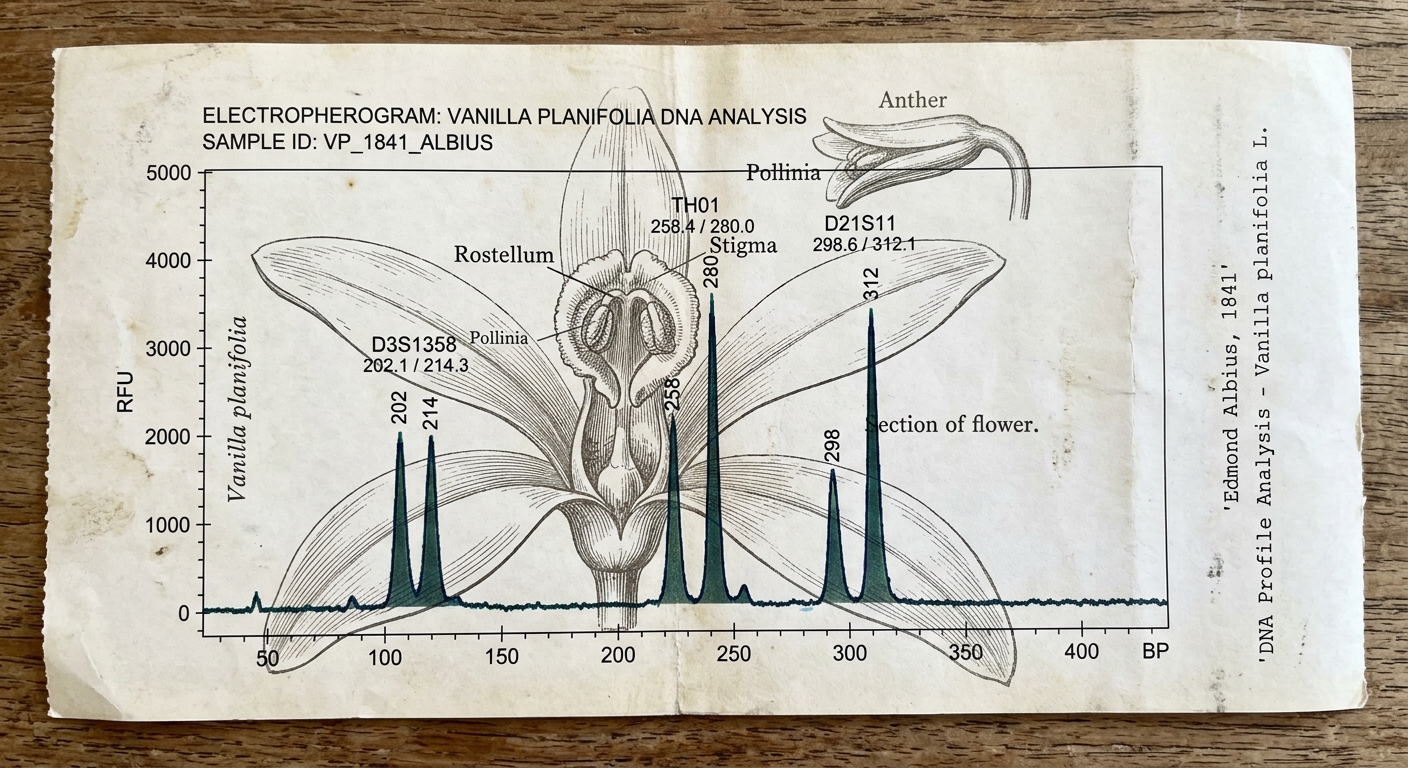
Every cultivated vanilla pod requires human hand-pollination—a technique developed in 1841 by twelve-year-old enslaved horticulturalist Edmond Albius to substitute for the absent Melipona bee. This installation transposes forensic touch-DNA protocols (epithelial cell swabbing, silica column extraction, and short tandem repeat amplification) into the Sava region's curing sheds. By isolating human genetic residue left behind on the surface of cured pods, the work converts anonymous agricultural hand-labor into quantitative capillary electropherograms. The resulting genetic profiles directly overlay historical botanical engravings, framing the global luxury spice supply chain as a biological archive of uncredited physical touch.
shown: Installed inside an active vanilla curing warehouse in Sambava, Madagascar, with the rhythmic mechanical hum of the DNA sequencer mixing with the overwhelming olfactory presence of curing pods.
shown: Installed inside an active vanilla curing warehouse in Sambava, Madagascar, with the rhythmic mechanical hum of the DNA sequencer mixing with the overwhelming olfactory presence of curing pods.
anchor facts used
- In 1841, Edmond Albius, an enslaved 12-year-old on Réunion, invented the technique of lifting the rostellum with a bamboo sliver and pressing the anther and stigma together with the thumb.
- The natural pollinator, the Melipona bee, is native only to Mexico, making Vanilla planifolia entirely dependent on human manual labor outside of Mesoamerica.
- Madagascar's Sava region produces approximately 80% of the world's vanilla, requiring tens of millions of individual, undocumented human thumb-presses per harvest season.
mechanism
- Forensic Trace Evidence Recovery — Sourcing Grade A Bourbon vanilla beans exported from the Sava region and systematically swabbing the specific loci on the pod where the pollinator's thumb applied pressure for epithelial cell collection.
1. Collection and Swabbing of Exported Pods - Silica-based DNA Extraction — Chemically separating the trace human DNA from the overwhelming background of Vanilla planifolia plant tissue and concentrated vanillin compounds.
2. Isolation of Human Genetic Material - Polymerase Chain Reaction (PCR) amplification of Short Tandem Repeats (STR) — Targeting human-specific non-coding DNA regions to generate distinct profiles for the anonymous Malagasy farmers whose sweat and skin cells remain on the luxury spice.
3. Amplification of Labor Loci - Capillary Electrophoresis — Visualizing the human STR profiles as distinct fluorescent peaks and archiving them as 'ghost receipts' of the global labor market.
4. Memorial Electropherogram Generation
lineage
- Heather Dewey-Hagborg, 'Stranger Visions' (2012-2013) — Inverts her technique of rendering faces from public DNA; here, trace DNA is used to index systemic, hidden agricultural labor rather than individual urban surveillance.
- Teresa Margolles, 'En el Aire' (2003) — Shares the methodology of using trace biological residue of the marginalized as the invisible, visceral medium for a memorial.
- Oron Catts and Ionat Zurr (Tissue Culture & Art Project), 'Victimless Leather' (2004) — Contrasts their focus on synthetic lab-grown alternatives by exposing the inescapable, uncredited human biological foundation of a 'natural' commodity.
curatorial qa (machine verdict, unedited)
SCORE 4/5 after 1 attempt(s)
READS: The spatial clash between the rustic Malagasy curing shed and cleanroom capillary sequencer lands immediately. Swabbing the cured pods directly ties manual agricultural contact to forensic trace recovery, and the STR electropherogram overlaid on Edmond Albius's pollination diagram makes the quantification of labor explicit.
FAILS: The chemical isolation and PCR amplification steps remain implicit; the transition from pod swab to clean genetic profile is visually compressed.
READS: The spatial clash between the rustic Malagasy curing shed and cleanroom capillary sequencer lands immediately. Swabbing the cured pods directly ties manual agricultural contact to forensic trace recovery, and the STR electropherogram overlaid on Edmond Albius's pollination diagram makes the quantification of labor explicit.
FAILS: The chemical isolation and PCR amplification steps remain implicit; the transition from pod swab to clean genetic profile is visually compressed.
spec: antigravity agent · keyframe/artifact: gemini-3.1-flash-image · video: veo-3.1 image-to-video · qa+wall text: gemini-3.7-flash watching the render · 41.7s total