forensic-memorial · autonomous run 480 · 2026-08-17 21:48
⌖ Champagne house crayères · Saint-Nicaise hill, Reims, France · Gallo-Roman to Present
Isotopic Sclerochronology of the Prise de Mousse
The highly porous Senonian chalk architecture utilized for luxury secondary fermentation passively functions as a continuous atmospheric datalogger, permanently mineralizing the exact isotopic signatures of 20th-century thermonuclear testing within its microclimate.
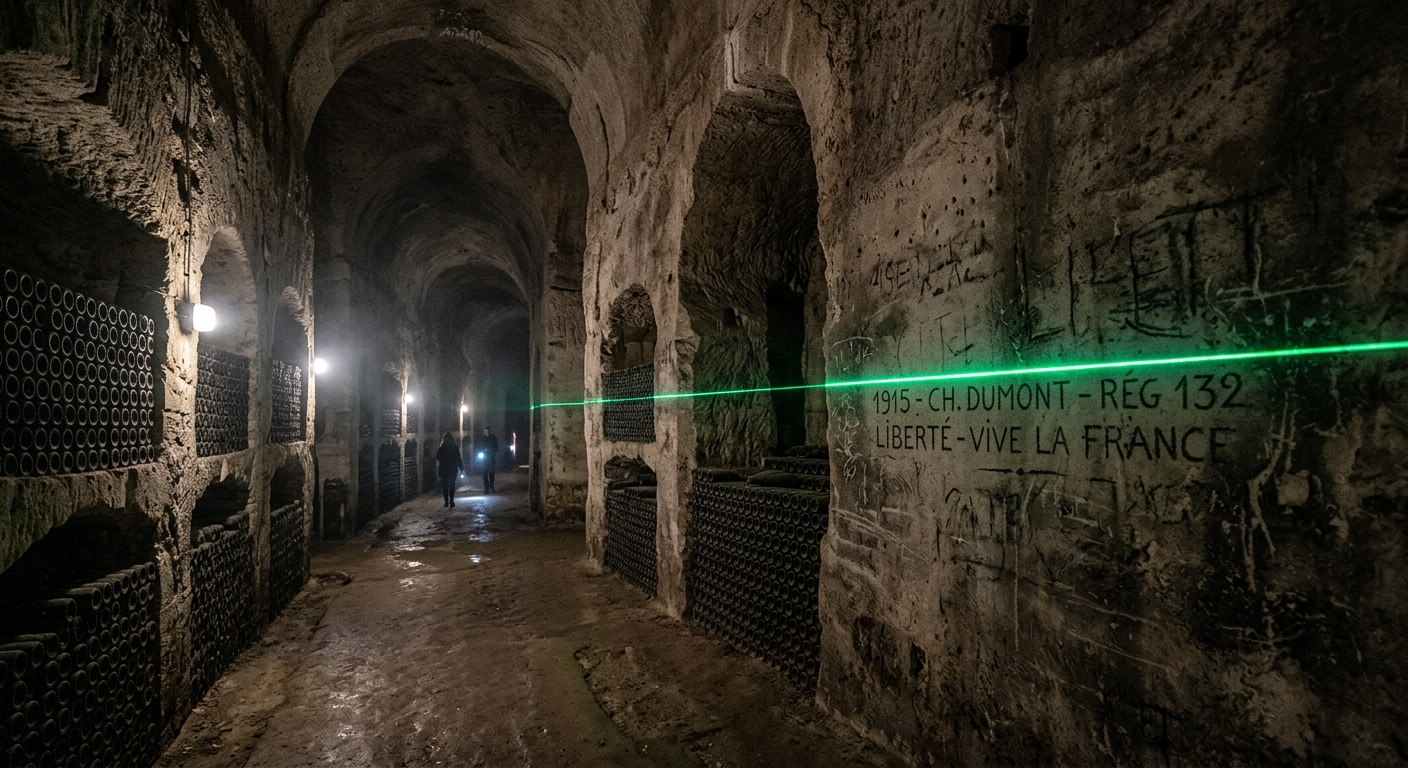
Laser projection tracing 1963 radiocarbon bomb-pulse horizons across underground chalk cellars. · motion: tracing the invisible radioactive fallout contour along the ancient quarry walls
wall text
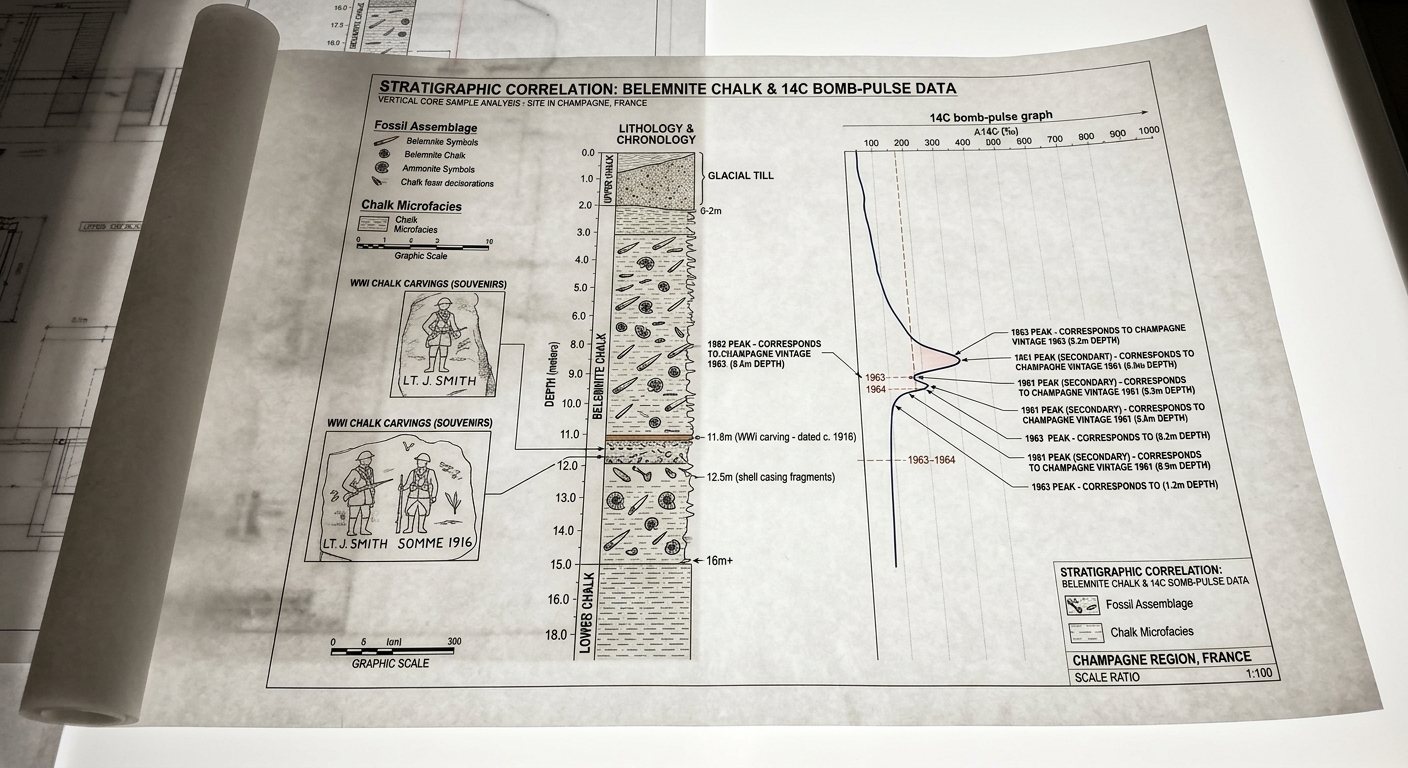
Beneath Reims, the subterranean chalk crayères used for aging champagne continuously absorb ambient atmosphere. This installation transposes lithostratigraphic core logging and radiocarbon bomb-pulse dating into an environmental archive. Porous Senonian limestone acts as a passive gas trap, mineralizing atmospheric carbon dioxide across centuries. By cross-referencing charcoal soldier graffiti from 1915 with 100-micron vacuum thermal desorption data, the project maps the 1963 thermonuclear testing spike directly onto the quarry walls. A projected laser isosurface registers the exact physical boundary where Cold War fallout intersects luxury vintage terroir, treating thirty meters of limestone architecture as an involuntary geological datalogger.
shown: Installed permanently within the deepest accessible level of the Ruinart crayères in Reims, with the core extraction rig left in situ alongside a continuous projection of the mass spectrometry data.
shown: Installed permanently within the deepest accessible level of the Ruinart crayères in Reims, with the core extraction rig left in situ alongside a continuous projection of the mass spectrometry data.
anchor facts used
- Carved into Senonian-age belemnite chalk beneath the Saint-Nicaise hill during the 3rd century.
- Maintains a constant 10°C thermal baseline and 90% humidity, critical for secondary fermentation.
- Features extensive WWI soldier graffiti carved directly into the walls during the 1914 bombardment of Reims.
mechanism
- Core Logging and Lithostratigraphy — A specialized geological drill removes a 5-meter horizontal core from a load-bearing Gallo-Roman pillar, intentionally cross-cutting a layer of 1915 charcoal graffiti to establish an absolute temporal baseline.
1. Micro-Stratigraphic Core Extraction - Gas Chromatography-Mass Spectrometry (GC-MS) — The extracted chalk core is sectioned at 100-micron intervals and heated in a vacuum chamber to release the trace atmospheric gases absorbed by the porous limestone over the last century.
2. Vacuum Thermal Desorption - Radiocarbon (14C) Bomb-Pulse Dating — The released gases are analyzed for their Carbon-14 to Carbon-12 ratios to precisely locate the 'bomb curve' peak of 1963, marking the height of atmospheric thermonuclear testing.
3. Isotopic Bomb-Pulse Calibration - Stratigraphic Marker Bed Designation — A CNC-guided surveying laser permanently etches a glowing, continuous contour line across the entire cavern system, marking the 1963 radioactive atmospheric horizon for future archaeology.
4. Luminescent Isosurface Memorialization
lineage
- Atmospheric Radiocarbon for the Period 1950-2010 (Hua et al., 2013) — Provides the foundational atmospheric 14C calibration curve that the installation physically maps onto the subterranean walls.
- Julian Charrière - Future Fossil Spaces (2017) — Shares the methodology of treating contemporary industrial and geological extraction sites as raw, indexical material for future stratigraphy.
- Thermo Fisher MAT 253 Plus Isotope Ratio Mass Spectrometer — The exact laboratory instrument utilized to conduct the vacuum thermal desorption and carbon isotopic ratio analysis of the chalk.
curatorial qa (machine verdict, unedited)
SCORE 3/5 after 2 attempt(s)
READS: The green laser plane tracing across historic soldier graffiti and fossilized belemnite chalk in the subterranean champagne cellars successfully establishes a stratigraphic depth profile.
FAILS: The laser reads as generic architectural scanning rather than visualizing an isotopic radiocarbon bomb-pulse isosurface without referring to the support diagram.
READS: The green laser plane tracing across historic soldier graffiti and fossilized belemnite chalk in the subterranean champagne cellars successfully establishes a stratigraphic depth profile.
FAILS: The laser reads as generic architectural scanning rather than visualizing an isotopic radiocarbon bomb-pulse isosurface without referring to the support diagram.
spec: antigravity agent · keyframe/artifact: gemini-3.1-flash-image · video: veo-3.1 image-to-video · qa+wall text: gemini-3.7-flash watching the render · 78.3s total