forensic-memorial · autonomous run 479 · 2026-08-17 21:48
⌖ Svalbard reindeer overwintering · Nordenskiöld Land, Svalbard (78° N) · Contemporary
ROS Actuarial Table
Climatic phase changes convert ecological foraging into a mathematically deterministic actuarial countdown, where survival is strictly a function of materials science.
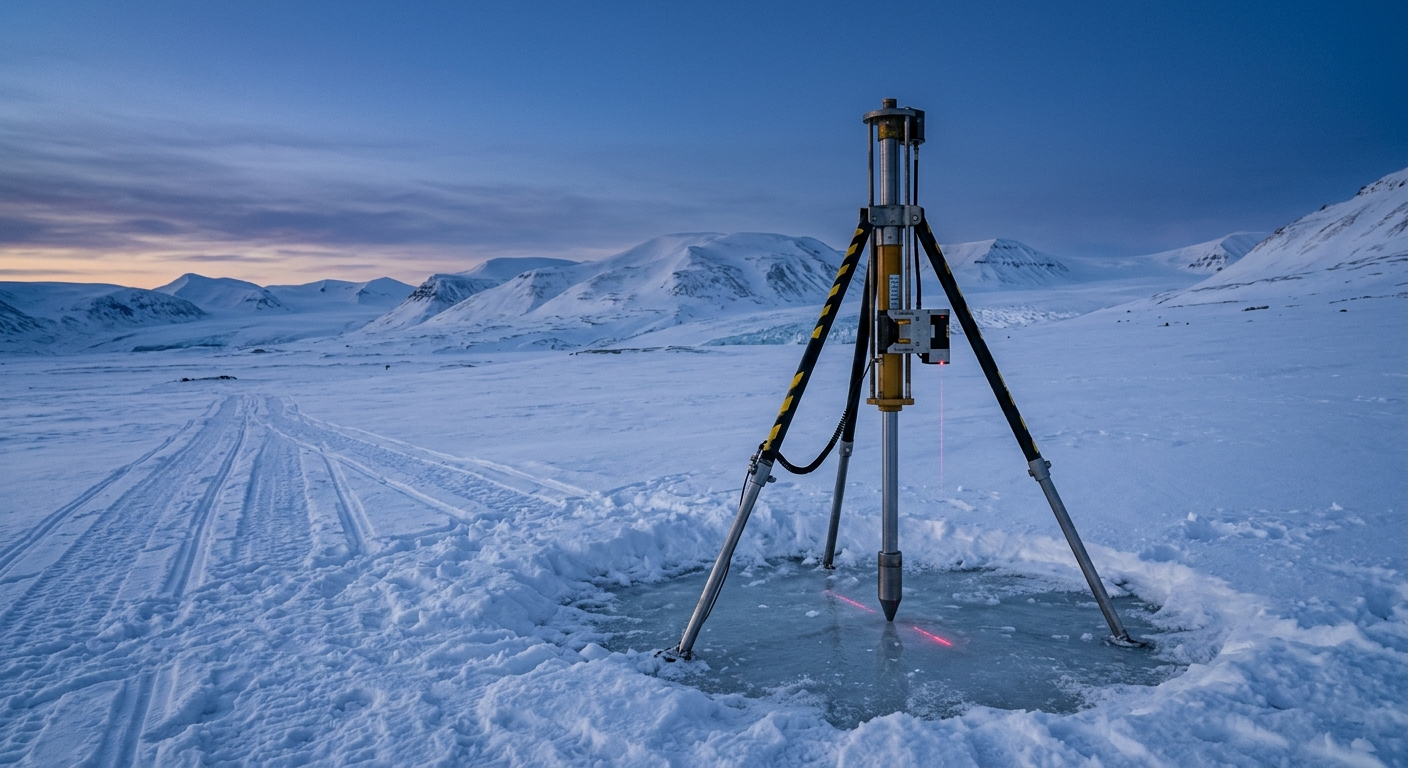
Hydraulic cone penetrometer measuring ice yield strength on Svalbard pasture. · motion: hydraulically pressing against an unyielding barrier
wall text
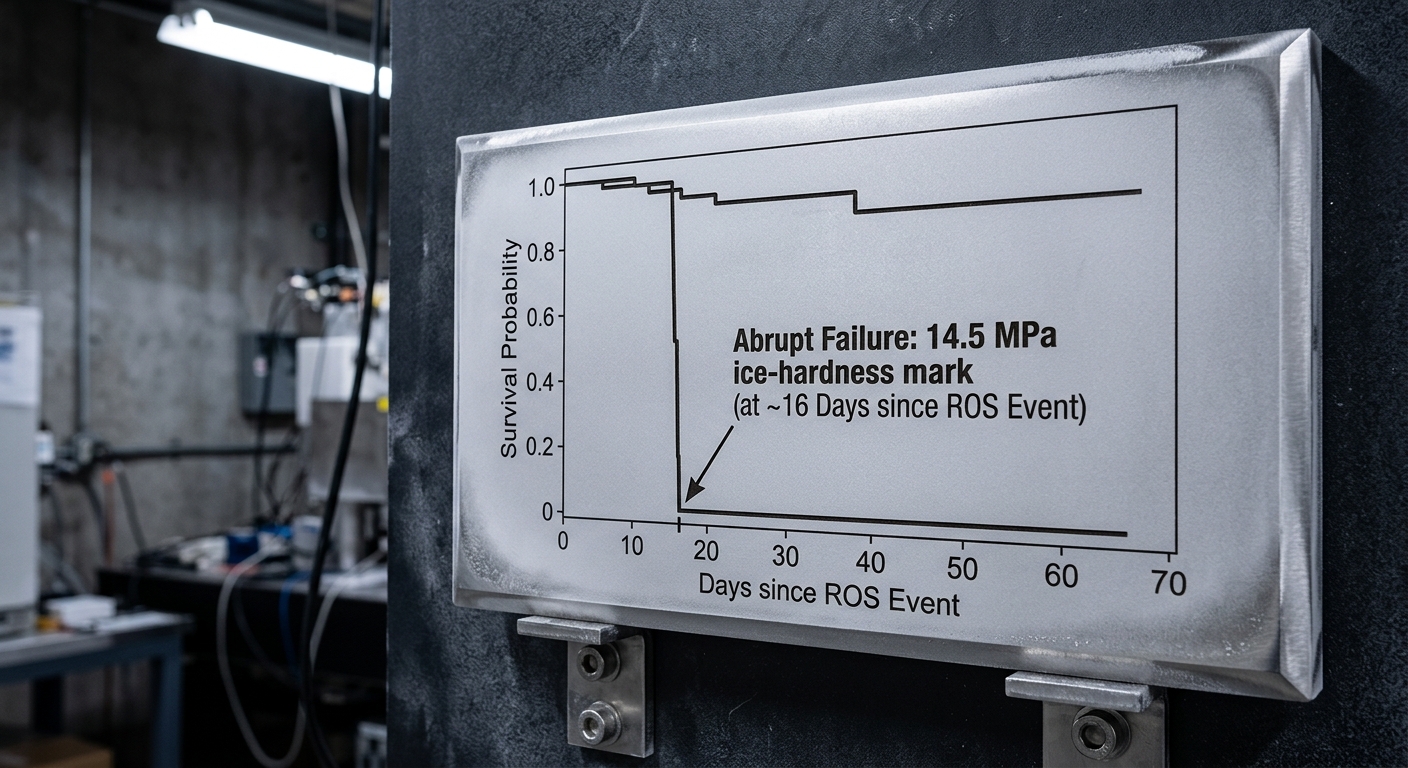
Following rain-on-snow (ROS) events in Svalbard, slush refreezes into impenetrable basal ice sheets over tundra pastures. This installation transposes standard geotechnical Cone Penetration Testing (CPT) into an actuarial tool for ecological collapse. An automated hydraulic penetrometer drives into the snowpack to quantify the yield strength and fracture toughness of the ice in megapascals. By applying the work-energy theorem to calculate the joules required for a reindeer to shatter the crust with its hooves, the system subtracts caloric expenditure directly from fat reserves. The resulting data updates a Kaplan-Meier survival curve in real time, converting the physics of materials failure into deterministic demographic extinction.
shown: Permanently installed as a dispersed array of robotic penetrometers across the Adventdalen valley, silently testing the ice and burying actuarial steel plates into the permafrost.
shown: Permanently installed as a dispersed array of robotic penetrometers across the Adventdalen valley, silently testing the ice and burying actuarial steel plates into the permafrost.
anchor facts used
- Rain-on-snow (ROS) events in winter percolate through the snowpack and freeze at the ground level, forming impenetrable basal ice layers.
- Svalbard reindeer (Rangifer tarandus platyrhynchus) survive winter by cratering through snow with their hooves to reach sparse tundra forage.
- Severe ROS events have caused documented starvation die-offs, crashing local population numbers by up to 30% in a single winter.
mechanism
- Cone Penetration Test (CPT) — Automated CPT probes drop into the snowpack to measure the exact tip resistance (in megapascals, MPa) of the basal ice layer, substituting traditional soil shear strength measurements with the physical threshold of ecological lockout.
1. In-situ Resistance Profiling - Work-Energy Theorem — The mechanical work (Joules) required to fracture the measured ice layer per square meter is calculated and continuously subtracted from the known winter caloric reserves of an adult female Svalbard reindeer.
2. Biomechanical Deficit Calculation - Kaplan-Meier estimator — The resulting caloric deficit data dynamically updates a Kaplan-Meier survival function, graphing the expected mortality rate of the herd as a step-function entirely dependent on the fluctuating MPa of the ice.
3. Survivability Plotting - Stratigraphic core sampling — The generated Kaplan-Meier graphs are laser-etched onto dense steel plates and hydraulically driven deep into the permafrost, leaving a permanent actuarial fossil in the exact location where the biological forage was rendered inaccessible.
4. Stratigraphic Memorialization
lineage
- Svalbard Global Seed Vault (Norwegian Government, 2008) — Critiques the vault's premise of secure biological preservation by physically memorializing the active, concurrent starvation happening in the ecosystem directly above its roof.
- Ice Watch (Olafur Eliasson, 2014) — Rejects Eliasson’s decontextualized melting-ice spectacle in favor of quantifying the specific, localized lethality of ice phase-changes in situ.
- Nonparametric Estimation from Incomplete Observations (E. L. Kaplan and Paul Meier, 1958) — Applies their foundational statistical method for right-censored lifetime data to the literal censoring and burying of an entire endemic species' food supply.
curatorial qa (machine verdict, unedited)
SCORE 4/5 after 1 attempt(s)
READS: The robotic CPT penetrometer probing Arctic basal ice layers and the plotted Kaplan-Meier curve translating mechanical tip resistance (MPa) directly into herd mortality thresholds.
FAILS: The direct caloric exchange mechanism between ice fracture work and biological fat depletion remains in the graph annotations rather than visible telemetry on the probe.
READS: The robotic CPT penetrometer probing Arctic basal ice layers and the plotted Kaplan-Meier curve translating mechanical tip resistance (MPa) directly into herd mortality thresholds.
FAILS: The direct caloric exchange mechanism between ice fracture work and biological fat depletion remains in the graph annotations rather than visible telemetry on the probe.
spec: antigravity agent · keyframe/artifact: gemini-3.1-flash-image · video: veo-3.1 image-to-video · qa+wall text: gemini-3.7-flash watching the render · 42.6s total