forensic-memorial · autonomous run 478 · 2026-08-17 21:48
⌖ Banana monoculture Gros Michel collapse · Motagua River Valley, Guatemala · 1890s-1960s
TR1: Biological Amortization of the Motagua Valley
Monoculture transforms biological pathogens into permanent geological strata, rendering corporate risk externalization visible as an enduring, measurable architectural layer in the soil.
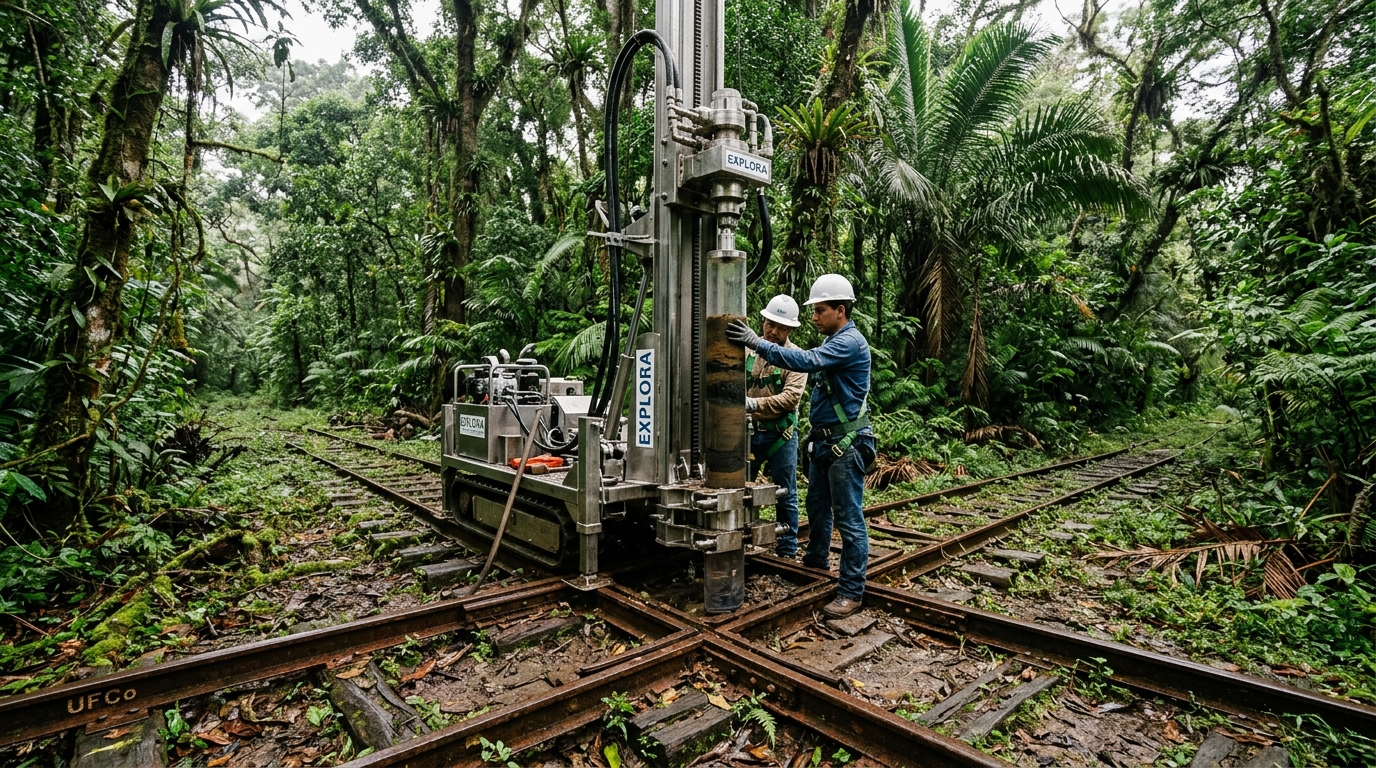
Geotechnical coring rig sampling 1920s rail beds for historical fungal strata. · motion: extracting the fungal strata
wall text
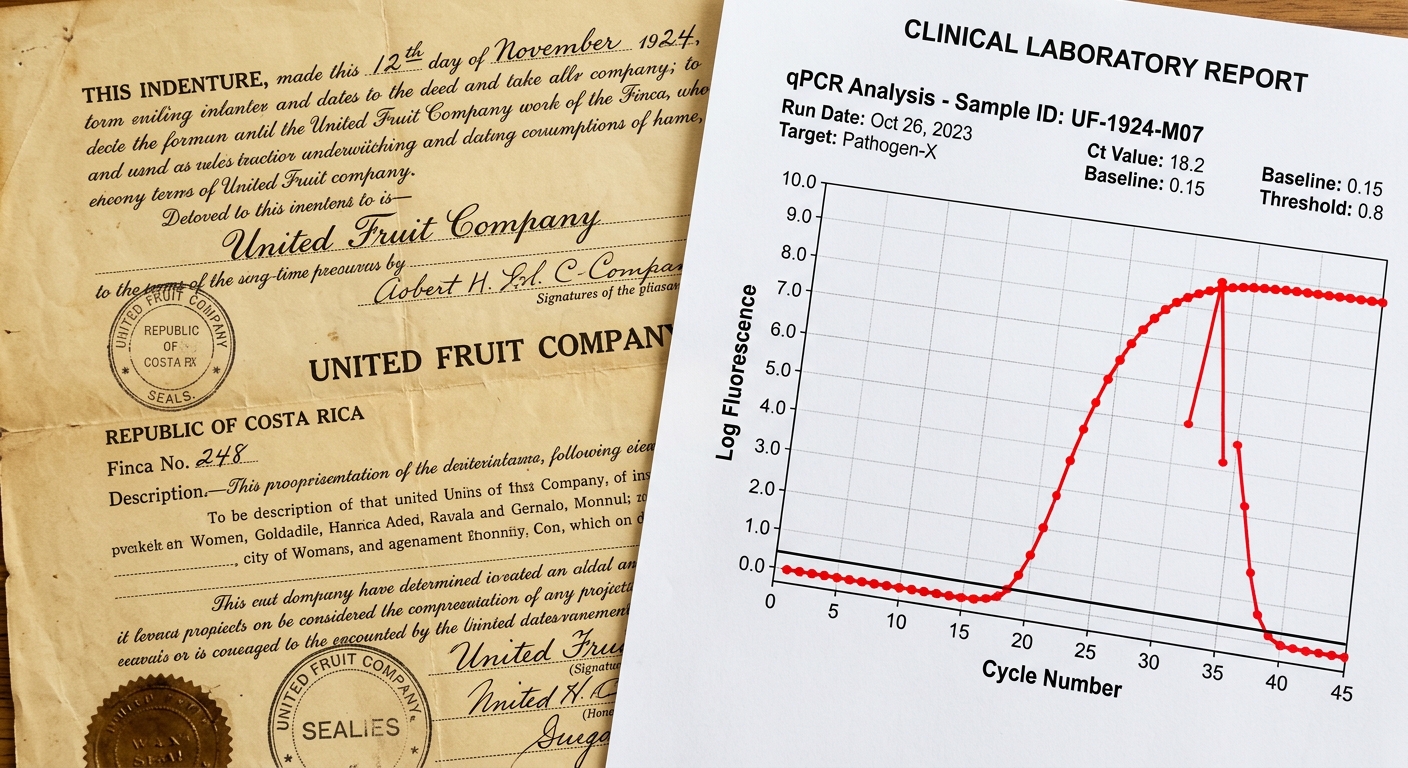
The installation samples abandoned United Fruit Company rail networks, deploying geotechnical core drilling to access 1920–1960 sediment layers. By pairing lead-210 geochronology with quantitative PCR analysis, the project maps persistent *Fusarium oxysporum* spore signatures within the soil horizon. The work repositions corporate monoculture collapse as a persistent chronostratigraphic layer, rendering historical risk externalization legible through forensic geology.
shown: Installed inside an abandoned banana packing shed near Quiriguá, Guatemala, with the soil cores displayed in refrigerated laboratory vitrines alongside the railway ruins.
shown: Installed inside an abandoned banana packing shed near Quiriguá, Guatemala, with the soil cores displayed in refrigerated laboratory vitrines alongside the railway ruins.
anchor facts used
- Fusarium oxysporum f. sp. cubense Tropical Race 1 (TR1) persists in soil as dormant chlamydospores for over 50 years.
- The United Fruit Company abandoned thousands of acres of plantation land and railway infrastructure in Guatemala during the 1920s-1930s due to Panama disease.
- The Gros Michel cultivar was completely replaced in global export markets by the TR1-resistant Cavendish variety by 1965.
mechanism
- Geotechnical core sampling and stratigraphic logging — Industrial geological drilling is repurposed to archive corporate agricultural history, treating soil as a physical ledger of ecological debt.
1. Extraction of 10-meter deep soil core samples from exact GPS coordinates matching abandoned 1920s United Fruit Company narrow-gauge railway loading zones. - Lead-210 geochronology — Locating the exact fiscal quarter of the biological collapse within the geological record to create a timeline of pathogenic saturation.
2. Isolation of the 1920-1960 chronostratigraphic sediment horizon within the core using radiometric lead-210 dating protocols. - Quantitative PCR (qPCR) absolute quantification — Translating latent biological extinction agents into readable digital sequences to prove the permanent forensic presence of the corporate event.
3. Extraction and amplification of Fusarium oxysporum TR1 DNA from the dated soil horizon using pathogen-specific oligonucleotide primers. - Data sonification and vinyl pressing — Converting the geometric growth of an invisible fungal pathogen into a playable acoustic memorial of an extinct ecosystem.
4. Mapping the resulting qPCR amplification curves to an acoustic waveform, pressed into a physical vinyl memorial record using a synthetic polymer laced with sterilized soil.
lineage
- Paul Vanouse, 'Latent Figure Protocol' — Expands Vanouse's use of DNA gel electrophoresis from human genetic identity to the forensic identification of corporate agricultural pathogens.
- Claire Pentecost, 'soil-erg' — Adapts Pentecost's proposal of soil as a tangible store of value, demonstrating instead how pathogen-laden soil represents a permanently depreciated asset.
- Center for Land Use Interpretation (CLUI), 'Pesticide Use in the Tulare Basin' — Shifts CLUI's geographic survey of agricultural interventions into a subterranean, stratigraphic investigation of permanent ecological modification.
curatorial qa (machine verdict, unedited)
SCORE 4/5 after 1 attempt(s)
READS: The core drilling rig mounted on abandoned narrow-gauge tracks directly links industrial rail infrastructure to stratigraphic soil sampling. The core retrieval visually grounds the historical-geological extraction process.
FAILS: The qPCR curve contains an erratic secondary trace, and the visual core lacks marked sediment horizon boundaries indicating the fungal transition layer.
READS: The core drilling rig mounted on abandoned narrow-gauge tracks directly links industrial rail infrastructure to stratigraphic soil sampling. The core retrieval visually grounds the historical-geological extraction process.
FAILS: The qPCR curve contains an erratic secondary trace, and the visual core lacks marked sediment horizon boundaries indicating the fungal transition layer.
spec: antigravity agent · keyframe/artifact: gemini-3.1-flash-image · video: veo-3.1 image-to-video · qa+wall text: gemini-3.7-flash watching the render · 37.8s total