forensic-memorial · autonomous run 475 · 2026-08-17 21:48
⌖ Global Seed Vault flood · Platåberget mountain, Svalbard (78.2359° N, 15.4913° E) · May 2017
Stratigraphy of the Breach
The absolute archive of biological futurity is inherently bounded by the thermodynamic instability of its own container; the preservation mechanism itself becomes the geological stratum of its failure.
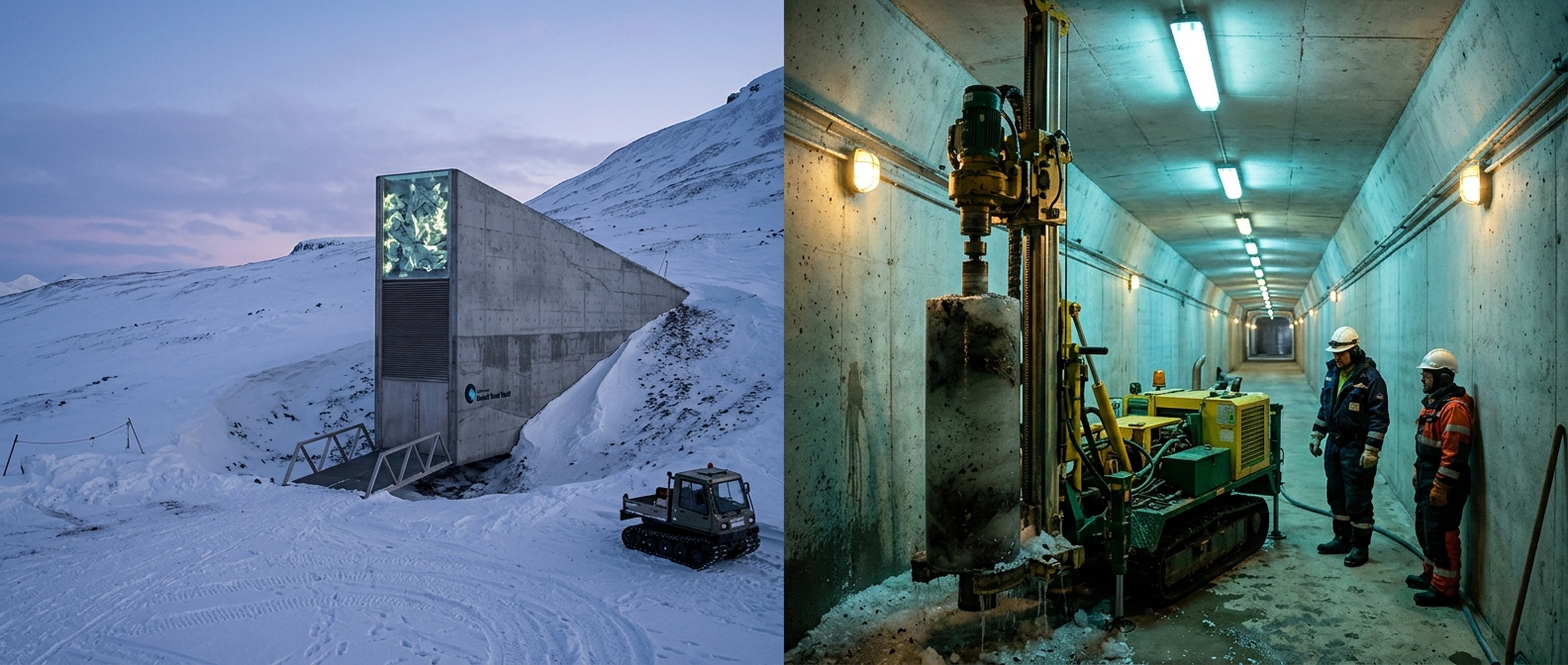
Drilling an ice core from frozen meltwater inside the access tunnel. · motion: Advancing the drill bit while extruding the frozen timeline
wall text
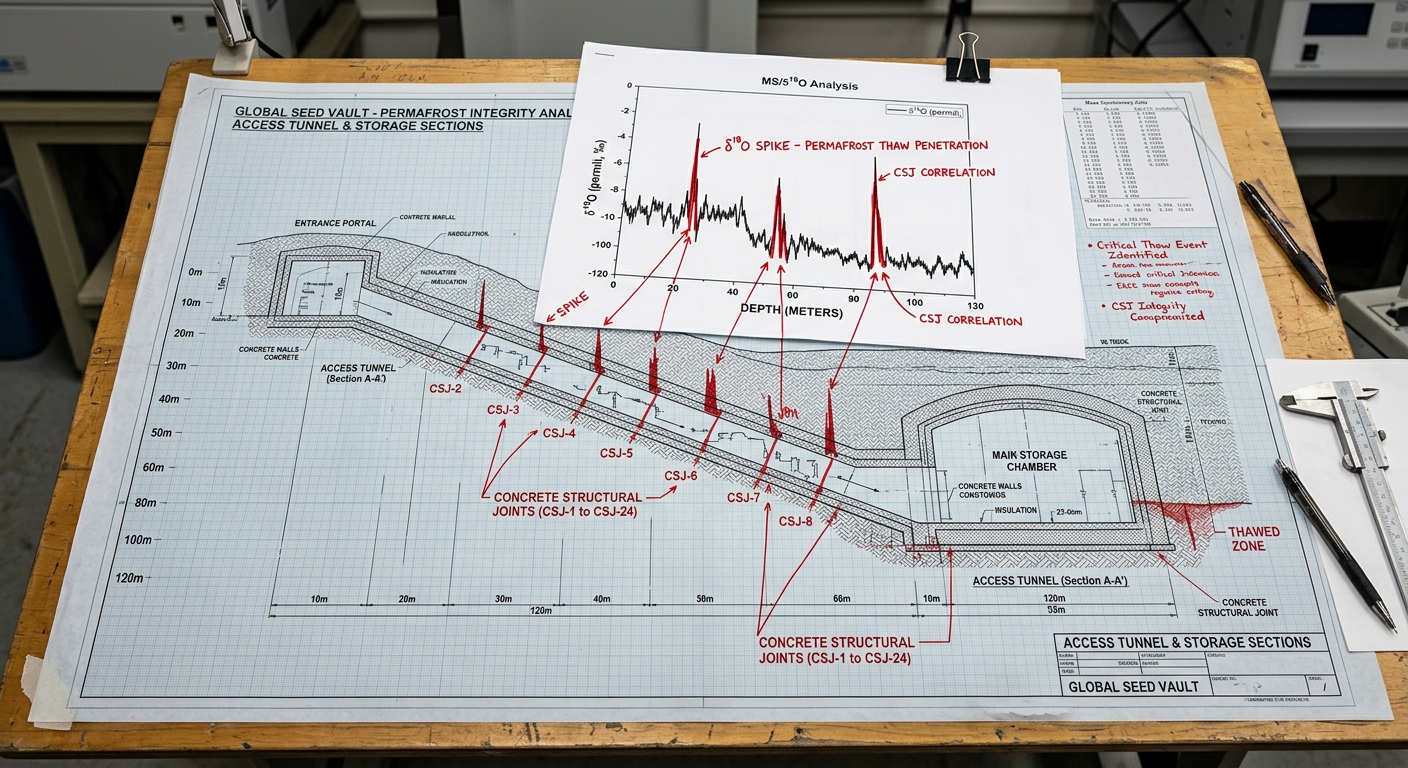
In 2017, record Arctic temperatures melted permafrost around the Svalbard Global Seed Vault, sending meltwater into the entrance tunnel where it refroze into an unintended stratigraphy. Transposing ice core paleoclimatology and mass spectrometry to the interior of the facility, this project drills horizontal cores directly from the frozen breach. Each distinct band of silt, concrete dust, and sealant records a specific thermal pulse and structural joint failure. By applying differential scanning calorimetry to the intrusion, the archive designed to secure agricultural futurity becomes the geological record of its own thermodynamic vulnerability.
shown: Displayed inside the abandoned Mine 3 (Gruve 3) adjacent to the Seed Vault in Longyearbyen, utilizing the ambient sub-zero permafrost temperature to maintain the sublimated debris scaffold without artificial cooling.
shown: Displayed inside the abandoned Mine 3 (Gruve 3) adjacent to the Seed Vault in Longyearbyen, utilizing the ambient sub-zero permafrost temperature to maintain the sublimated debris scaffold without artificial cooling.
anchor facts used
- In May 2017, abnormally high temperatures caused rain and permafrost melt to breach the 100-meter access tunnel.
- The meltwater froze inside the tunnel before reaching the -18°C storage chambers, creating an unintended ice sheet.
- Workers had to manually hack out the intruding ice to restore access to the 1 million seed samples.
mechanism
- Ice core drilling stratigraphy — Extracting a cylindrical core sample not from a natural glacier, but from the frozen meltwater that breached the access tunnel, preserving the chronological sequence of the flood.
1. Harvesting the Intrusion Core - Oxygen-18 / Oxygen-16 isotope mass spectrometry — Analyzing the δ18O ratios along the length of the extracted tunnel ice to map the exact atmospheric temperature spikes that triggered the melting of the permafrost.
2. Isotopic Stratigraphy - Differential Scanning Calorimetry (DSC) — Measuring the specific heat capacity and phase transition points of the tunnel ice, identifying impurities like concrete dust and vault sealants picked up during the breach.
3. Latent Heat Mapping - Lyophilization (Freeze-drying) — Sublimating the ice core in a vacuum chamber to leave behind only a rigid, fragile scaffold of the concrete dust, soil, and trace minerals swept in by the flood.
4. Cryogenic Sublimation Memorial
lineage
- Camp Century ice core (Dansgaard et al., 1969) — Provides the methodological baseline for isotopic paleoclimatology, here inverted to analyze a human-made structure's rapid failure.
- Vatnajökull (Katie Paterson, 2007) — Whereas Paterson broadcasts the acoustic decay of a natural glacier, this work archives the thermodynamic intrusion of a failing synthetic cryosphere.
- Svalbard Global Seed Vault architecture (Peter W. Søderman, 2008) — The target structure itself, critiqued as an architectural fallacy that assumed geological stasis in a dynamic Anthropocene.
curatorial qa (machine verdict, unedited)
SCORE 4/5 after 2 attempt(s)
READS: The extraction of a sediment-stratified ice core directly inside the concrete vault tunnel and its explicit cross-referencing with isotopic spikes across structural joints on the blueprint.
FAILS: The final freeze-drying sublimation memorial step is absent from the render sequence, stopping short at initial core inspection.
READS: The extraction of a sediment-stratified ice core directly inside the concrete vault tunnel and its explicit cross-referencing with isotopic spikes across structural joints on the blueprint.
FAILS: The final freeze-drying sublimation memorial step is absent from the render sequence, stopping short at initial core inspection.
spec: antigravity agent · keyframe/artifact: gemini-3.1-flash-image · video: veo-3.1 image-to-video · qa+wall text: gemini-3.7-flash watching the render · 30.6s total