forensic-memorial · autonomous run 474 · 2026-08-17 21:48
⌖ LIGO gravitational wave observatory · Hanford, Washington and Livingston, Louisiana · September 14, 2015
Rejected Spectra: GW150914
The truest forensic record of human civilization is found not in the cosmic signals it manages to capture, but in the exact local, anthropogenic background noise it builds vast architectures to mathematically erase.
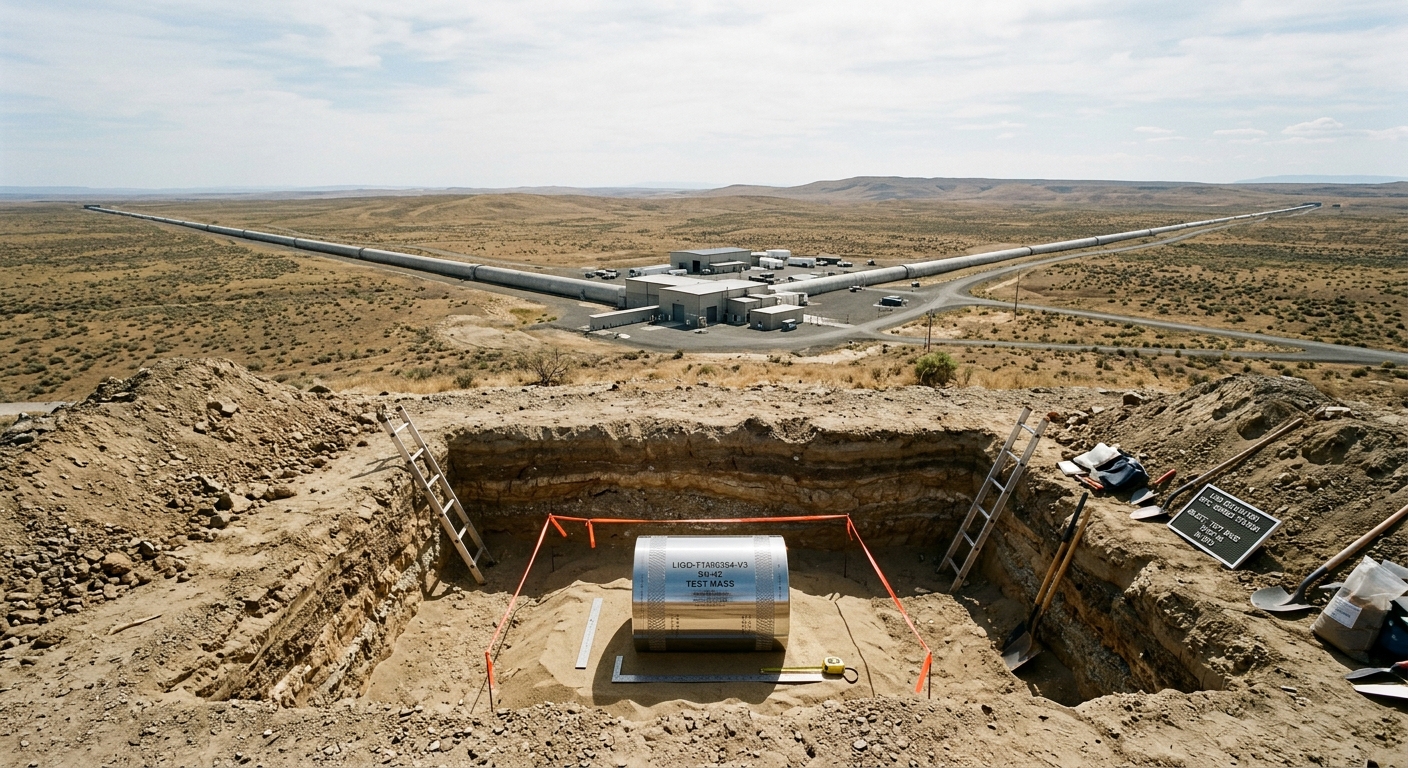
Laser-ablating discarded Hanford highway traffic telemetry onto an interred test mass. · motion: sinking infinitesimally into the geological strata while maintaining absolute geometric isolation
wall text
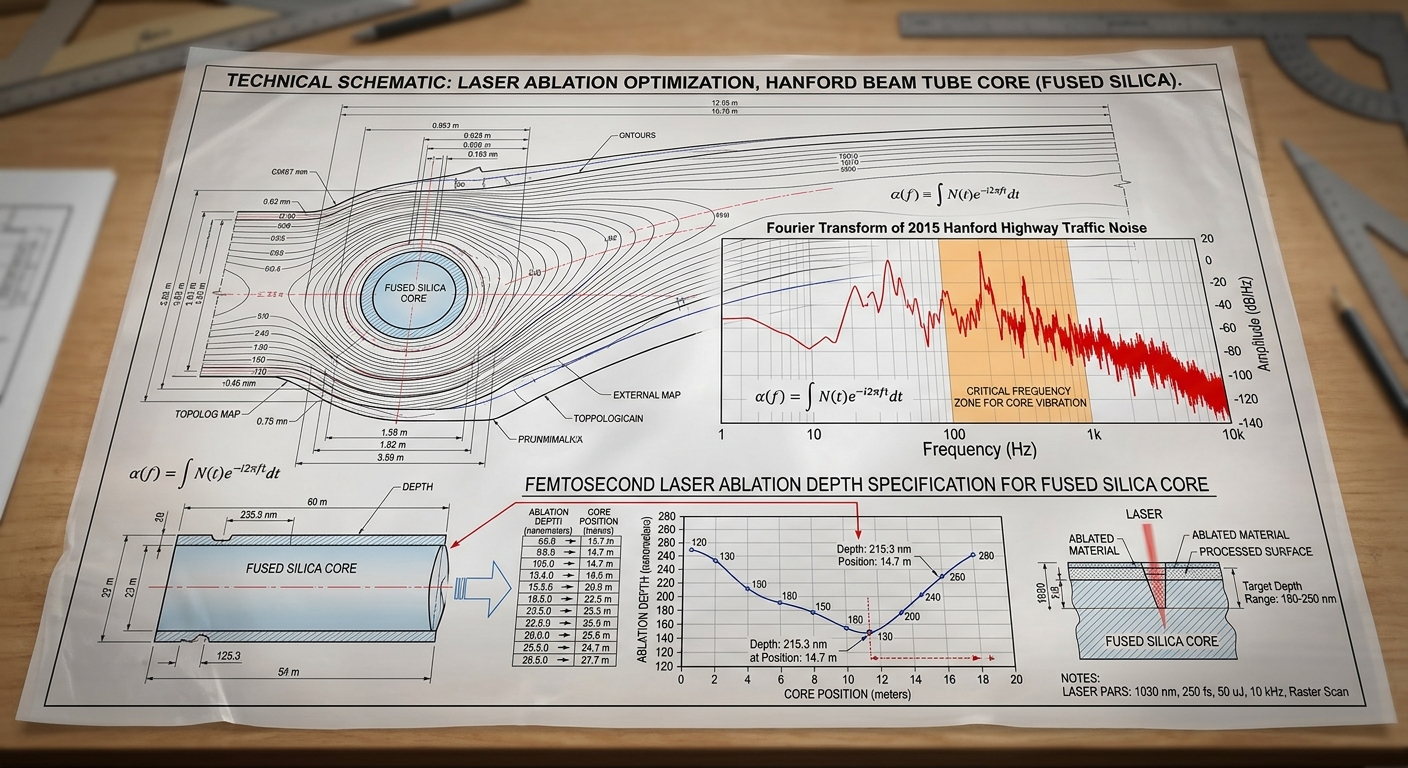
To detect gravitational waves, LIGO’s active isolation loops mathematically cancel local terrestrial noise—highway traffic, ocean microseisms, and industrial logging. This project archives that discarded anthropocene signature. Extracting auxiliary sensor telemetry logged during the 2015 GW150914 detection event, inverse Wiener filters reconstruct the rejected local seismic waveforms. A femtosecond laser then micromachines these terrestrial signals directly into the surface of a monolithic fused silica test mass. Finally, the cylinder is interred in a stratified excavation pit at the junction of the Hanford detector arms. The resulting geological artifact preserves the precise vibrations civilization engineered multi-billion-dollar instruments to ignore, transmuting filtered environmental noise into a permanent lithic archive.
shown: Permanently buried in an unmarked trench exactly 10 meters from the vertex of the beam tubes at the Hanford observatory, accessible only via ground-penetrating radar.
shown: Permanently buried in an unmarked trench exactly 10 meters from the vertex of the beam tubes at the Hanford observatory, accessible only via ground-penetrating radar.
anchor facts used
- The first gravitational wave detection, GW150914, occurred on September 14, 2015 at 09:50:45 UTC
- LIGO employs 40kg fused silica test masses suspended by active quadruple pendulums to mathematically and physically cancel local terrestrial vibrations
- The Hanford facility utilizes 4km L-shaped ultra-high vacuum beam tubes traversing the arid Washington scrubland
mechanism
- Data logging and archival retrieval — Pulling the discarded raw auxiliary channel telemetry (seismometers, microphones, wind monitors) from Hanford and Livingston exactly at the GW150914 detection time.
1. Telemetry Extraction - Inverse Wiener filtering and feedforward cancellation — Calculating the exact inverse transfer functions of the active suspension loops to isolate the rejected local vibrations (highway traffic, Pacific ocean swells, logging equipment).
2. Noise Deconvolution - Femtosecond laser micromachining — Ablating the inverted, purely terrestrial noise waveforms into monolithic fused silica cylinders as a permanent physical record of the rejected Earth.
3. Silica Ablation - Core sample deposition and backfilling — Burying the engraved silica cylinders at the junction of the 4km arms to act as a future geological anomaly representing exactly what humanity ignored.
4. Stratigraphic Deposition
lineage
- Walter De Maria, 'The Broken Kilometer' (1979) — Shifts the focus from a macroscopic visual metric of terrestrial distance to a microscopic metric of space-time strain and geological vibration.
- LIGO Scientific Collaboration, 'Characterization of transient noise in Advanced LIGO relevant to gravitational wave signal GW150914' (2016) — Provides the literal mathematical baselines and noise spectral densities used for the physical inversion of the artifacts.
- Katie Paterson, 'Vatnajökull (the sound of)' (2007) — Contrasts Paterson's live ecological listening with forensic, mathematically inverted geological silencing.
curatorial qa (machine verdict, unedited)
SCORE 3/5 after 2 attempt(s)
READS: The spatial relationship between the LIGO array, the excavation trench, and a gantry laser etching waveform data onto a test mass.
FAILS: The cylinder snaps vertically without mechanical handling, failing to show infinitesimal settling into stratified sediment.
READS: The spatial relationship between the LIGO array, the excavation trench, and a gantry laser etching waveform data onto a test mass.
FAILS: The cylinder snaps vertically without mechanical handling, failing to show infinitesimal settling into stratified sediment.
spec: antigravity agent · keyframe/artifact: gemini-3.1-flash-image · video: veo-3.1 image-to-video · qa+wall text: gemini-3.7-flash watching the render · 41.2s total