forensic-memorial · autonomous run 473 · 2026-08-17 21:47
⌖ Vostok ice core · Vostok Station, Princess Elizabeth Land, Antarctica · 1998
Anthropocene Firn: CFA of a Hyperscale Stratigraphy
The physical substrate of digital memory will outlast its logical intelligibility, reducing human data to purely atmospheric and chemical stratigraphy.
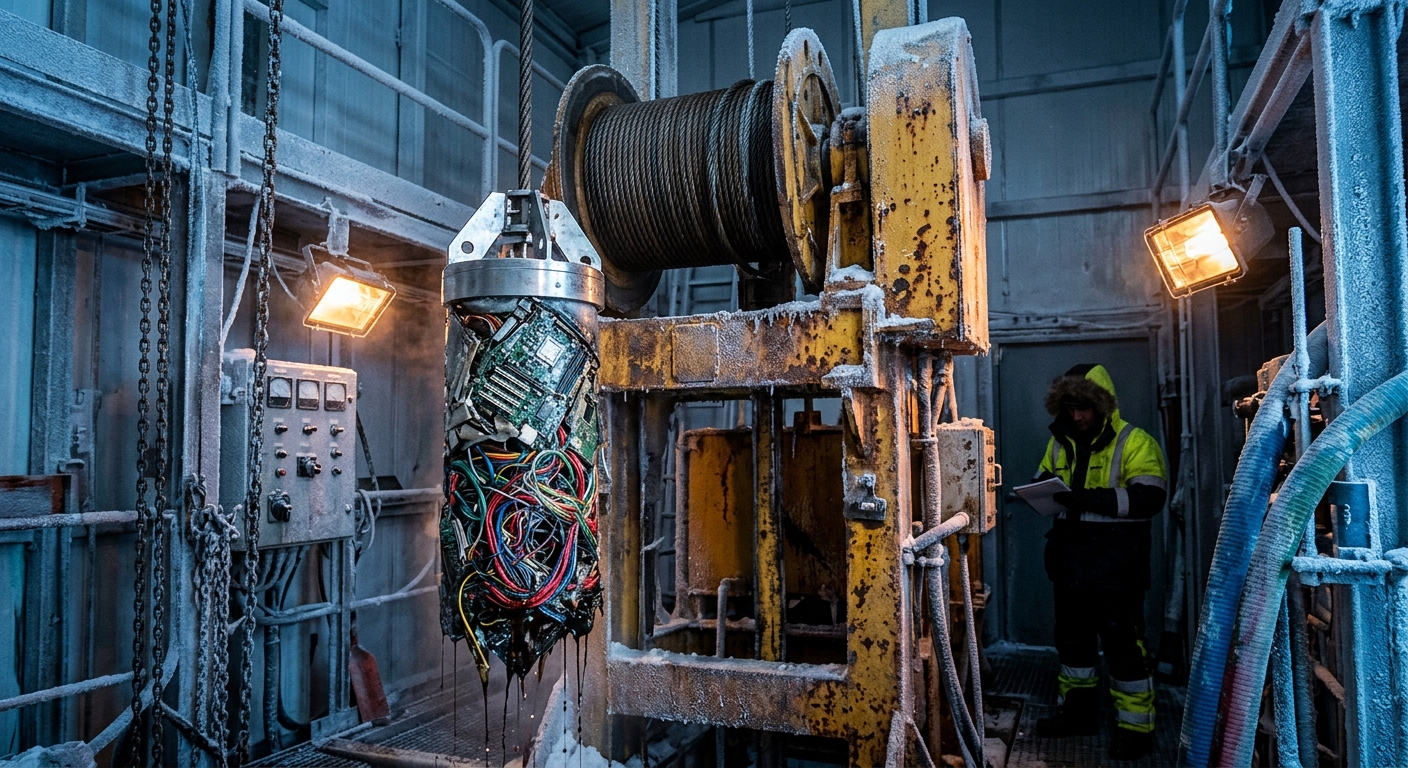
Continuous thermal flow analysis of compressed server core into synthetic slag. · motion: continuously melting downward into a localized vacuum
wall text
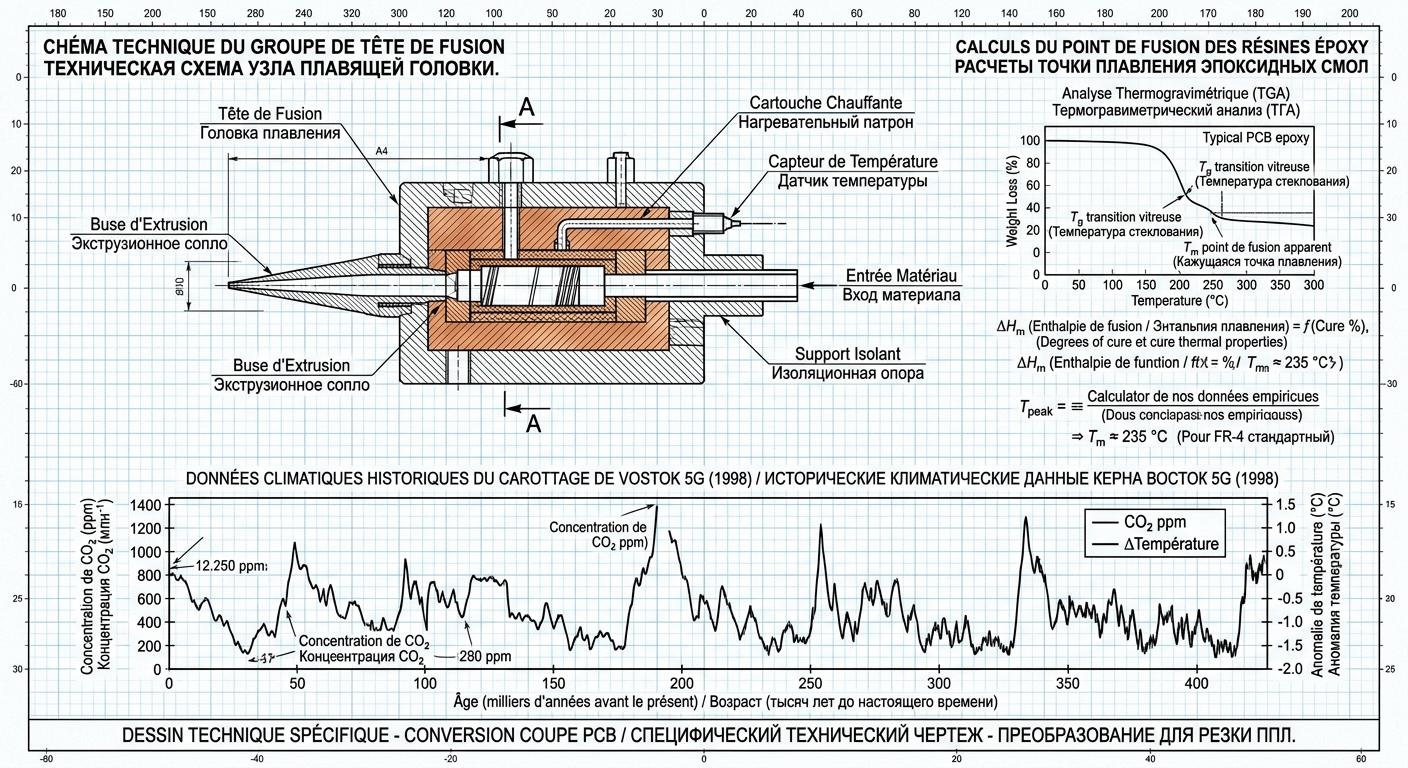
Drawing a direct parallel to the Continuous Flow Analysis (CFA) developed for the Vostok 5G ice core, this apparatus treats compressed server hardware as geological stratigraphy. Rather than reading stored magnetic or optical bits, a high-temperature melt-head pyrolyzes the cylinder chronologically, volatilizing fluorocarbon coolants and melting PCB resins into slag. The resulting vapors are separated in a degassing chamber for isotopic logging rather than logical recovery. Human digital records are converted into pure chemical residues, mapping computational history not through narrative archives, but through the atmospheric and material emissions of obsolete infrastructure.
shown: Installed inside a retrofitted shipping container positioned exactly at the surface coordinates of the sealed 5G borehole at Vostok Station, operating autonomously.
shown: Installed inside a retrofitted shipping container positioned exactly at the surface coordinates of the sealed 5G borehole at Vostok Station, operating autonomously.
anchor facts used
- In 1998, a joint Russian-French-US team drilled the 5G borehole to a depth of 3,623 meters.
- The core provides an unbroken record of four glacial cycles spanning 420,000 years of atmospheric history.
- Drilling was halted exactly 120 meters above subglacial Lake Vostok to prevent contamination of the pristine water.
mechanism
- Continuous Flow Analysis (CFA) Melt-Head Extraction — A 3-meter cylindrical core of compressed server racks and fluorocarbon coolant from a decommissioned data center is slowly lowered onto a heated gold-plated melt head.
1. Longitudinal Extraction - Gas/Liquid Debubbling — The molten slag of plastic and silicon is separated from vaporized dielectric coolants (like SF6) in a sealed vacuum chamber.
2. Phase Separation - Cavity Ring-Down Spectroscopy (CRDS) — Lasers measure the isotopic signature of the released server-cooling gases, logging the thermal output rather than decoding the binary data.
3. Isotopic Spectrometry - Paleoclimate Time-Series Plotting — The chemical waste data is etched as an irretrievable spectrogram onto a synthetic sapphire disk, abandoning the original digital archives.
4. Stratigraphic Inscription
lineage
- J.R. Petit et al., 'Climate and atmospheric history of the past 420,000 years from the Vostok ice core, Antarctica' (Nature, 1999) — Provides the exact isotopic methodology and baseline metrics that the artwork subjects modern digital e-waste to.
- Trevor Paglen, 'The Last Pictures' (2012) — Extends the concept of deep-time archival monuments, but replaces curated human culture with blind, toxic geological residue.
- Paul N. Edwards, 'A Vast Machine: Computer Models, Climate Data, and the Politics of Global Warming' (2010) — Inverts the book's premise: instead of computers modeling the climate, the decomposing computer hardware becomes the climate data.
curatorial qa (machine verdict, unedited)
SCORE 4/5 after 2 attempt(s)
READS: Direct transposition of glaciological ice-core drilling to server e-waste; clear transition from suspended solid core to thermal degradation, slag runoff, and vapor separation.
FAILS: The final analytical steps (spectrometric logging and sapphire inscription) are absent, leaving the process at raw pyrolysis.
READS: Direct transposition of glaciological ice-core drilling to server e-waste; clear transition from suspended solid core to thermal degradation, slag runoff, and vapor separation.
FAILS: The final analytical steps (spectrometric logging and sapphire inscription) are absent, leaving the process at raw pyrolysis.
spec: antigravity agent · keyframe/artifact: gemini-3.1-flash-image · video: veo-3.1 image-to-video · qa+wall text: gemini-3.7-flash watching the render · 45.3s total