forensic-memorial · autonomous run 471 · 2026-08-17 21:47
⌖ Kowloon Walled City memory · Kowloon City, Hong Kong · 1950-1993
Lithification of the Walled City
The total physical demolition of a hyper-dense human habitat does not erase its volume, but compresses its 14-story architectural and biological memory into a subterranean geologic stratum that continues to govern the local biochemistry.
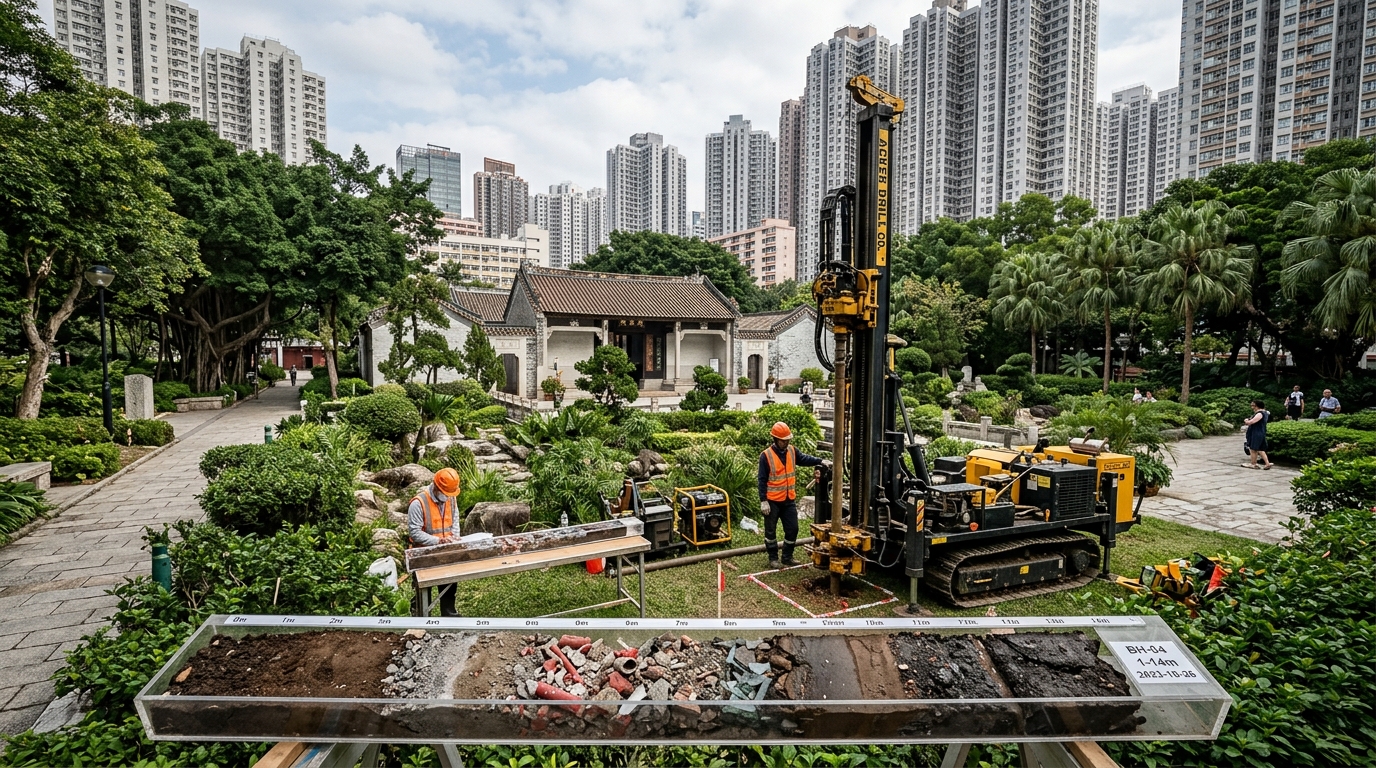
Thermal loss-on-ignition isolates synthetic rubble from park subsoil cores. · motion: mechanically extruding and thermally separating compressed architectural strata
wall text
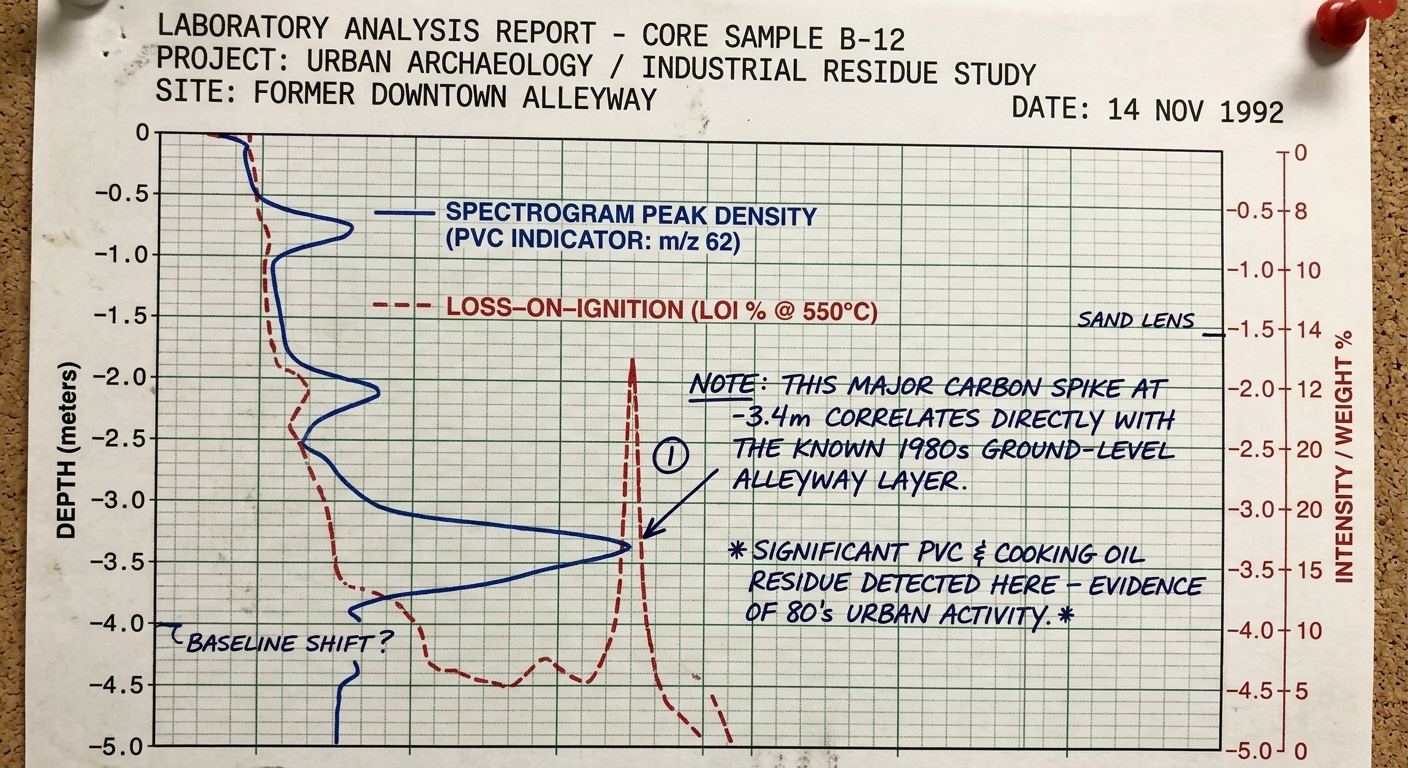
Geotechnical core drilling within Kowloon Walled City Park isolates fourteen vertical meters of subsoil, transposing depth into architectural elevation. Using loss-on-ignition sequential analysis, cylindrical core sections are subjected to stepped thermal degradation inside heated sleeves. Modern post-demolition topsoil vaporizes first, leaving an unburnt anthropic horizon of synthetic polymers, concrete aggregate, and rebar. Paired with loss-on-ignition spectrometry, this forensic stratigraphy measures how fourteen stories of hyper-dense habitation were mechanically crushed rather than removed. The resulting matrix reveals persistent domestic residues and heavy industrial particulates that continue to dictate subterranean soil chemistry beneath the simulated traditional landscape.
shown: Displayed as a temporary field laboratory inside the preserved Yamen building at the center of Kowloon Walled City Park, directly adjacent to the boreholes.
shown: Displayed as a temporary field laboratory inside the preserved Yamen building at the center of Kowloon Walled City Park, directly adjacent to the boreholes.
anchor facts used
- 2.6 hectare footprint that housed approximately 33,000 residents
- Maximum vertical limit of 14 stories dictated by the Kai Tak airport flight path
- Demolished between 1993 and 1994, replaced by a Qing-style park in 1995 while preserving the original Yamen building
mechanism
- Geotechnical core drilling — Cylindrical soil samples are extracted from the current park grounds to a precise depth of 14 meters, equating one vertical meter of subterranean depth to one story of the vanished 14-story superstructure.
1. Extractive Spatial Coring - Loss-on-ignition (LOI) sequential analysis — The extracted cores are heated in a muffle furnace at stepped temperatures to systematically vaporize modern post-1995 organic park matter, isolating the dense synthetic polymers, heavy metals, and concrete dust of the Walled City.
2. Stratigraphic Thermal Decomposition - High-performance liquid chromatography (HPLC) — The isolated rubble is pressurized in a solvent matrix to identify and quantify chemical markers specific to hyper-dense human occupation, such as polymerized cooking oils, PVC particulates, and aerosolized industrial exhaust.
3. Anthrome Chemical Isolation - Electrophoretic deposition — An electric field is used to permanently deposit the extracted chemical particulates onto scaled titanium plates, creating an incorruptible physical obituary of the compressed architectural strata.
4. Forensic Stratigraphy Printing
lineage
- Forensic Architecture, 'The Architecture of Memory' (2014) — Builds on their spatial reconstruction of vanished structures by applying chemical stratigraphy rather than 3D digital modeling.
- Gordon Matta-Clark, 'Conical Intersect' (1975) — Reverses his volumetric extraction of urban space by treating the compressed, demolished absence of volume as a dense physical specimen.
- Greg Girard and Ian Lambot, 'City of Darkness' (1993) — Quantifies their ethnographic and photographic evidence of hyper-density into an invisible, subterranean chemical index.
curatorial qa (machine verdict, unedited)
SCORE 3/5 after 2 attempt(s)
READS: The core tube undergoes thermal combustion, burning away top organic soil layers to reveal underlying architectural aggregate and rebar.
FAILS: The exact 14-story depth correlation and precise chemical chromatography are reliant on the accompanying diagram rather than the footage.
READS: The core tube undergoes thermal combustion, burning away top organic soil layers to reveal underlying architectural aggregate and rebar.
FAILS: The exact 14-story depth correlation and precise chemical chromatography are reliant on the accompanying diagram rather than the footage.
spec: antigravity agent · keyframe/artifact: gemini-3.1-flash-image · video: veo-3.1 image-to-video · qa+wall text: gemini-3.7-flash watching the render · 40.5s total