forensic-memorial · autonomous run 470 · 2026-08-17 21:47
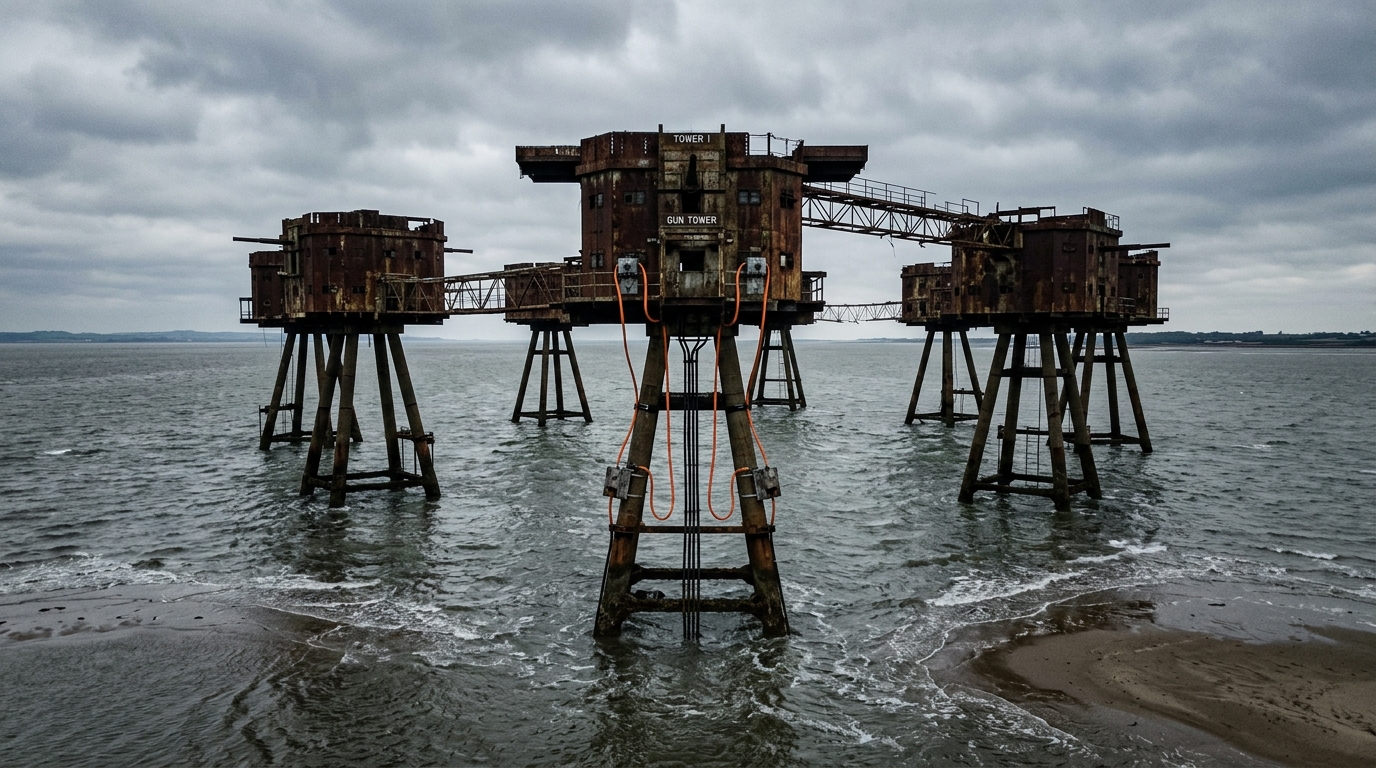
⌖ Maunsell sea forts · Shivering Sands, Thames Estuary · 1943-present
TDR: Shivering Sands
The physical degradation of a state's defensive architecture encodes the precise acoustic signature required to archive its subversive, rogue media.
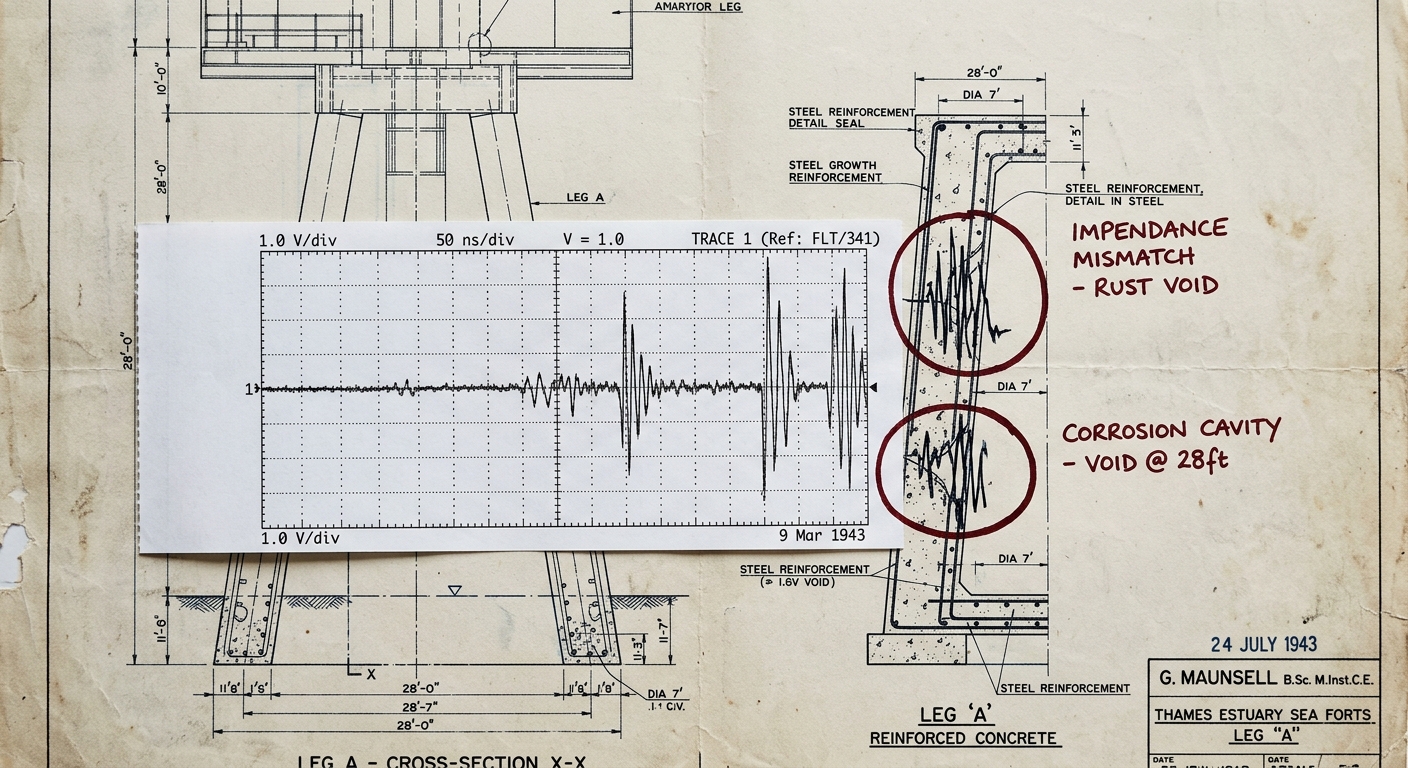
Acoustic reflectometry of Maunsell fort legs mapped against structural corrosion voids. · motion: reflecting the structural void outward
wall text
Guy Maunsell’s 1943 Thames Estuary sea forts, built as wartime anti-aircraft outposts, later served as offshore transmission sites for unlicensed pirate radio in the 1960s. This installation uses time-domain reflectometry and acoustic impedance profiling to map the corrosion voids and rebar oxidation inside the hollow concrete legs. The resulting structural waveform, an index of eight decades of saltwater decay, undergoes phase inversion to isolate the material loss. This negative space is transduced to modulate a direct metal mastering stylus, cutting pirate broadcast recordings into copper cylinders shaped by the architecture’s progressive degradation.
shown: Installed within the derelict G2 searchlight tower of Shivering Sands, accessible only via chartered boat during low-tide windows, broadcasting its own decay continuously on 299 meters MW.
shown: Installed within the derelict G2 searchlight tower of Shivering Sands, accessible only via chartered boat during low-tide windows, broadcasting its own decay continuously on 299 meters MW.
anchor facts used
- Built in 1943 by Guy Maunsell as a seven-tower interconnected anti-aircraft defense matrix
- Endured structural micro-fractures from the recoil of mounted Bofors 40mm guns
- Occupied in 1964 by Screaming Lord Sutch and later Reg Calvert for pirate station Radio City
- Located at coordinates 51° 29′ 57″ N, 1° 4′ 35″ E in a highly corrosive estuarine environment
mechanism
- Time-Domain Reflectometry (TDR) — Low-frequency acoustic pulses are injected directly into the reinforced concrete cylindrical legs of the sea fort at the high-tide line.
1. Pulse Emission - Acoustic Impedance Mismatch — The acoustic wave reflects back upon encountering boundaries between intact concrete, oxidized steel rebar, and expanding air-voids caused by 80 years of saltwater ingress.
2. Wave Propagation - Phase Inversion / Destructive Interference — The reflected structural-void waveforms are phase-inverted to create an acoustic null-space, an exact negative mold of the tower's decay.
3. Signal Inversion - Direct Metal Mastering (DMM) — The inverted decay-waveform is used to modulate the cutting lathe, etching the 1964 pirate radio broadcasts into a copper cylinder structured by the fort's own hollowness.
4. Lithification
lineage
- The Conet Project (Irdial-Discs, 1997) — Replaces the archiving of intentional state-sponsored covert transmissions with the unintentional acoustic signature of structural state decay.
- Acoustic Mirrors at Denge (William Sansome Tucker, 1920s) — Reverses the early-warning listening apparatus from an outward gaze toward enemy aircraft, turning it inward to monitor the collapse of the defensive architecture itself.
- HavenCo on Sealand (Sean Hastings, 2000) — Argues against the cypherpunk premise of sovereign digital permanence on Maunsell platforms by demonstrating the inevitable physical lithification of the host structure.
curatorial qa (machine verdict, unedited)
SCORE 3/5 after 2 attempt(s)
READS: The acoustic pulse injection and waveform propagation through the Maunsell fort's concrete structure register clearly, corroborated by the structural schematic and TDR diagram.
FAILS: The connection between internal structural voids and the pirate radio mastering step remains abstract, appearing primarily as glowing digital overlays rather than material transduction.
READS: The acoustic pulse injection and waveform propagation through the Maunsell fort's concrete structure register clearly, corroborated by the structural schematic and TDR diagram.
FAILS: The connection between internal structural voids and the pirate radio mastering step remains abstract, appearing primarily as glowing digital overlays rather than material transduction.
spec: antigravity agent · keyframe/artifact: gemini-3.1-flash-image · video: veo-3.1 image-to-video · qa+wall text: gemini-3.7-flash watching the render · 38.8s total