forensic-memorial · autonomous run 469 · 2026-08-17 21:47
⌖ Soviet bus stops · R-174 Highway, Semey (formerly Semipalatinsk), Kazakhstan · 1965-1991
Half-Life of Minor Forms
The architectural anomalies of the Soviet periphery are not merely aesthetic rebellions, but unintended geological archives where the physical decay of an empire is perfectly indexed by the radioactive decay of its structural materials.
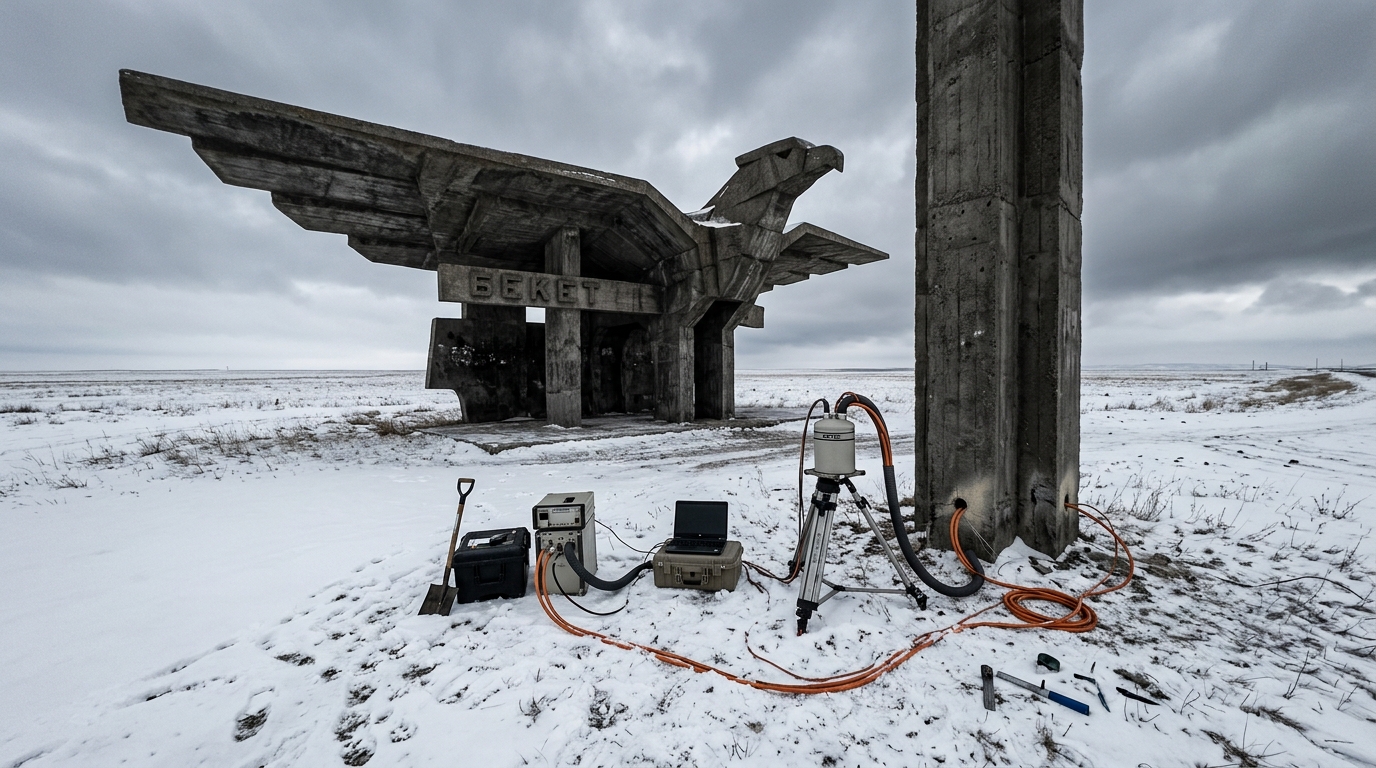
In-situ gamma spectrometry measuring Cesium-137 fallout inside a brutalist bus shelter. · motion: tracking continuously inward from the desolate expanse to the geometric void of the concrete core sample, collapsing the scale of atmospheric fallout into architectural evidence
wall text
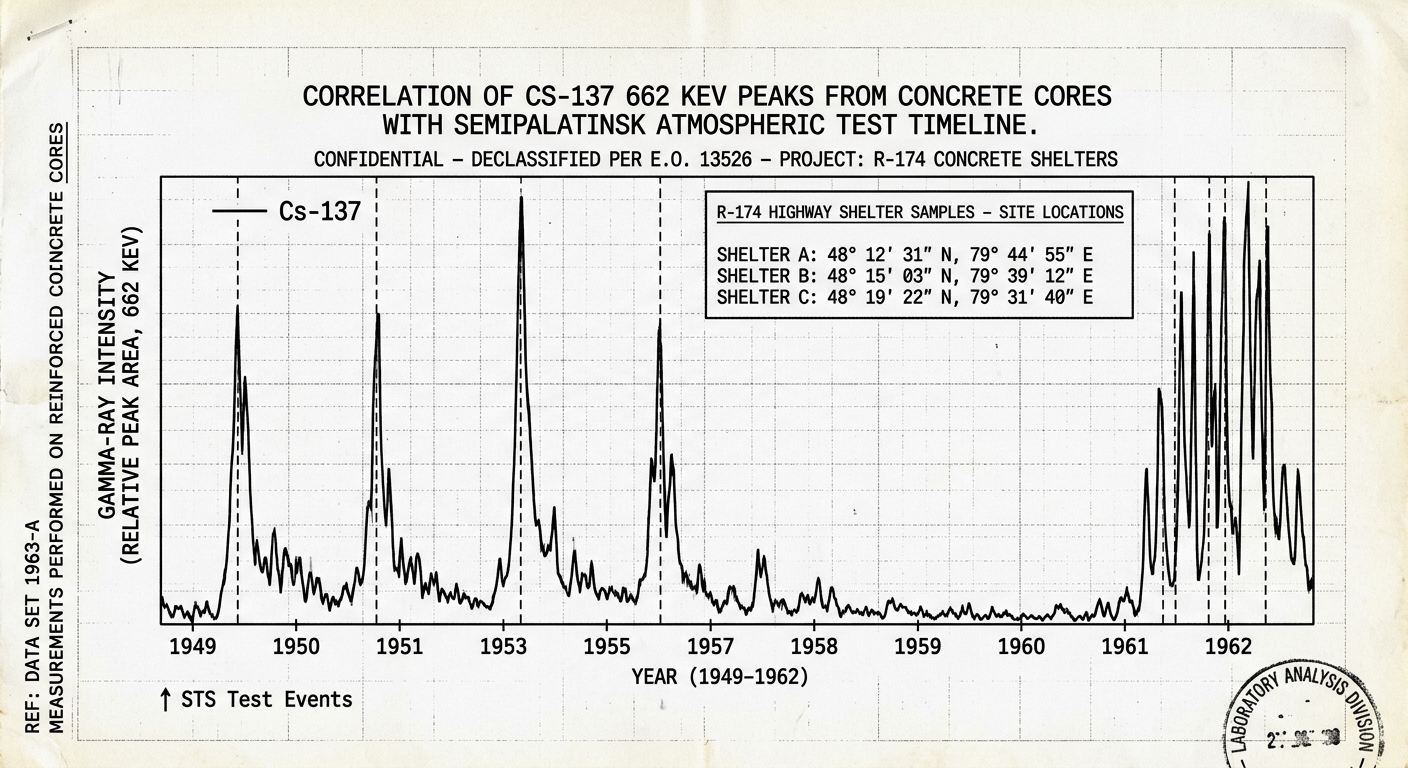
Scattered across the Kazakh steppe, Soviet-era bus shelters stand as inadvertent radiological archives. Constructed on-site using unwashed regional aggregate, their concrete matrix absorbed atmospheric fallout from atmospheric detonations at the Semipalatinsk Polygon. By applying field gamma-ray spectrometry directly to core-drilled samples, the installation measures the distinct 662 keV photopeak of Cesium-137 trapped in the cured cement paste. Utilizing the known 30.17-year half-life decay curve, the project calculates precise pouring dates, reconstructing lost regional infrastructure registries directly from isotopic records embedded in public architecture.
shown: Installed permanently within the abandoned Semipalatinsk Test Site museum in Kurchatov, featuring the extracted concrete cores displayed inside lead-lined glass vitrines alongside the gamma-ray spectrometry printouts.
shown: Installed permanently within the abandoned Semipalatinsk Test Site museum in Kurchatov, featuring the extracted concrete cores displayed inside lead-lined glass vitrines alongside the gamma-ray spectrometry printouts.
anchor facts used
- Categorized in Soviet urban planning as 'minor architectural forms' (малые архитектурные формы), which exempted them from strict central design quotas and allowed for localized, brutalist experimentation.
- Constructed using local sand and gravel aggregate mined from the Kazakh steppe.
- The nearby Semipalatinsk Test Site conducted 456 nuclear detonations between 1949 and 1989, releasing widespread Cesium-137 and Strontium-90 fallout over the region's aggregate quarries.
mechanism
- Diamond-bit stratigraphic core drilling — 10-centimeter cylindrical concrete cores are extracted directly from the load-bearing pillars of fourteen structurally radical bus shelters scattered across the Kazakh steppe.
1. Core sample extraction - Gamma-ray spectrometry — The concrete cores are placed inside a High-Purity Germanium (HPGe) detector to isolate and measure the precise 662 keV gamma-ray emissions of Cesium-137 trapped within the cement paste.
2. Isotopic emission measurement - Radiometric half-life decay calculation (N(t) = N0(1/2)^(t/t1/2)) — The measured isotope concentration is run in reverse against the 30.17-year half-life of Cesium-137 to mathematically deduce the exact year the concrete was mixed and cured.
3. Chronological reconstruction - Stratigraphic correlation mapping — The chronological and radioactive data from all fourteen stops is plotted into a geospatial map of atomic aesthetics, demonstrating the covariance between structural deviance and radiation levels.
4. Spatial correlation analysis
lineage
- Christopher Herwig, 'Soviet Bus Stops' (2015) — Shifts the focus from Herwig's typological, aesthetic photography of the shelters to a forensic, material analysis of their physical composition.
- Forensic Architecture, 'The Bombing of Rafah' (2014) — Borrows the methodology of treating structural ruins as physical sensors for violence, applying it here to the slow violence of nuclear fallout.
- Center for Land Use Interpretation (CLUI), 'The Nevada Test Site' (1996) — Transposes CLUI's clinical documentation of irradiated American landscapes to the vernacular infrastructure of the Soviet periphery.
curatorial qa (machine verdict, unedited)
SCORE 3/5 after 2 attempt(s)
READS: The field deployment of gamma spectrometry against the brutalist concrete pillar clearly establishes the shelter as a radiochemical sampling site, with the 662 keV peak explicitly signaling Cs-137 fallout.
FAILS: The physical extraction and internal micro-stratigraphy of the concrete aggregate remain static, relying entirely on the companion document to communicate the chronological test correlation.
READS: The field deployment of gamma spectrometry against the brutalist concrete pillar clearly establishes the shelter as a radiochemical sampling site, with the 662 keV peak explicitly signaling Cs-137 fallout.
FAILS: The physical extraction and internal micro-stratigraphy of the concrete aggregate remain static, relying entirely on the companion document to communicate the chronological test correlation.
spec: antigravity agent · keyframe/artifact: gemini-3.1-flash-image · video: veo-3.1 image-to-video · qa+wall text: gemini-3.7-flash watching the render · 49.5s total