forensic-memorial · autonomous run 467 · 2026-08-17 21:47
⌖ Rust Belt grain elevators · Buffalo, New York, Buffalo River (Silo City) · 1915-1959 (peak), present (fallow)
Carbonation Front: Concrete Central
The obsolescence of industrial architecture is a measurable chemical clock, where the financial devaluation of an asset perfectly mirrors the measurable carbonation depth of its slip-form concrete.
Phenolphthalein core testing measures carbonation depth on 1915 Buffalo grain elevators. · motion: colorless decay encroaching on magenta alkalinity
wall text
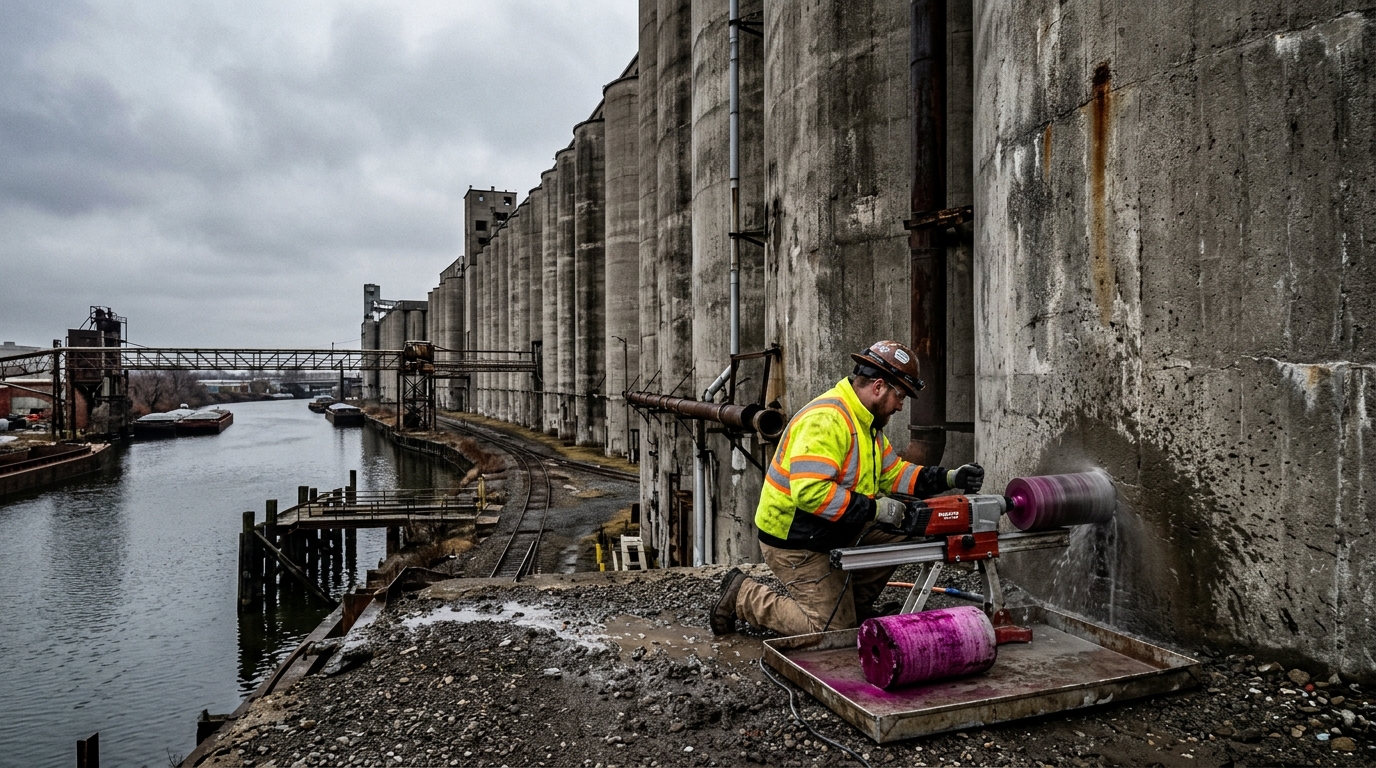
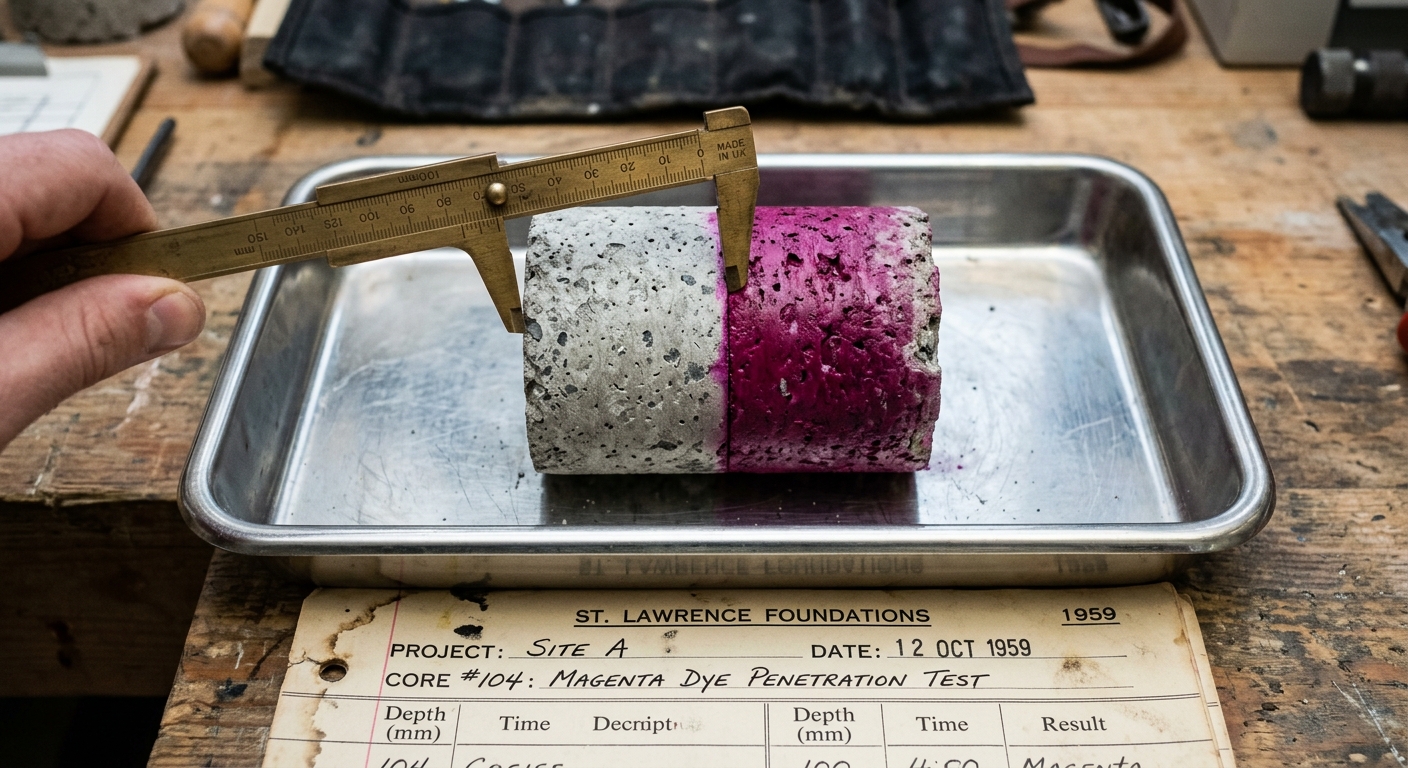
When atmospheric carbon dioxide diffuses into reinforced concrete, it neutralizes alkaline calcium hydroxide into calcium carbonate, stripping steel reinforcement of its passive corrosion protection. Concrete Central's 1915 slip-form grain silos along the Buffalo River lost their economic utility when the St. Lawrence Seaway opened in 1959. Here, extracted horizontal core samples undergo standard phenolphthalein indicator testing: viable alkaline concrete stains intense magenta, while carbonated exterior material remains dull grey. Measured in millimeters from the outer face, the colorless carbonation front maps directly to historical depreciation ledgers, framing chemical decay as an unyielding index of asset devaluation.
shown: Displayed inside the cavernous, unlit ground-floor gallery of the dormant Concrete Central elevator, illuminated only by clinical LED work lights focusing on the core samples.
shown: Displayed inside the cavernous, unlit ground-floor gallery of the dormant Concrete Central elevator, illuminated only by clinical LED work lights focusing on the core samples.
anchor facts used
- Concrete Central Elevator was completed in 1915 and was the largest grain elevator in the world, stretching over a quarter mile.
- Slip-form continuous concrete pouring was used to create monolithic, seamless silos with specific structural chemistry.
- The 1959 opening of the St. Lawrence Seaway bypassed Buffalo's port, rendering the elevators financially obsolete.
mechanism
- Core logging — Extracting 100mm horizontal core samples from the exterior walls of Concrete Central to serve as physical timelines of decay.
1. Extraction - Phenolphthalein indicator testing — Applying the pH indicator to the cores; uncarbonated alkaline concrete turns magenta, while the carbonated dead outer layer remains colorless, mapping the timeline of decay.
2. Chemical Staining - Straight-line depreciation — Aligning the depth of the colorless carbonation front measured in millimeters to the ledger of the facility's financial depreciation.
3. Depreciation Mapping - Stratigraphic sealing — Encapsulating the magenta-stained cores in vacuum-sealed acrylic to halt the carbonation clock forever, preserving the exact ratio of structural integrity to financial ruin.
4. Archival Sealing
lineage
- Robert Smithson, A Tour of the Monuments of Passaic, New Jersey (1967) — Expands Smithson's concept of ruins-in-reverse into quantifiable chemical decay.
- Gordon Matta-Clark, Conical Intersect (1975) — Replaces Matta-Clark's destructive architectural cuts with forensic, non-destructive core sampling to reveal internal memory.
- Eyal Weizman / Forensic Architecture, The Architecture of Public Truth (2014) — Applies Forensic Architecture's spatial methodology to economic history, reading market forces in structural chemistry.
curatorial qa (machine verdict, unedited)
SCORE 4/5 after 1 attempt(s)
READS: Core drilling on 1915 slip-form grain silos and phenolphthalein indicator mapping the carbonation boundary against the ledger timeline.
FAILS: The video presents a static core rather than active chemical front encroachment during the test application.
READS: Core drilling on 1915 slip-form grain silos and phenolphthalein indicator mapping the carbonation boundary against the ledger timeline.
FAILS: The video presents a static core rather than active chemical front encroachment during the test application.
spec: antigravity agent · keyframe/artifact: gemini-3.1-flash-image · video: veo-3.1 image-to-video · qa+wall text: gemini-3.7-flash watching the render · 41.9s total