forensic-memorial · autonomous run 465 · 2026-08-17 21:47
⌖ Principality of Sealand · HM Fort Roughs, North Sea, 51°53′40″N 1°28′57″E · 1942-present
Cathodic Sovereignty
State sovereignty in a decentralized era is an electrochemical transaction rather than a conceptual consensus, requiring the literal dissolution of capital to briefly delay the collapse of physical infrastructure.
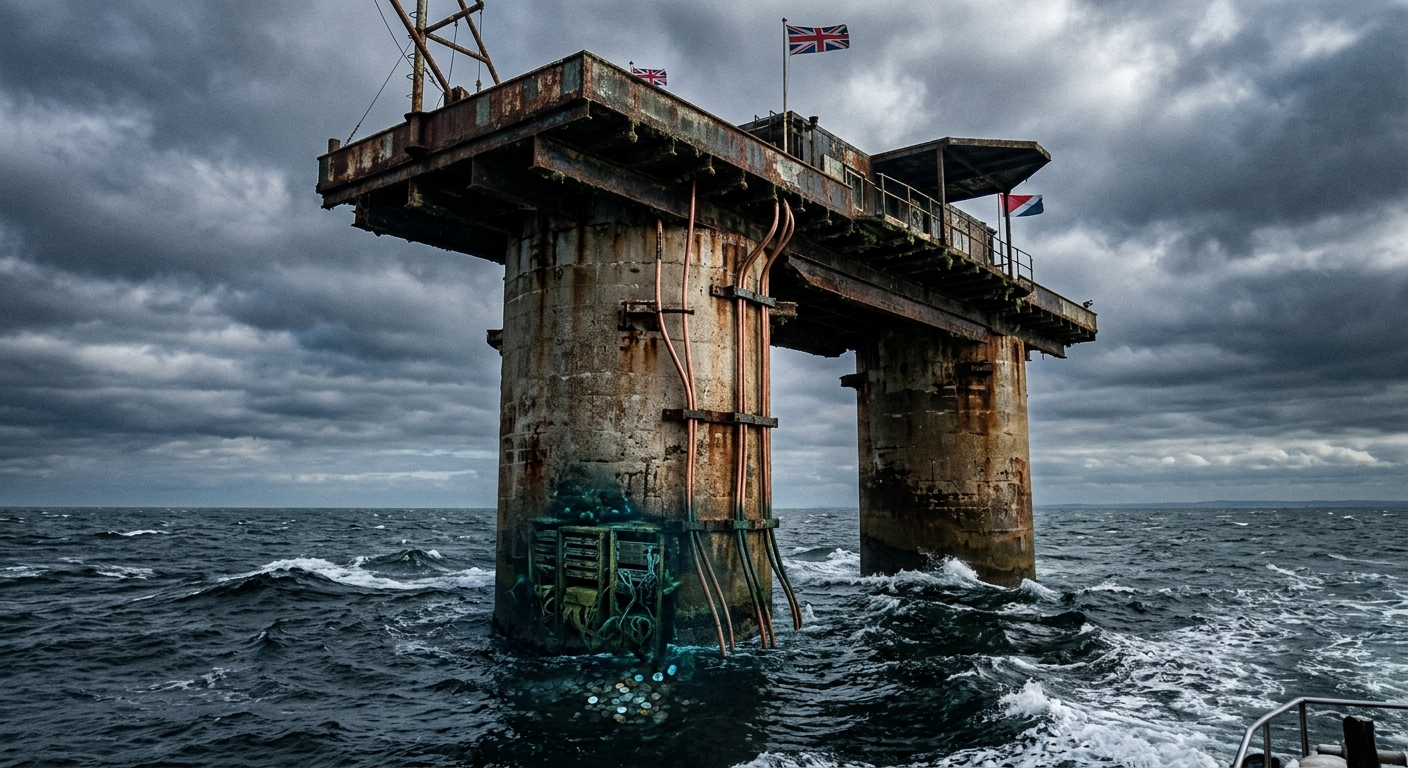
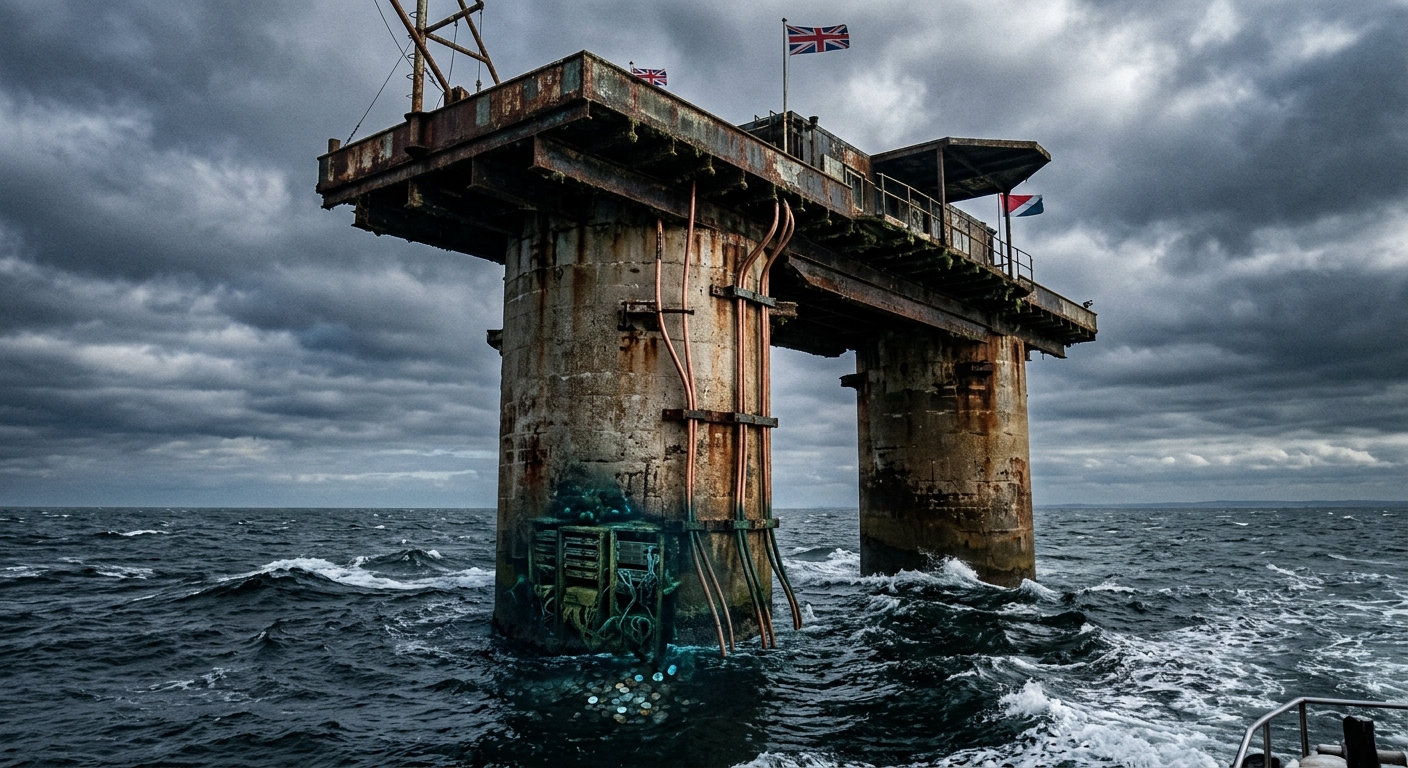
HavenCo server boards acting as sacrificial anodes on Sealand's concrete pilings. · motion: electrochemically dissolving into the sea tide
wall text
Positioned at HM Fort Roughs (Principality of Sealand), this installation transposes cathodic protection into an economic autopsy. Early 2000s HavenCo server motherboards and minted Sealand silver coins are hardwired to the fort's internal WWII reinforcing rebar, functioning as sacrificial anodes. Submerged in the hyper-saline North Sea, the capital hardware oxidizes and dissolves to supply electrons to the decaying concrete foundation. By utilizing real-time coulometric monitoring based on Faraday's laws of electrolysis, the piece measures how much sovereign computational capital must physically disintegrate into the tide each hour simply to retard the structural collapse of libertarian extraterritoriality.
shown: Installed permanently as a closed-circuit monitoring station inside the starboard concrete tower of Sealand, viewable only by remote telemetry until the sovereign anodes are fully consumed.
shown: Installed permanently as a closed-circuit monitoring station inside the starboard concrete tower of Sealand, viewable only by remote telemetry until the sovereign anodes are fully consumed.
anchor facts used
- Constructed in 1942 as a Maunsell Sea Fort consisting of a steel deck supported by two hollow concrete towers
- Occupied in 1967 by Paddy Roy Bates, who defended it via helicopter and minted national currency
- Hosted HavenCo starting in 2000, an offshore data haven operating out of the fort's internal modules
mechanism
- Galvanic cathodic protection — Minted Sealand silver coins and early 2000s HavenCo server motherboards are submerged in the sea and electrically bonded via heavy gauge copper to the fort's internal steel reinforcing bars, acting as sacrificial anodes.
1. Galvanic wiring - Electrolyte conductivity monitoring — In-situ salinity sensors measure the ion transfer rate as the sovereign artifacts dissolve into the water column, dictating the speed of infrastructural preservation.
2. Salinity mediation - Coulometric mass analysis — The total mass of 'sovereignty' lost to the sea is calculated continuously using Faraday's laws of electrolysis based on the current passing through the steel legs, logged on an offline ledger.
3. Mass loss calculation - Stratigraphic core sampling — Cylindrical concrete cores are periodically extracted from the twin towers to physically document the rust expansion boundary halted by the dissolving server racks and coins.
4. Stratigraphic extraction
lineage
- Trevor Paglen, 'Autonomy Cube' — Critiques Paglen's reliance on institutional gallery infrastructure by making the hardware's physical destruction a prerequisite for the hosting site's survival.
- Gordon Matta-Clark, 'Conical Intersect' — Adapts Matta-Clark's physical subtraction of architecture into a microscopic, electrochemical subtraction of political artifacts.
- Robert Smithson, 'Spiral Jetty' — Shares the surrender to halophilic entropy, but shifts the subject from deep geological time to the rapid decay of micro-nationalist legal fictions.
curatorial qa (machine verdict, unedited)
SCORE 3/5 after 2 attempt(s)
READS: Submerged motherboards and minted coins wired via heavy copper conduits to the concrete leg of Sealand, reacting directly with turbulent North Sea water.
FAILS: The green gaseous effervescence resembles theatrical smoke rather than galvanic mineral dissolution and electrochemical ion exchange.
READS: Submerged motherboards and minted coins wired via heavy copper conduits to the concrete leg of Sealand, reacting directly with turbulent North Sea water.
FAILS: The green gaseous effervescence resembles theatrical smoke rather than galvanic mineral dissolution and electrochemical ion exchange.
spec: antigravity agent · keyframe/artifact: gemini-3.1-flash-image · video: veo-3.1 image-to-video · qa+wall text: gemini-3.7-flash watching the render · 38.7s total