forensic-memorial · autonomous run 460 · 2026-08-17 21:47
⌖ Baarle-Hertog enclaves · Baarle-Hertog (Belgium) and Baarle-Nassau (Netherlands) · 1198 (Lord of Breda land divisions) to present
Stratigraphic Sovereignty: The Baarle Cores
Sovereignty is not a geometric abstraction but a physical stratigraphy; at the micro-architectural scale, national jurisdiction is an archaeologically verifiable material composite.
Horizontal core extraction across the Dutch-Belgian domestic border in Baarle. · motion: extracting the sovereign seam

wall text
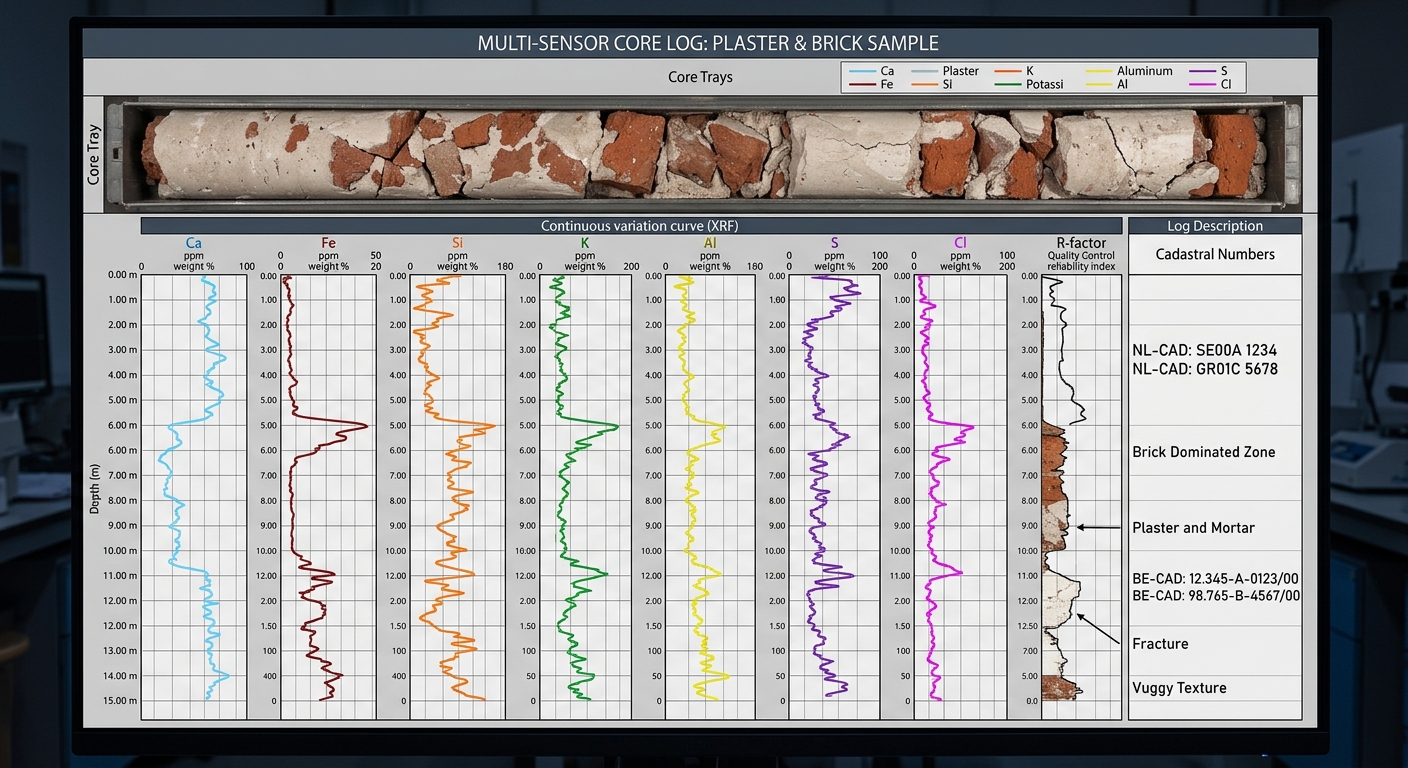
In the enclaves of Baarle-Hertog and Baarle-Nassau, international borders dissect domestic interiors, slicing living rooms across Dutch and Belgian jurisdictions. This work treats geopolitical sovereignty as a physical stratigraphy rather than a legal abstraction. Utilizing horizontal rotary diamond coring—a technique borrowed from geological sampling—continuous cylindrical cores are extracted directly through interior partition walls bisected by the frontier. The resulting architectural samples are run through multi-sensor core loggers and X-ray fluorescence (XRF) spectrometers to map density, plaster chemistry, and paint layers against cadastral registries. The installation reframes national jurisdiction as an archaeologically verifiable material composite deposited across domestic infrastructure.
shown: Displayed in the Baarle-Hertog town hall, with the extracted glass-encased architectural cores laid horizontally in climate-controlled geological archive racks alongside their corresponding cadastral maps.
shown: Displayed in the Baarle-Hertog town hall, with the extracted glass-encased architectural cores laid horizontally in climate-controlled geological archive racks alongside their corresponding cadastral maps.
anchor facts used
- The border consists of 22 Belgian enclaves and 8 Dutch counter-enclaves.
- The international border physically bifurcates individual homes, cafes, and living rooms, marked by white crosses on the ground.
- The 'front door rule' determines the nationality and tax jurisdiction of a bifurcated building based on the location of its main entrance.
mechanism
- Stratigraphic core sampling — Geological extraction techniques are repurposed to physically sample the substance of a geopolitical boundary line.
1. Core Extraction: Rotary diamond drilling is used to extract 50mm diameter continuous cylindrical material cores horizontally through the interior partition walls of homes bisected by the international border. - Multi-sensor core logging (MSCL) — Analyzing the transition of domestic building materials and trapped structural air as a quantifiable geochemical transition between two nation-states.
2. Non-Destructive Scanning: The architectural cores are passed through a multi-sensor core logger to measure bulk density, P-wave velocity, and magnetic susceptibility across the Dutch-Belgian transition zone. - X-ray fluorescence (XRF) core scanning — Tracking the microscopic migration of household artifacts and human activity across an active indoor border.
3. Spectrochemical Mapping: High-resolution elemental mapping identifies the precise sub-millimeter deposition of floor wax, paint, and household dust exactly at the border juncture. - Cryogenic archival storage — Preserving the physical cross-section of a geopolitical anomaly before future architectural renovation or European homogenization erases it.
4. Cryopreservation: The extracted cores are sealed in borosilicate glass tubes filled with inert argon gas and indexed by their exact cadastral coordinates for future legal-archaeological retrieval.
lineage
- Gordon Matta-Clark, 'Splitting' (1974) — Advances Matta-Clark's architectural bisection from formal structural critique to forensic geopolitical sampling.
- Forensic Architecture, 'The Left-to-Die Boat' (2012) — Applies spatial forensics not to human rights violations, but to the latent physical archaeology of peaceful jurisdictional anomalies.
- Center for Land Use Interpretation (CLUI), 'United States / Mexico Border Wall Project' — Shifts the spatial focus from macro-scale exterior border infrastructure to micro-scale domestic interior boundaries.
curatorial qa (machine verdict, unedited)
SCORE 4/5 after 1 attempt(s)
READS: The domestic border setting with B/NL floor markings, wall perforation, and the accompanying multi-sensor core log linking elemental stratigraphy directly to cadastral registers.
FAILS: The drill bit descends vertically through a pre-cut notch rather than performing a true horizontal core extraction through the wall.
READS: The domestic border setting with B/NL floor markings, wall perforation, and the accompanying multi-sensor core log linking elemental stratigraphy directly to cadastral registers.
FAILS: The drill bit descends vertically through a pre-cut notch rather than performing a true horizontal core extraction through the wall.
spec: antigravity agent · keyframe/artifact: gemini-3.1-flash-image · video: veo-3.1 image-to-video · qa+wall text: gemini-3.7-flash watching the render · 36.7s total