forensic-memorial · autonomous run 459 · 2026-08-17 21:46
⌖ Internet Archive warehouse fires · 300 Funston Avenue, Richmond District, San Francisco · November 2013
XOR Taphonomy: 300 Funston
The ultimate backup of the physical world is digital, but the ultimate backup of the digital world requires physical parity; a system's true vulnerability lies in the irreversible phase change between the two mediums.
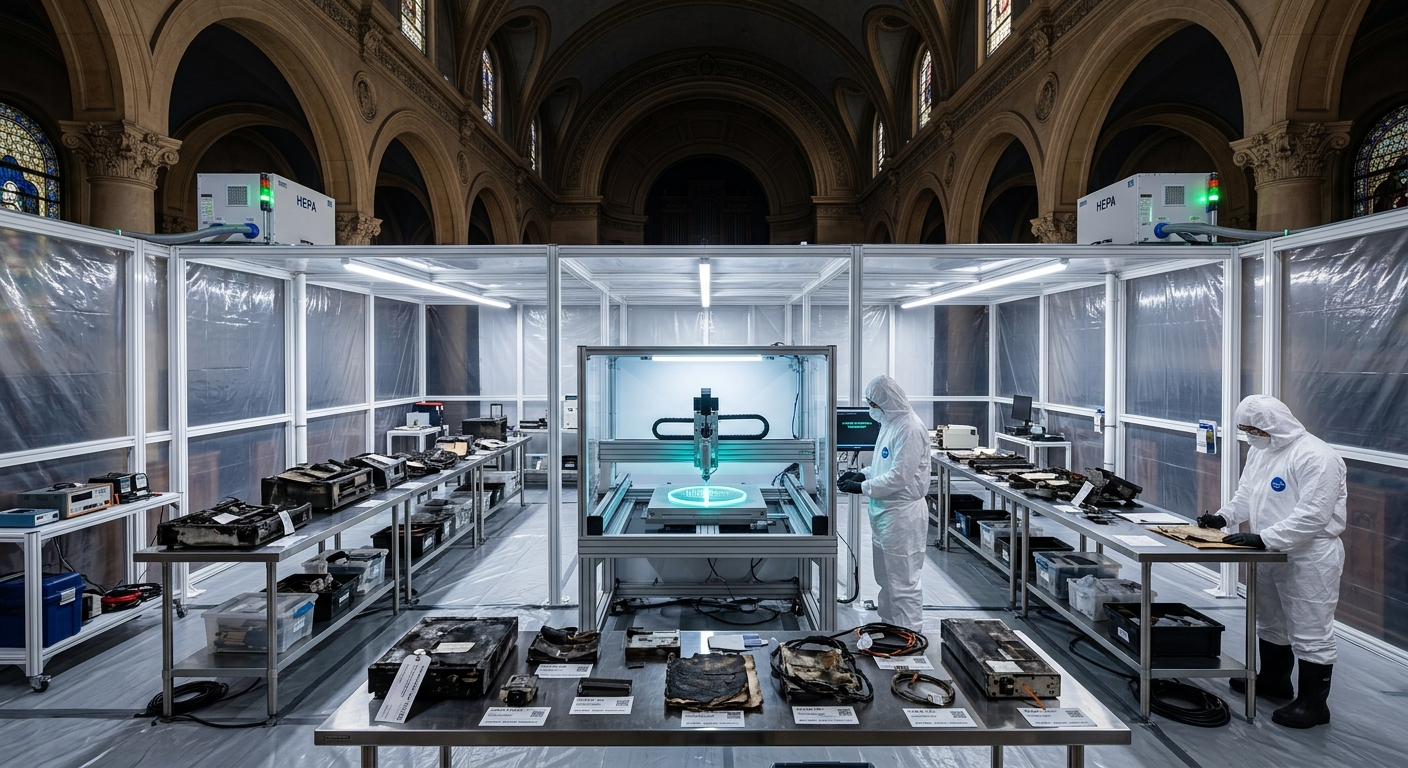
Robotic laser-etching of cross-matter parity data onto fused quartz optical discs. · motion: calculating parity across states of matter
wall text
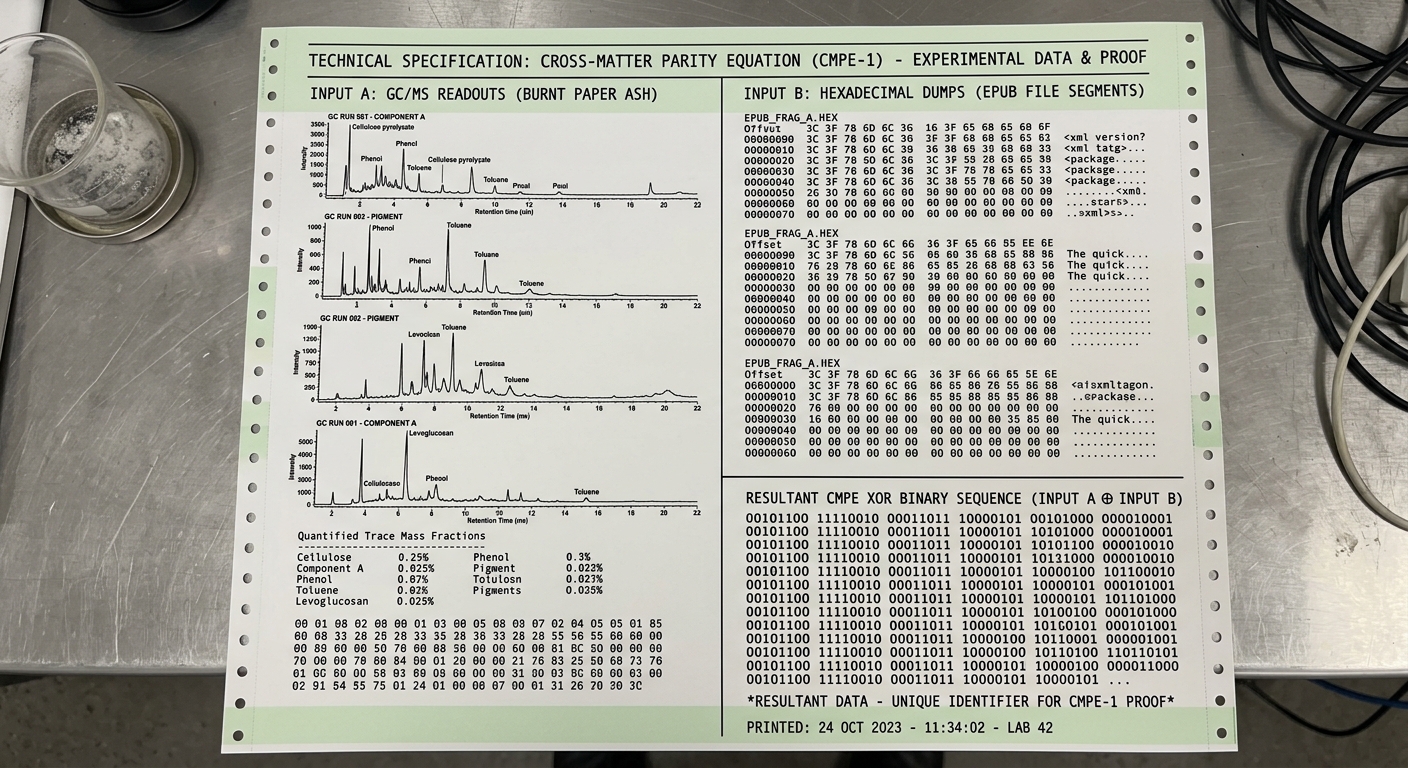
Set within a deconsecrated nave, this installation stages a forensic recovery system for destroyed data archives. Following the loss of scanning hardware and source texts, technicians catalog charred cellulose and pyrolyzed circuit boards. Using bitwise XOR parity equations transposed across physical and digital states, the mass spectroscopy of paper ash is reconciled against redundant digital bitstreams retrieved from remote geographic nodes. The calculated parity difference is laser-etched directly into fused quartz optical discs via five-axis robotic milling. The project treats catastrophic phase changes between physical artifacts and binary data as a continuous storage medium, transforming material loss into archival parity.
shown: Installed permanently in the vestibule of the Internet Archive headquarters at 300 Funston Avenue, acting as a literal and functional firewall between the street and the servers.
shown: Installed permanently in the vestibule of the Internet Archive headquarters at 300 Funston Avenue, acting as a literal and functional firewall between the street and the servers.
anchor facts used
- The fire occurred on November 6, 2013, destroying a scanning center adjacent to the main headquarters.
- Approximately $600,000 worth of specialized physical scanning equipment and source media was destroyed.
- The fire was contained before breaching the firewall of the main Christian Science church building housing the primary servers.
- Zero digital data was lost due to geographic asynchronous replication, though the physical source books were permanently turned to ash.
mechanism
- Forensic Stratigraphy — Treating the immediate physical aftermath of an IT facility fire as a geological deposit of lost source code.
1. Excavation and cataloging of charred cellulose and melted plastic from the exact footprint of the destroyed scanning annex. - Asynchronous Geographic Replication — Pulling the surviving 'ghost' data back to the exact geographical coordinates of its physical body's destruction.
2. Retrieval of the exact digital bitstreams corresponding to the burned physical books from the Archive's redundant node in Alexandria, Egypt. - Bitwise Exclusive OR (XOR) Parity Calculation — Applying a RAID 5 parity logic gate across two divergent states of matter: digital bytes and carbon mass.
3. Calculating the binary difference between the volumetric mass of the ash samples and the byte-size of the surviving digital files. - WORM (Write Once Read Many) Archival Storage — Creating a third, heat-proof physical artifact that theoretically allows the reconstruction of the burned books if the digital servers ever fail.
4. Milling the resulting mathematical parity data into fire-resistant fused quartz optical plates.
lineage
- Katie Paterson, 'Future Library' (2014-2114) — Inverts Paterson's forward-looking biological optimism by treating physical destruction as the prerequisite baseline for digital preservation.
- Eyal Weizman / Forensic Architecture, 'Cloud Studies' — Extends Weizman's spatial analysis of airborne particulate matter to the informational architecture and failovers of internet infrastructure.
- University of Southampton, 5D Optical Data Storage — Appropriates their fused-quartz femtosecond laser writing technique not for commercial backup, but for calculating the entropic deficit of a specific historical fire.
curatorial qa (machine verdict, unedited)
SCORE 4/5 after 1 attempt(s)
READS: Forensic cleanroom within a basilica, cataloged fire debris, and robotic laser-milling of optical quartz storage discs.
FAILS: The exact cross-matter XOR parity computation linking ash mass to bitstreams remains conceptual without reading the technical printout.
READS: Forensic cleanroom within a basilica, cataloged fire debris, and robotic laser-milling of optical quartz storage discs.
FAILS: The exact cross-matter XOR parity computation linking ash mass to bitstreams remains conceptual without reading the technical printout.
spec: antigravity agent · keyframe/artifact: gemini-3.1-flash-image · video: veo-3.1 image-to-video · qa+wall text: gemini-3.7-flash watching the render · 37.4s total